
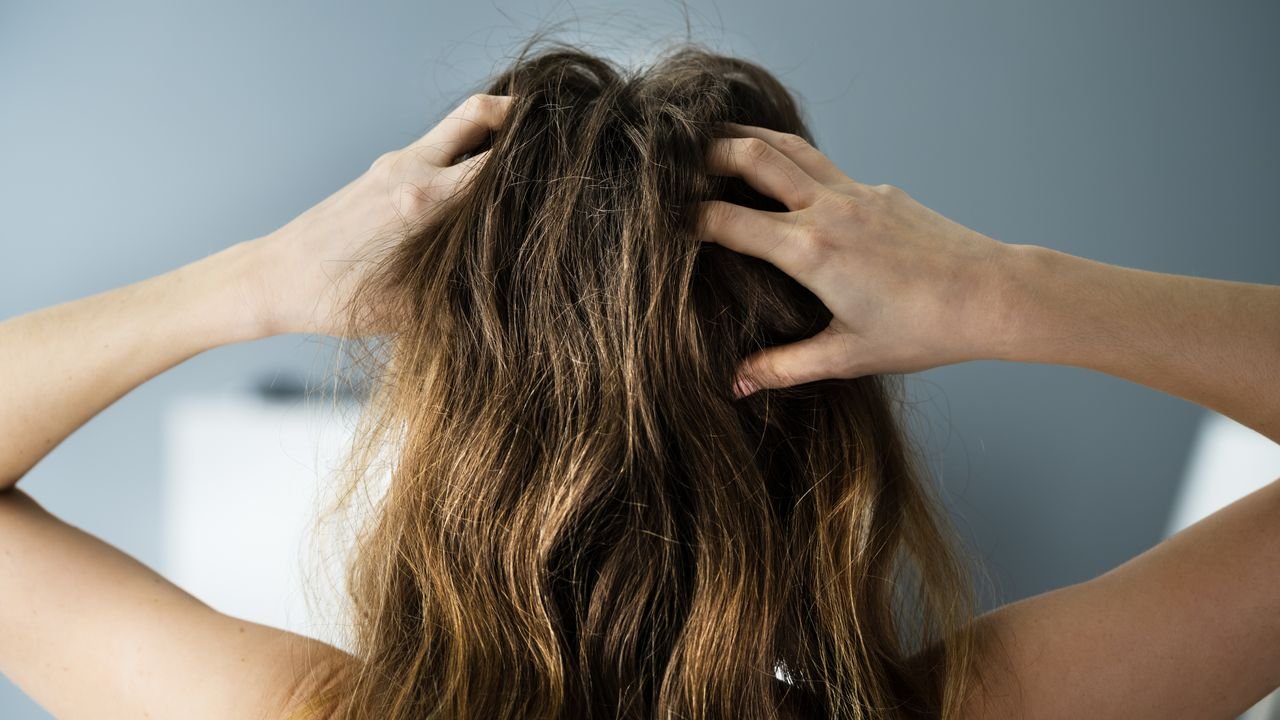
If you’re wondering how to get rid of dandruff, know that you’re not alone in the fight against flakes. Not only is the scalp condition incredibly common for all hair types, but it also has a variety of potential causes. That doesn’t make dealing with constant white flakes of dead skin cells all over your clothes any less frustrating, but at least you’re in good company.
What is dandruff actually? Also known as seborrheic dermatitis, it’s an inflammatory response to an imbalance in the scalp microbiome. “This causes the overgrowth of Malassezia, a normal yeast found on the scalp,” says Carmen Castilla, MD, a board-certified dermatologist in NYC. “This overgrowth causes an inflammatory reaction, which leads to scalp flaking and itching.” Fun!
While there is no known cure for dandruff, there are plenty of treatment options. Ahead, everything you need to know about how to get rid of dandruff.
What causes dandruff in the first place?
According to Caroline Robinson, MD, FAAD, a board-certified medical and cosmetic dermatologist, there isn’t one clearly defined cause for the scalp condition. “While we do not completely understand all of the causes of dandruff, we do know that the oils on our skin [sebum], a friendly yeast that lives there [Malassezia], and our sensitivity to the interaction between the two can all play a role in how likely we are to get dandruff,” she says. “Areas of high sebum production such as the scalp, parts of the face, and the center of the chest are the most common areas where we see dandruff.”
If that wasn’t enough, there may be other contributing factors, such as medical conditions and environmental causes. “Flares are common when the weather turns cold and dry, and stress can also trigger a flare,” says Hadley King, MD, a board-certified dermatologist in NYC. This type of dermatitis can also affect other areas of the body, such as the ears, eyebrows, center of the face, eyelids, upper chest, upper back, armpits, and groin area.
What’s the difference between dry scalp and dandruff?
There’s a common misconception that if you have dandruff, your scalp must be dry—when really, these are two different diagnoses, according to Pooja Rambhia, MD, a board-certified dermatologist at Union Derm. “Dandruff is primarily fungal in nature, caused by an overgrowth of Malassezia yeasts rather than bacteria. These lipophilic (lipid-loving) yeasts are part of the normal scalp microbiome but can proliferate excessively in certain individuals, leading to the inflammatory response that characterizes dandruff,” she says.
How to tell the difference? Dandruff typically causes thicker, oilier, and sometimes yellow flakes. Dry scalp, on the other hand, has thinner, smaller white flakes. Both are signals of a compromised skin barrier on the scalp, and a board-certified dermatologist can help you determine the best treatment path for you.
Scalp psoriasis and scalp eczema are other common skin disorders that cause skin cells to grow extremely fast and become patches of dry, itchy, flaky skin, according to Dr. Robinson. “Psoriasis (or eczema) often requires management with prescription therapy, which is why I recommend speaking to your dermatologist if you suspect that you might have this.”
What ingredients fight dandruff?
“For dryness and flaking caused by seborrheic dermatitis, dandruff shampoos—which include ingredients such as ketoconazole, selenium sulfide, salicylic acid, or zinc pyrithione—can be a big help,” says Iris Rubin, MD, board-certified dermatologist and founder of Seen Hair Care.
Dr. King adds that you’ll want to look for the following antifungal ingredients to fight overproduction of yeast.
- Selenium sulfide: Has antifungal properties; can decrease irritation, itching, and flakiness
- Pyrithione zinc: Has antimicrobial and antifungal properties; also helpful with inflammation and itchy scalp
- Salicylic acid: Helps to reduce scaling and excess oil on the scalp
- Ketoconazole: Is an antifungal with mild anti-inflammatory properties
- Coal tar: Suppresses fungus; decreases inflammation; may reduce sebum production
- Tea tree oil: Has antibacterial, antifungal, and anti-inflammatory properties
