

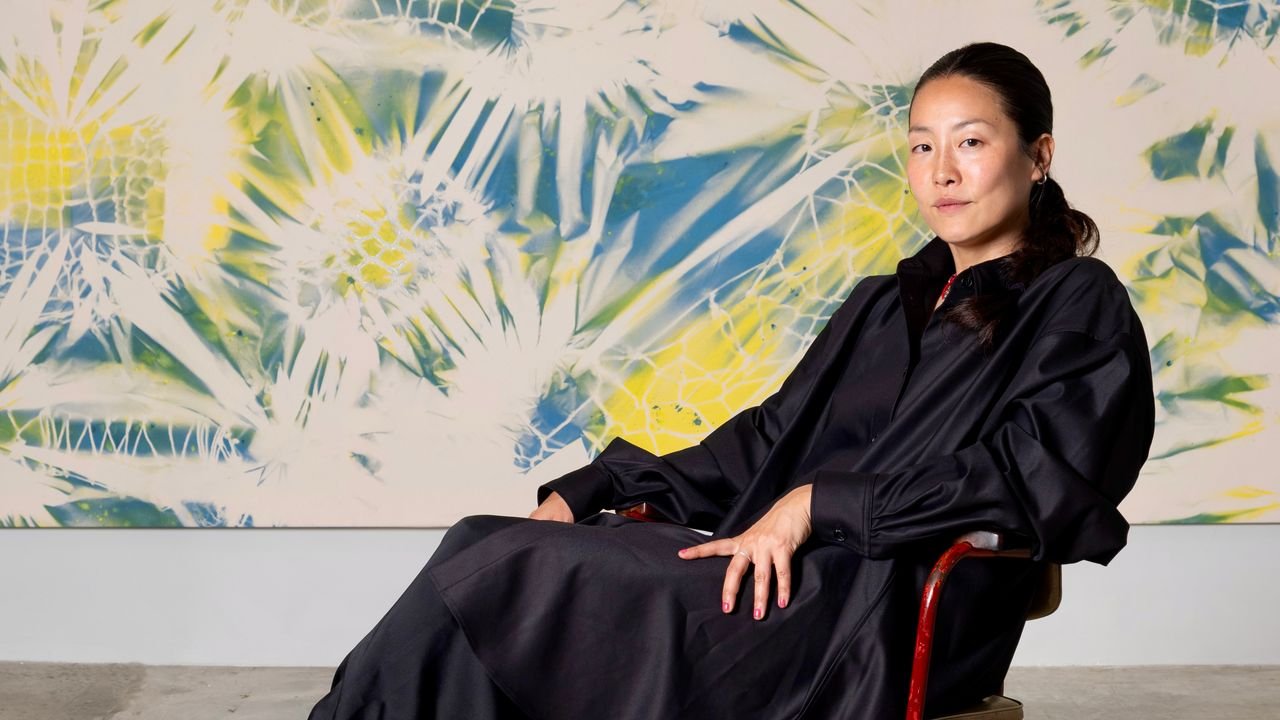
In 2013 the artist Maia Ruth Lee, whose multidisciplinary work uses a wide array of materials to explore the tangled topic of migration, paid a visit to her parents in Nepal, where she had lived from kindergarten until the end of high school. Passing through the Kathmandu airport, she was newly captivated by a familiar sight: luggage wrapped in colorful tarps and fastened with rope and tape, often belonging to workers returning home from jobs abroad.
“It was one of those things where you’ve seen it growing up, but you’ve never noticed,” says Lee. “And you notice for the first time because you are looking at everything differently.”
Her relocation to New York City a few years prior had broadened her perspective on the world, and her own shifting place within it. She had moved many times before as a kid: She was born in 1983 in Busan, South Korea, but her parents’ work as Bible translators brought Lee and her brother to Singapore and Papua New Guinea before they settled in Nepal for the massive undertaking of translating the New Testament into Sherpa, which first called for the creation of a new alphabet. After Lee graduated from high school in Kathmandu, she returned to South Korea to study painting at Hongik University in Seoul. But it was her leap in her late 20s to New York City, a richly multicultural place but also a seat of Western power, that was the biggest shakeup of them all.
“For the first time I could fully zoom out and see the big picture,” she says. That’s what clicked for her at the Kathmandu airport on the 2013 trip. She saw what these beautifully rumpled pieces of luggage represented: displacement, labor, self-preservation, borders. She started photographing them, and her Bondage Baggage series, which continues to this day, was born.
Maia Ruth Lee, B.B.Tetris 1-4, 2026, acrylic ink and enamel on canvas.Photo: Hyunjung Rhee. Courtesy of Tina Kim Gallery
In the 13 years since, Lee, who now lives in San Francisco with her husband and their eight-year-old son, has expanded Bondage Baggage through thoughtful iteration. In 2018 she began making sculptures out of tarps, old bedding, and ropes to mimic the luggage she’d seen throughout her childhood. In 2020, after an unexpected move from New York to Colorado spurred by the pandemic, she started evolving her sculptures into paintings by coating their surfaces in ink and then cutting the ropes to reveal poignant, tie-dye-like prints. And this year she has found even more ways to explore life in transit, with soft towers of expandable duffel bags and latex molds made from previous Bondage Baggage sculptures.
Her many years of experimentation come to a head in “Double Vision,” Lee’s new solo exhibition at Tina Kim Gallery in Chelsea, opening September 10. The show’s title, which comes from Homi K. Bhabha’s 1994 book of postcolonial theory, The Location of Culture, is a nod to perception’s mutability—and to the artistic ouroboros inherent to Lee’s work. People often ask her how she makes the paintings, whether they come before or after the sculptures, and which parts are painted and which left untouched. She smiles. “I like the confusion that it creates. What started first doesn’t really matter to me because it’s being recycled,” she says. “There’s a cyclical thing always happening in my work.”
