

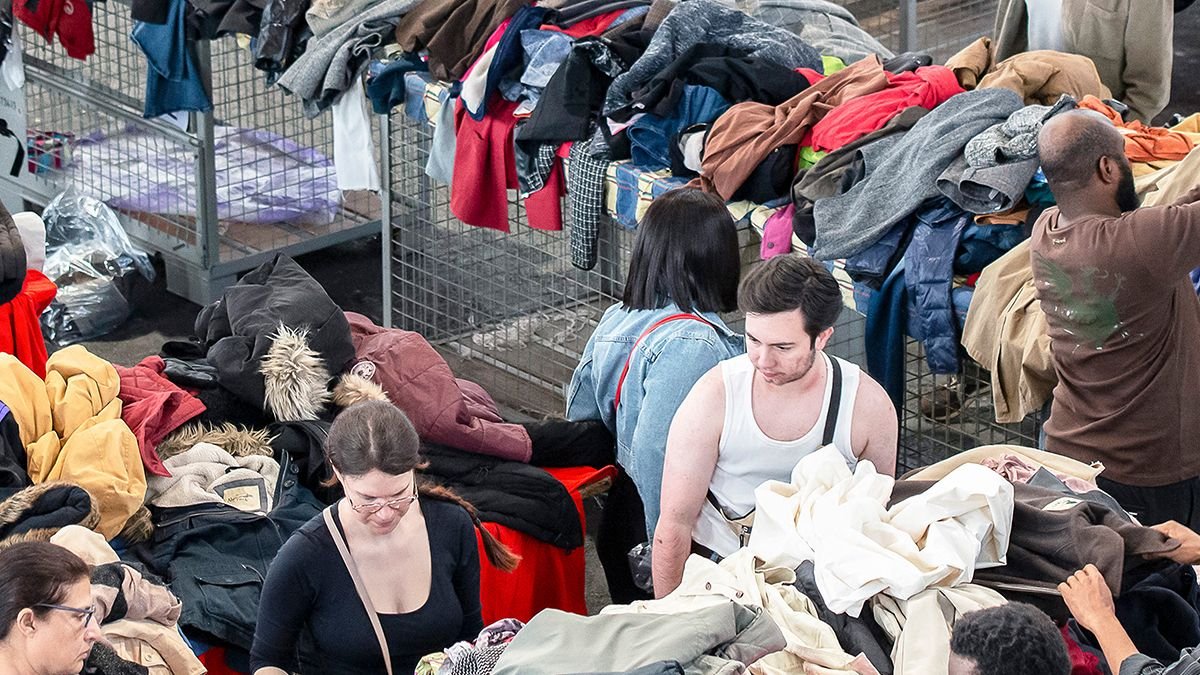
Charity retail is facing a crisis, flooded with high volumes of low-quality goods and struggling to justify a business model that sends swathes of unused items to countries that do not have the right infrastructure to process it. It’s exacerbated by rising costs and competition from online resale sites like Vinted and Ebay, which lure consumers’ best items away from being donated and sold instead.
Now, the disconnect in secondhand sales is becoming impossible to ignore: while McKinsey predicts that the global market for secondhand fashion will grow up to three times faster than that of new fashion in 2027, many of the UK’s 9,900 charity shops face closure. In October 2025, for example, Cancer Research UK unveiled plans to shut 90 stores by May 2026 and a further 100 by April 2027. In June 2026, the British Heart Foundation said it would close 150 stores, which are “no longer financially sustainable”, over the next two years. Meanwhile, many of the so-called textile recycling companies charity retailers relied on to shift unsold stock (which tend to sort and export textiles rather than actually recycling them) face a similar fate.
There is a similar shift at play in Europe, too. The region is among the three largest exporters of worn clothes, alongside the US and China, but unlike the US — where charity resale continues to grow — charity retailers in Europe have struggled to meet changing consumer demands in the digital age, losing ground to newcomers like Vinted, which became the biggest fashion retailer in France (based on volume) in 2025.
How has it come to this? Globally, shoppers donate tens of millions of tons of worn clothes to charity shops every year, much of which is unsuitable for resale (Goodwill alone says it recirculates more than two million tons of household and clothing waste per year). But the value in unsellable clothes is waning — to the extent that European ‘recycling’ companies have been sounding the alarm about an inevitable collapse. A little over a decade ago, recycling companies in the UK would buy a kilo of these unsold clothes for £0.45, just enough to keep volunteer-run charity retailers afloat. Today, the Charity Retail Association (CRA) says this price has plummeted to £0.15 per kilo. CRA CEO Robin Osterley describes it as a “very significant decline”, but explains that today, charities see these collections as a way to clear vast quantities of donated clothes rather than generate income.
With such a low price for a kilo of clothing, these bags of unsold stock now represent wasted potential — every item in the bag has the potential to generate far more value than an entire collection, but only if the retail spaces dealing with them are fit for purpose. In a bid to find a path forward for charity retail, Vogue Business looked to the communities around the world doing things differently. Could a shopping center in Sweden or an upcycler in Ghana hold the key to a charity shop revival?
What if reuse were as easy as buying new?
In the Swedish town of Eskilstuna, around 100km west of Stockholm, sits ReTuna Återbruksgalleria, the world’s first recycling mall. Inside, specialist shops sell clothes, electronics, sports equipment, furniture, and building tools. There’s even an Ikea. The difference is that every single item is secondhand and has been donated by the public — often dropped off at the drive-through donation point.
Once a city in decline, Eskiltuna decided to reverse its fortunes by transitioning to an innovation hub for recycling and opening ReTuna in 2015. The mall is owned and operated by a municipal-owned management company called Eskilstuna Energy and Environment, which has an emphasis on organic waste management and biogas production, explains manager Simon Glimtoft. ReTuna was part of a broader effort to move up the waste hierarchy, as experts recommend treating recycling as a last resort. (The waste hierarchy framework — which underpins EU legislation — prioritizes preventing waste, followed by reducing, reusing and recycling, and only then does it advocate for waste recovery or disposal.)
