

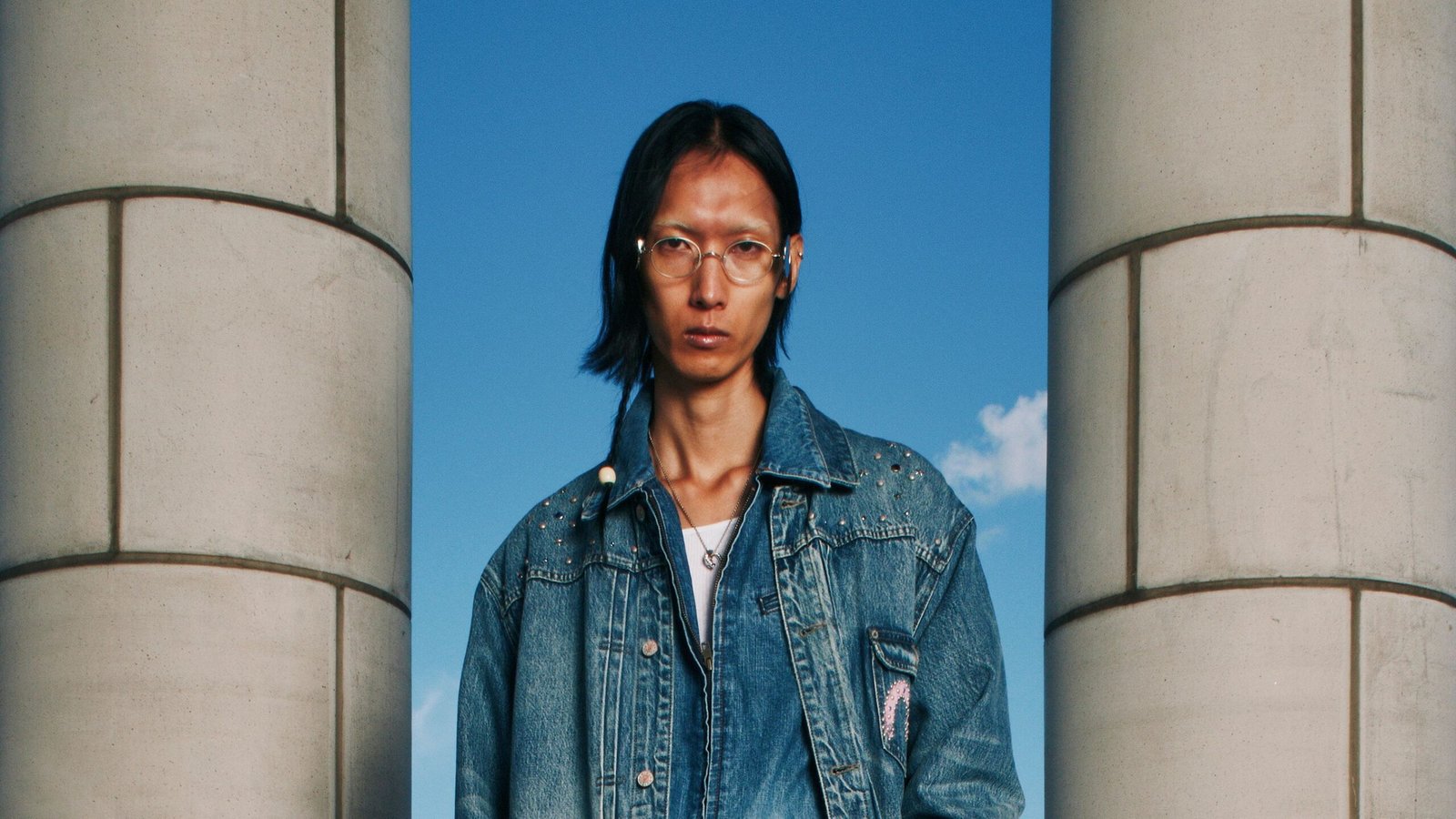
There’s often a feeling of things coming apart and back together again in designer Kozaburo Akasaka’s work. Inspired by the Japanese craft of kintsugi—where gold lacquer is used to repair broken ceramics, imbuing them with a newfound sense of design—the designer continued his ongoing explorations of hybridized garments or pieces touched by hand-worked processes.
“I like that moment of something being sensitive and brutal, said Akasaka. “Highlighting the history of something broken, but then adding additional value.” Take the opening coat, made in collaboration with denim brand Evisu, where two deadstock denim coats were combined into one longer garment, stitched together with a pneumatic stapler. This technique is a brand signature, and it appeared here in novel ways, like a pair of pants with spiraling seams stapled and lined with loose edges of fabric or T-shirts and baseball caps made from two or more pieces bisected and joined by a neat line of staples. Other denim styles with sinuous seaming and curved pockets and back yokes were achieved through 3-D cutting, and generally had a slightly ’70s feel with higher waists and flared silhouettes (some with button closure details at the hem).
Other highlights included cotton flannels manipulated with a needle-punching technique to give a fuzzy patina, a process also used on a droopy blouson jacket. Lightweight cotton shirting in a bandanna print and some hoodies and sweatpants printed with the phrase Peace on Earth, a reference to jazz great John Coltrane, who Akasaka regards highly, were also quite appealing. A few interestingly outré pieces stood out, like a pair of loose, wide-leg shorts that gave the appearance of a full skirt (the designer’s response to the ever-hotter summers), or an indigo button-up with a flannel piece affixed to the shoulder, which could be tossed over the shoulder like a scarf, or left to hang. Accessories included some small, wire-rimmed sunglasses and reworked shoes, like a leather belt strapped to a pair of beat-up Converse or high-top uppers jammed into leather loafers.
Overall, the collection kept in line with Akasaka’s general interest in American vintage as seen through a Japanese lens, a cross-cultural exchange that can seemingly be mined in perpetuity. Still, Akasaka is able to come at it from the side, providing results that feel original.
