

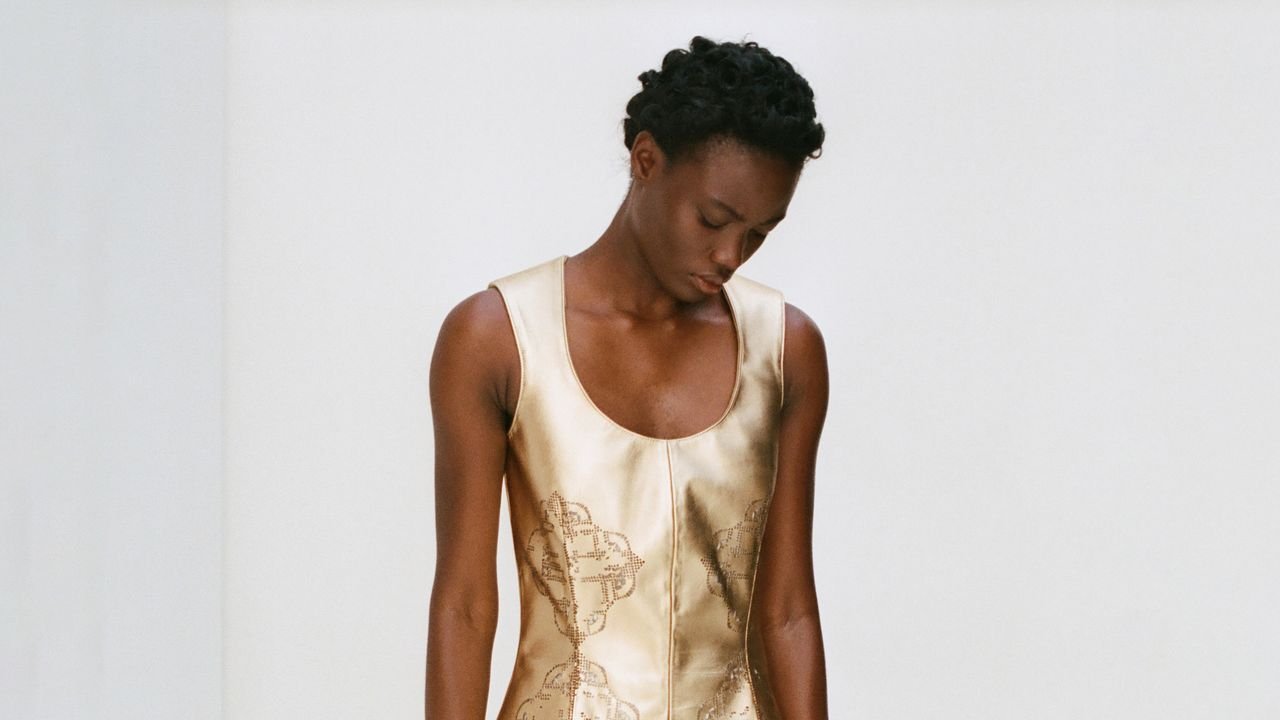
Joshua Ewusie’s spring 2027 collection began at home: in the front rooms of migrant households, where faux flowers sat atop plastic tablecloths and colorful crochet throws.
“The home is the first place where you start to get an idea of creating an aesthetic, where you realize things have been put somewhere intentionally,” said the London designer, now on his third collection as a British Fashion Council NEWGEN recipient. His own memories returned him to his grandmother’s and Ghanaian family’s homes, whose front rooms were salons and meeting places. “I thought a lot about women in our cultures who see the home as an opportunity to show everything that is precious to them,” he said.
For the collection, titled In Lieu of Flowers, Ewusie also looked to Michael McMillan’s The Front Room, a study of the domestic interiors of post-war Caribbean migrants in Britain, and began reconsidering the objects sometimes consigned to the category of kitsch or “cheap.” Why, he wondered, should the pattern of a plastic tablecloth be deemed bad taste when its origins lie in handmade lace? The question proved fertile ground for a designer already known for making leather do unexpected and gorgeous things.
Photo: Erik Cesla
Photo: Erik Cesla
That material remains the binding thread of his work, but this season, Ewusie, who is a recent Central Saint Martins MA graduate, and currently Fashion Designer in Residence at The King’s Foundation as part of a partnership with Chanel, pushed further into the interchange between it and everything around it. The lace-like motif of a vinyl tablecloth was translated into intricately laser-cut leather. Elsewhere, the actual tablecloth material was dyed, cut into cloth, then braided and bound with leather to give PVC pants and a dress, with its sweet pintucked front panel, heft and structure. Dresses based on the domestic adornment were piped in leather, while a gleaming gold dress was laser-cut with the decorative pattern. Leather was made to feel more delicate, while other humble materials were guided by leather’s permanence and authority.
The concept of home offered those same softer propositions. Nightgowns were another reference and appeared with curved necklines, satin bindings, lace trims, and tiny rosebud embellishments. “This season feels more feminine,” said Ewusie. Color and texture, the designer explained, stopped it from veering into the twee, gravitating toward “distinctive, odd, sometimes ugly color combinations” that expanded beyond the largely neutral palette associated with his work. Lime green piping traced an aubergine silk skirt; flashes of acidic color appeared on necklines and linings.
There was continuity in the tailoring. A deconstructed tuxedo jacket developed a silhouette from last season, with a collar shifted sideways until its lapel began to resemble a petal. Housecoat shapes and familiar Ewusie shirting remained in the mix, while oversized laser-cut leather flowers worn at the neck nodded to late-’90s and early-2000s eveningwear, styled in a campaign shot by Erik Cesla. (Another emerging creative Ewusie was keen to work with.)
