

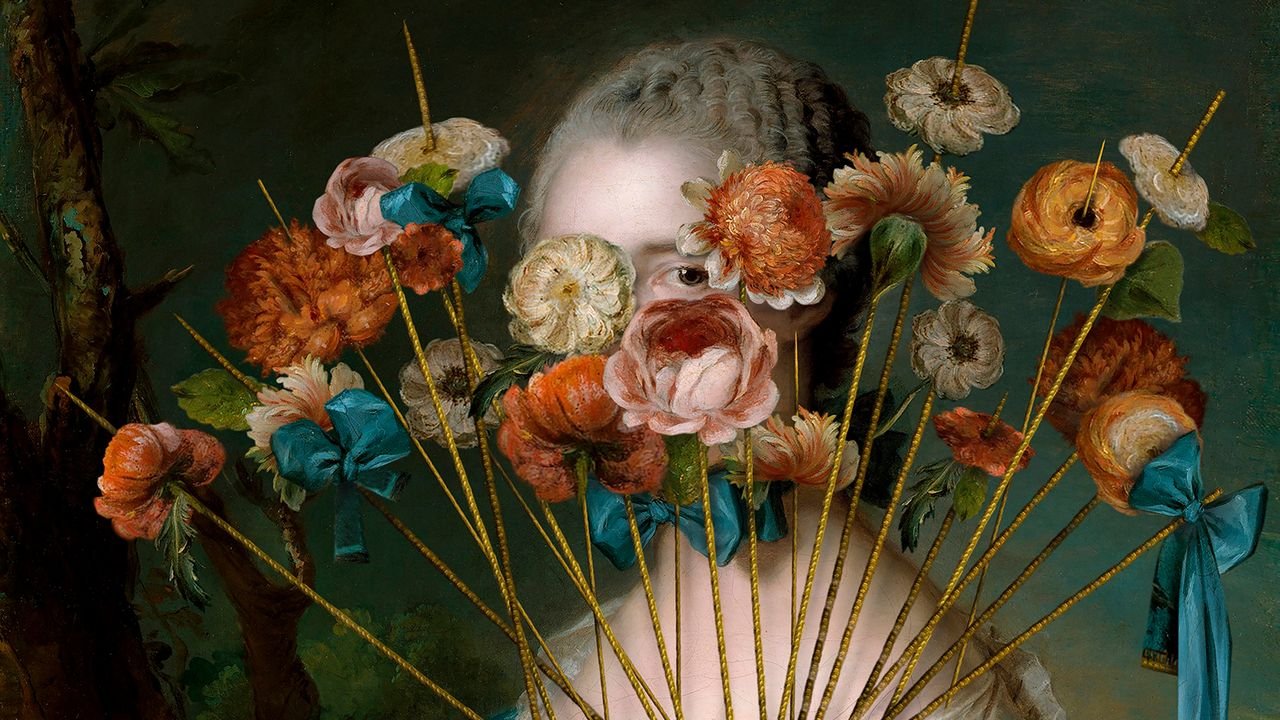
When we see a portrait, we are often drawn to the face at the expense of other details. Hermes wants his work to give us pause. He wants us to take in the many splendors of the imagery, yes, but also to notice its messaging. “I’m choosing portraits [that deal with] the topic that I want to talk about at the moment,” he says.
His subjects are various. “I want to point out, for example, that [formal portraits] are relics of an elite; this is the top 1% of a society. And the restrictions for women, or for people who were thinking different, were so hard.” Hermes is aware that his interventions can be triggering—but the point is to wrestle, intellectually and optically, with what you think you know. Enchanting surfaces can, and often do, hide darker realities.
He offers an example. “Quite often I extend pearl necklaces and I wrap them around the necks of the women because I love pearls and they are a timeless sign for wealth and beauty. But women had no rights. When I wrap pearls around them I want to point that out. I want to tell people, ‘Wait, this was different at that time.’ The thought that follows very secretly—and I hope that people get it—is be happy that we are different.”
In a world of endless scroll and visual overload, a world where “there is a pornography of information and communication, a pornography of circuits and networks,” as Jean Baudrillard once put it in The Ecstasy of Communication, there is also a lesson in visual literacy embedded in Hermes’s interventions. “We can’t hinder AI coming into our lives,” he says, “but we can look closely and we can judge and we can say, ‘This is made up; this is not reality.’”
Volker Hermes, Hidden Jacometto, 2019. Photo collage.
Photo: Courtesy of Volker Hermes / 44DeVore
Still, there is a real sense of joy and playfulness in this artist’s work—especially his use of ribbons. “They are my favorite tool,” he says. “These are two-dimensional works, you see the people from the front, but they have a back; the dresses that they are wearing are three-dimensional, and there is a body. If you wrap or let a ribbon float around this person, the viewer gets the feeling that there is really somebody sitting there. And sometimes I lead the ribbons out of the painting because the paintings don’t really stop at the border of the canvas, they are really worlds. When the viewer is following the ribbons…you get a rhythm, you get life, you get movement.” It should be noted, as Hermes explains in the exhibition catalog, that any changes he makes to a work only iterate elements that already exist. “Nothing is added to the paintings.”
