

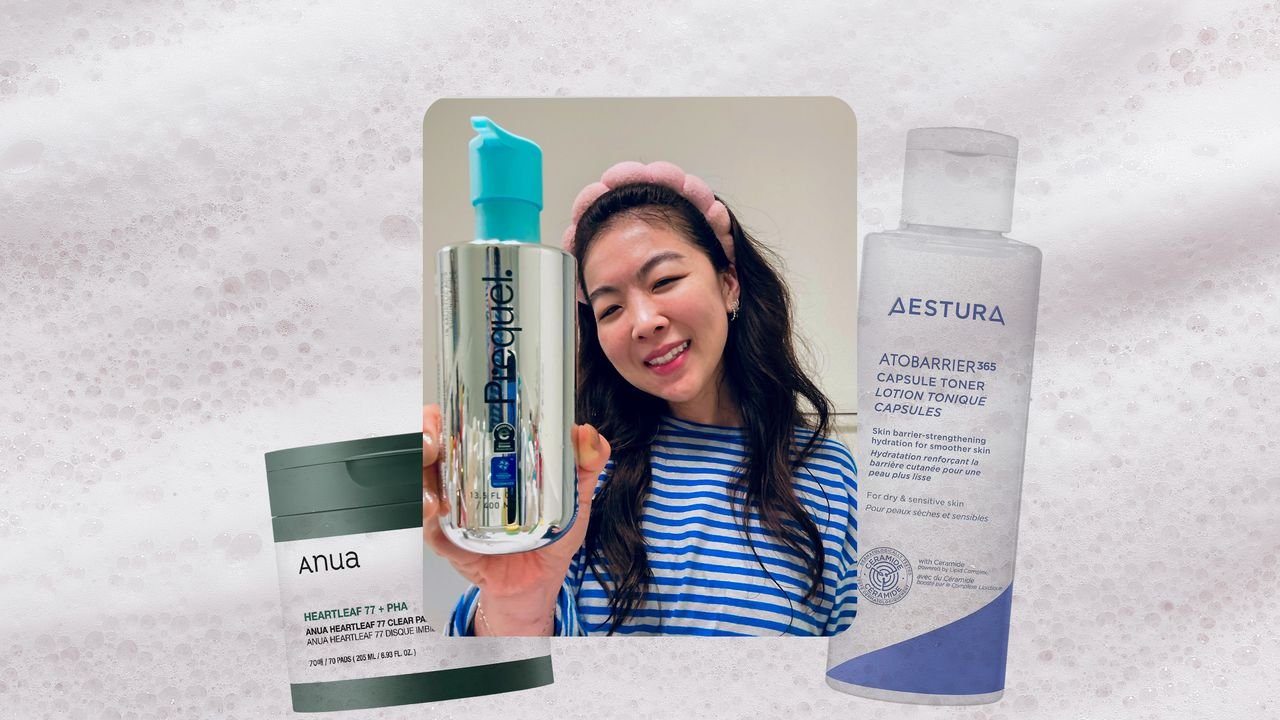
The ANUA Heartleaf 77 Clear Pads combine polyhydroxy acid (PHA) exfoliation with heartleaf and madecassoside, a compound derived from the Centella asiatica (cica) plant that helps support the skin barrier, to gently smooth and soothe skin. The embossed side gives a little physical exfoliation for those who prefer (and can tolerate) it, but the pads can also be placed directly on areas that need extra attention and left on like a mini sheet mask. In this case, there’s no swiping or rubbing at all—just let the pads sit and soak in for a few minutes before gently patting in the excess.
Frequently asked questions
Sensitive skin is generally skin that is more reactive to products or environmental triggers, like cold and wind, explains Dr. Watchmaker, often causing burning, stinging, redness, itching, or tightness. The skin barrier, which is the outermost protective layer of the skin, can also play an important role in how reactive skin is, says Alan Meyers, an R&D and formulation expert based in New Jersey. “When the barrier is weakened, your skin has a harder time keeping moisture in and protecting itself from external irritants, so it can become much more reactive.”
Should I exfoliate if I have sensitive skin?
All of the experts interviewed for this story agree that people with sensitive skin can benefit from exfoliation. “Our skin naturally sheds dead skin cells, but sometimes they don’t all shed evenly and can build up on the surface,” explains Meyers. “That’s where gentle exfoliation can be really helpful. It can make the skin feel smoother, help bring back some radiance, and improve the appearance of dullness, uneven texture, and clogged pores.”
With sensitive skin, you just have to be a little more strategic about how you exfoliate. Dr. Chang’s recommended approach: prioritize gentle, gradual exfoliation, starting with a mild exfoliant, such as a PHA, a lower-concentration alpha hydroxy acid, or beta hydroxy acid, once a week and increasing frequency only if your skin tolerates it well.
What is the difference between physical and chemical exfoliation?
Physical exfoliation uses friction to manually remove dead skin cells. (Think: Scrubs, brushes, beads, or textured pads.) Chemical exfoliation uses ingredients such as AHAs like lactic acid, BHAs like salicylic acid, or PHAs like gluconolactone to loosen the bonds between dead skin cells, so they shed more easily. “I generally prefer chemical exfoliation over physical exfoliation for most patients with sensitive skin, as physical scrubs create friction that can cause excess irritation and inflammation,” says Dr. Chang.
Dr. Watchmaker also prefers gentle chemical exfoliants for sensitive skin because they’re “easier to control and don’t require physically scrubbing the skin,” but points out that there is no universal rule. “Rather than telling sensitive-skin patients that they have to avoid one particular ingredient altogether, I think it’s more important to look at the entire formulation, concentration, and frequency of use,” she explains. “Even a typically well-tolerated ingredient can cause irritation if it’s used too often or combined with several other active ingredients.”
What should I avoid if I have sensitive skin?
For starters, you should avoid exfoliating skin that is already irritated, sunburned, or actively peeling. Give your skin barrier some time to recover first. Once it has, you can gradually incorporate a gentle exfoliant into your weekly routine, but Dr. Chang emphasizes starting slow and cautions against using multiple active ingredients (i.e., retinoid or benzoyl peroxide) in the same routine, which can increase the risk of irritation. She adds that “fragrance and high levels of alcohol can also be irritating for some people with sensitive skin.”
What do dermatologists recommend for exfoliating sensitive skin?
Dr. Watchmaker echoes Dr. Chang’s advice to start slow, emphasizing that more exfoliation isn’t necessarily better. “The biggest mistake I see is over-exfoliation. Your skin does not need to feel tight, sting, or peel for an exfoliant to be working. For sensitive skin, I recommend introducing one exfoliating product at a time, starting once or twice a week, and adjusting based on how the skin responds.” She also recommends applying a moisturizer afterward and wearing broad-spectrum sunscreen every day.
To find the best exfoliators for sensitive skin, we spoke with dermatologists and a product formulation expert about what makes an exfoliator effective without being too harsh. Their advice helped guide our picks, which we then put to the test. We looked at everything from texture and exfoliating strength to how our skin looked and felt after use, paying particular attention to concerns like dullness, uneven texture, clogged pores, dryness, and redness. In the end, we narrowed the list down to five formulas that delivered the benefits of exfoliation without leaving skin feeling tight, stinging, or overly sensitized.
- Y. Claire Chang, a board-certified cosmetic dermatologist in New York City.
- Jacqueline Watchmaker, MD, FAAD, a board-certified, fellowship-trained dermatologist in Scottsdale, Arizona.
- Alan Meyers, R&D and formulation expert and Executive Scientific Advisor for Dr.Althea.
