
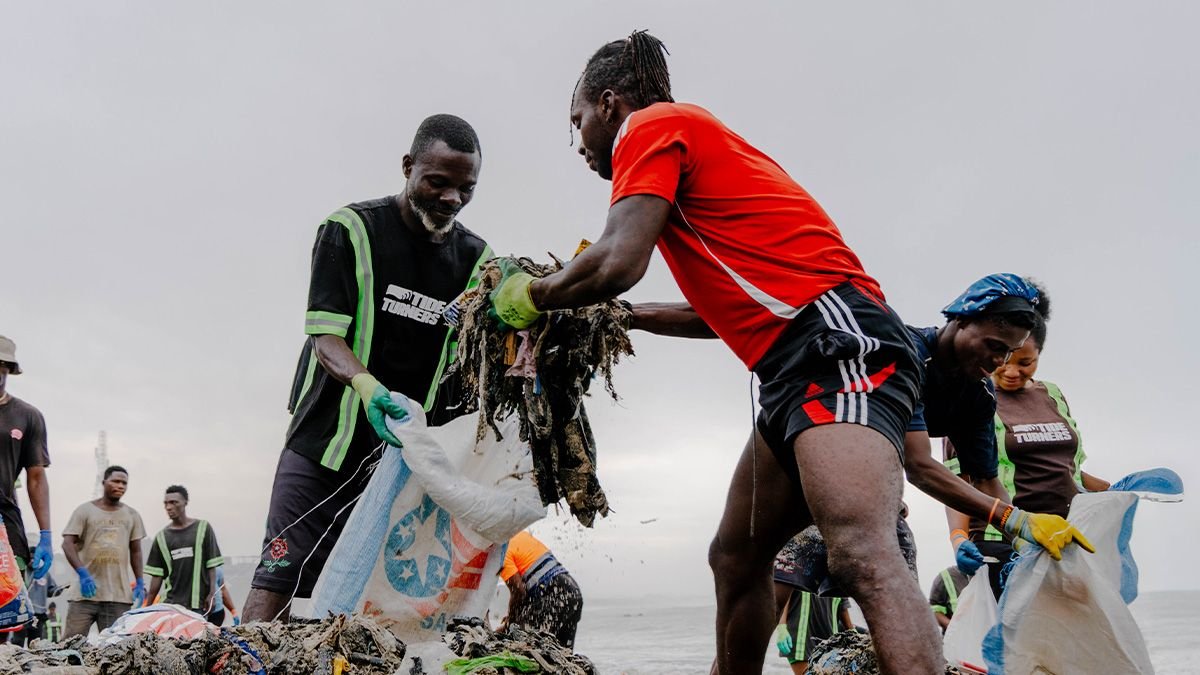
Last year, while reporting our (Re)Made in Ghana series, I stood on the beach in Accra, Ghana, and witnessed the destruction caused by used clothing exports up close. I walked over the mountains of used clothing clogging the sand; wrestled with the tangled tentacles of waste to unearth individual items and register individual brand labels; and watched as local volunteers took pickaxes to those with deeper roots.
The Tide Turners cooperative, supported by US Ghanaian non-profit The Or Foundation, runs these weekly beach clean-ups. But their efforts to tackle a textile waste crisis they did nothing to create go unnoticed — and uncompensated — despite the EU’s progress toward extended producer responsibility (EPR) regulations that would make the polluter pay for cleaning up its own waste.
The problem is that policymakers do not allow EPR fees to flow across borders, mirroring the flow of used textiles, says The Or Foundation co-founder and executive director Liz Ricketts. That’s why, for the last five years, The Or Foundation has been calling for “globally accountable EPR”. Today, it launched Apparel Recovery Coalition (ARC), a coalition with Adidas, H&M Group, Inditex and Bestseller, to find out how that would work in practice.
The program will funnel voluntary funds from major European brands into the countries receiving the post-consumer textiles they created, providing a clear case study for EPR fees to cross borders. It will focus on upstream interventions, preventing waste from entering the beach and other dumpsites in the first place by leveraging and expanding the thriving circular fashion ecosystem at Accra’s Kantamanto Market, one of the world’s largest resale and upcycling ecosystems. The Or Foundation estimates that upcyclers and resellers there already manage to recirculate 25 million garments each month, but there is room for improvement — as the waste currently clogging the beaches demonstrates — with the support of brands.
Kantamanto Market already has a robust reuse and upcycling ecosystem in place. The ARC pilot program will fortify existing initiatives and invest in scaling others, to create a blueprint that can be applied in other countries too.
Photo: Julius Tornyi/ Sylvester Darku
“Instead of theorizing for another five years while communities like Kantamanto carry an unfair burden, ARC is testing how [to make globally accountable EPR a reality],” says Ricketts. “Kantamanto isn’t a dumpsite and it isn’t a perfectly functioning circular economy, but it is a place of action, ingrained knowledge, skill and possibility. Launching here sends a signal that ambitious plans for circularity must be grounded in reality.”
ARC will explore how EPR fees and other accountability mechanisms for brands could support circular fashion ecosystems around the world, focusing on reuse, upcycling, recycling and responsible waste management in countries that receive large volumes of exported secondhand apparel. Ghana will be the testbed, but the coalition will apply its blueprint to at least one other country in the next two years. During that time, its activities will be funded by voluntary contributions from Adidas, H&M Group, Inditex and Bestseller, but the hope is that other brands join too, and the blueprint is eventually embedded in EPR policies across the EU.
“Studies show that a majority of post-consumer textiles collected and sorted in the EU are exported beyond its borders. Even when these garments are reused or upcycled — which isn’t always the case — they ultimately become waste in the countries receiving these exports,” says ARC spokesperson Hilde van Duijn, CEO of the Netherlands-based organization Circle Economy, which will act as the coalition’s secretariat. “We will explore how producer responsibility contributions could follow textiles until the end of life, wherever this happens. We hope, through ARC, we can show that this is possible.”
