

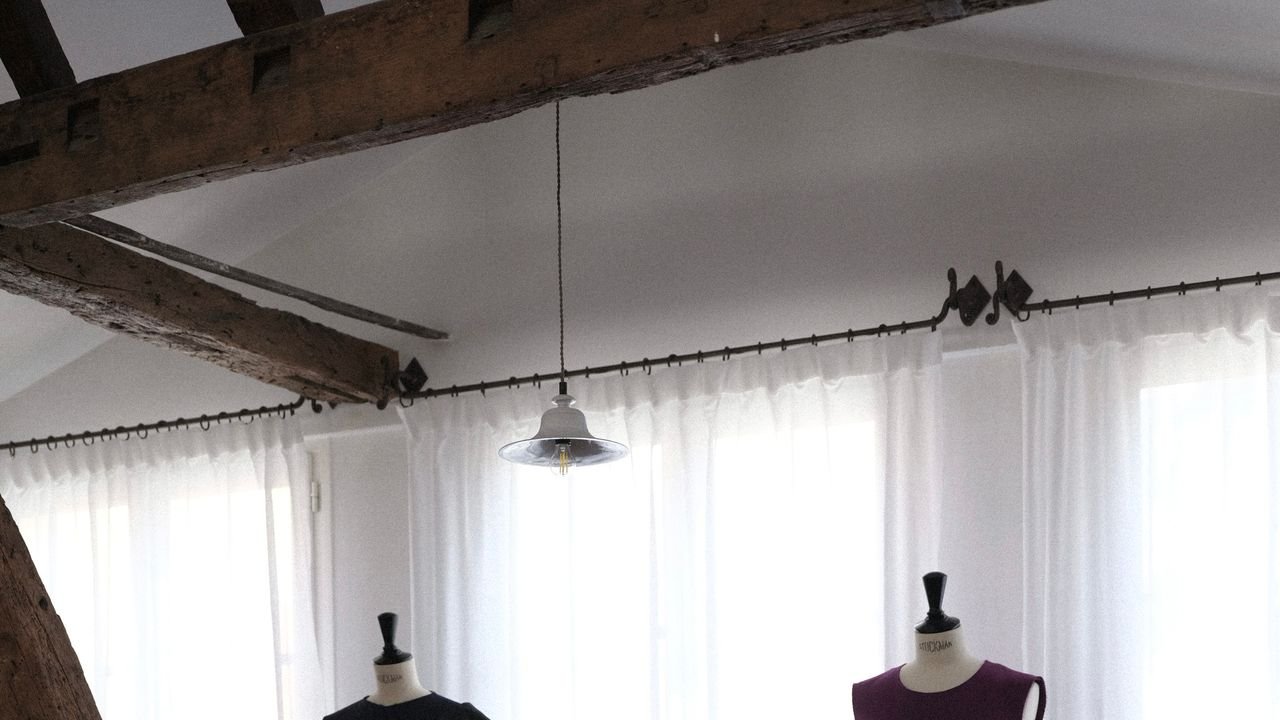
As a menswear designer, Larcher can go granular on details. He spent 10 years at Dior Homme: two years as an intern with Kris Van Assche, followed by eight years as a designer in Jones’s studio, making the transition to the first season of Jonathan Anderson. He grew up in Reims, France and studied at Esmod (the “Higher School of Fashion Arts and Techniques), which was where he met Jiang. Before she arrived in Paris to study marketing, she had never really been drawn to fashion, having grown up “in a traditional Chinese family.” Once here, she says with zeal, “It opened my eyes!”
As Larcher tells it, the collection began with their personal archives and things they wore. Together, they developed “obsessions—wanting to have a particular piece, and perhaps finding it in other colors.” They hunted down pieces that they found inspirational and things that they figured might inspire designers—for moodboards, fabrics, embroidery, whatever. Gradually, there were people—stylists and designer friends—whom he would lend pieces to and he eventually started renting them out. “We started to think about it this year as a business,” he says, adding that once they found the space, they could start developing the storytelling. Their model works, he says, since people will take pieces on loan to study as they might with a library book.
“The same piece could be interesting in different ways with different eyes. Some might like the fabric, some will like the color,” says Larcher, with Jiang echoing his thought. “I observe different clients coming and looking at the same pieces so differently. Some try on something for the shape or focus on the buttons; it’s funny.”
Occasionally, although they remain discreet on the particulars, they have noticed how something that’s been rented seems to inform a new design that appears on the runway—mainly menswear, Larcher clarifies. Not that this is sacrilege. On the contrary, they are delighted to be a resource. “Of course, we are proud,” says Jiang.
Charlie ULMER
