

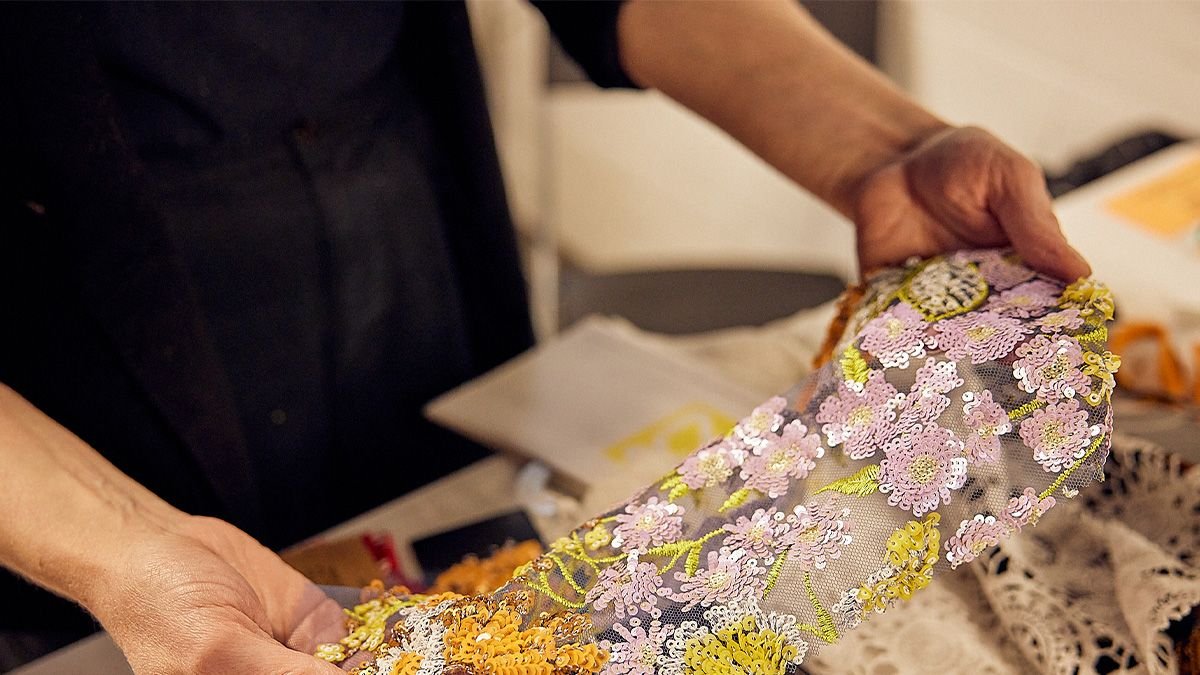
In the time since, Fabscrap has been through its fair share of “revamps, corrections and additional streamlining”, says Tagle, who stepped into the executive director role after Schreiber’s departure in 2025 to focus on her family. Today, it focuses on collecting pre-consumer waste from local brands, and recirculating as much as possible, with small amounts going to downcycling or landfill.
It operates on a ‘pay as you throw’ model, scaled according to donation size. For smaller donations, brands pay per bag before collection. For larger donations, which usually arrive on pallets, brands pay per pound, after Fabscrap has collected and weighed the donations. Tagle introduced this distinction in 2025 following a donation audit, which revealed that 24% of brands donated 84% of incoming materials during the year. She also optimized the warehouse processes, improving sorting rates by 58% in the past 18 months and reducing the backlog of donations by 159,407 lbs.
Brands sending smaller donations receive a Fabscrap bag to fill with waste, which is then weighed and catalogued on arrival. Brands sending more waste tend to use pallets.Photo: Dawnpoint Studios
Over the last decade, Fabscrap has collected pre-consumer waste from more than 900 brands across the US, mainly concentrated around New York, but also including Philadelphia, Pennsylvania, New Jersey and Massachusetts. It currently has around 400 regular customers, spanning luxury to mass market. J.Crew, PVH, Steve Madden and Urban Outfitters parent company Urbn has worked with Fabscrap since its foundation, and several of those brands (plus others like Carolina Herrera) have also supported the non-profit with grants and group volunteering.
But Tagle says Fabscrap’s potential to scale is limited by a lack of industry collaboration. Getting to the next level, and keeping more waste in circulation, will rely on brand and manufacturing partners upstream designing with circularity in mind. There’s a long way to go.
