

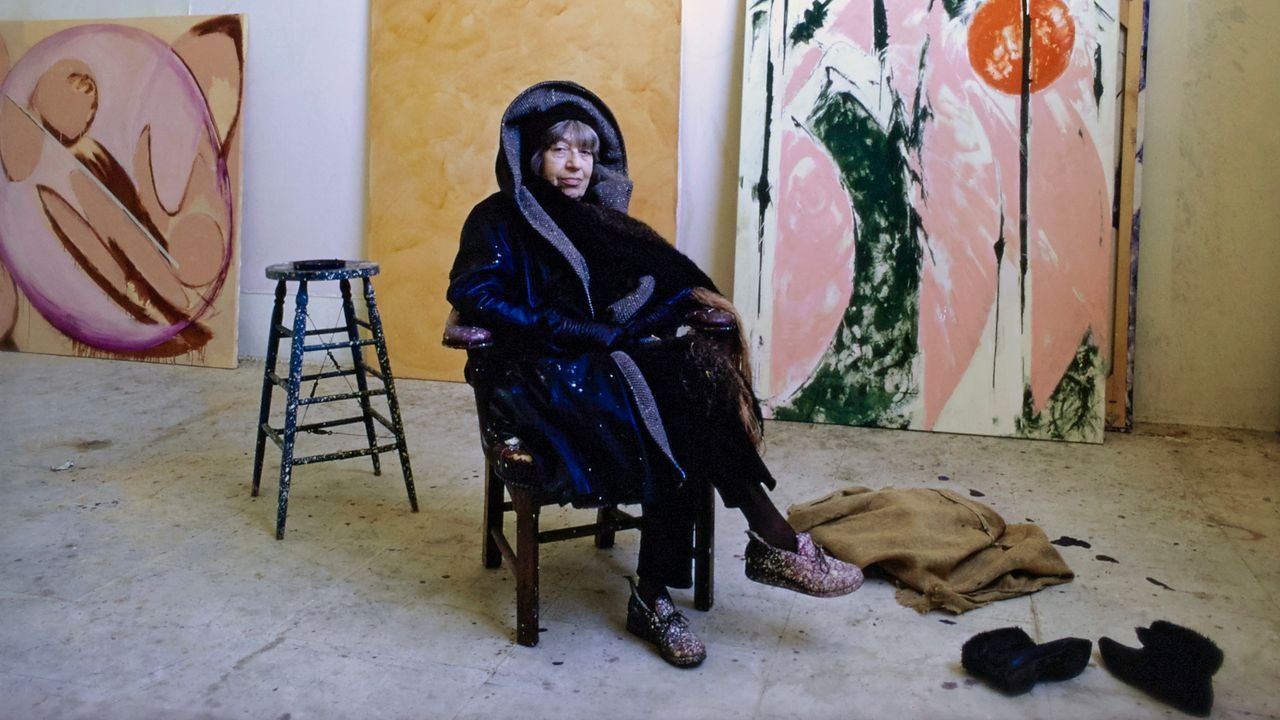
When I asked Lee Krasner why she was not one of the “Irascible Eighteen,” the now famous group of New York School artists who signed a petition in the ’forties—precipitating one of the most notable controversies ever stirred up about American painting—a petition protesting the virtual absence of American art in The Metropolitan Museum of Art in New York, she answered, “I wasn’t asked to sign. Barney Newman [the organizer of the protest, Barnett Newman, the outstanding American painter who died in 1970] called, and when I answered the phone, he asked for Jackson. He didn’t even bother to inform me of the protest.”
And so it went, until recently—when Lee Krasner the painter began to replace Mrs. Jackson Pollock as a public personality.
The Pollocks and their marriage were, and are, their own untold story. Despite his image as the macho he-man, Pollock treated Lee Krasner as an equal, a serious professional artist whose work he admired. In her home, Lee Krasner was at least as much painter and comrade-in-art as wife. It turns out that, in fact, Pollock was the only major American artist of the great ’forties to marry another avant-garde artist of his generation.
And Pollock, alone among the patriarchal Abstract Expressionists, investigated the myths of female creativity, painting feminine archetypes (like “The She-Wolf” and “Pasiphaë”), totems, and symbols to balance the masculine principle. While his contemporaries, for the most part, turned to Freud for inspiration, Pollock preferred Jungian subject matter, subject matter that gave equal if not greater emphasis to earth goddesses and the primal creativity of the feminine.
Pollock was not afraid of strong women and Lee Krasner was one of the most courageous, outspoken, and tenacious women any man might have chosen. In many respects, her education was better than Pollock’s. A New Yorker who had studied at Cooper Union and the National Academy School of Fine Arts, she had discovered modern art as a young painter during the ’thirties, while Pollock was still painting the American Scene in the manner of his teacher, Thomas Hart Benton, the Missouri painter who tried to make an epic subject of the prairies and fields of rural America but ended with provincial versions of the old masters. Indeed, many have credited Lee Krasner with deflecting Pollock’s attention from Benton and focusing it on the great modern masters. She is reticent on the subject. “When I first met Pollock, we disagreed on many things,” she admits. “But as struck as I was by the revelation his paintings were to me, still I couldn’t believe he was discussing Benton that seriously. I can’t say if I affected Pollock’s views at all. I know that Pollock affected me enormously; I dare say I must have had some effect on him.”
