

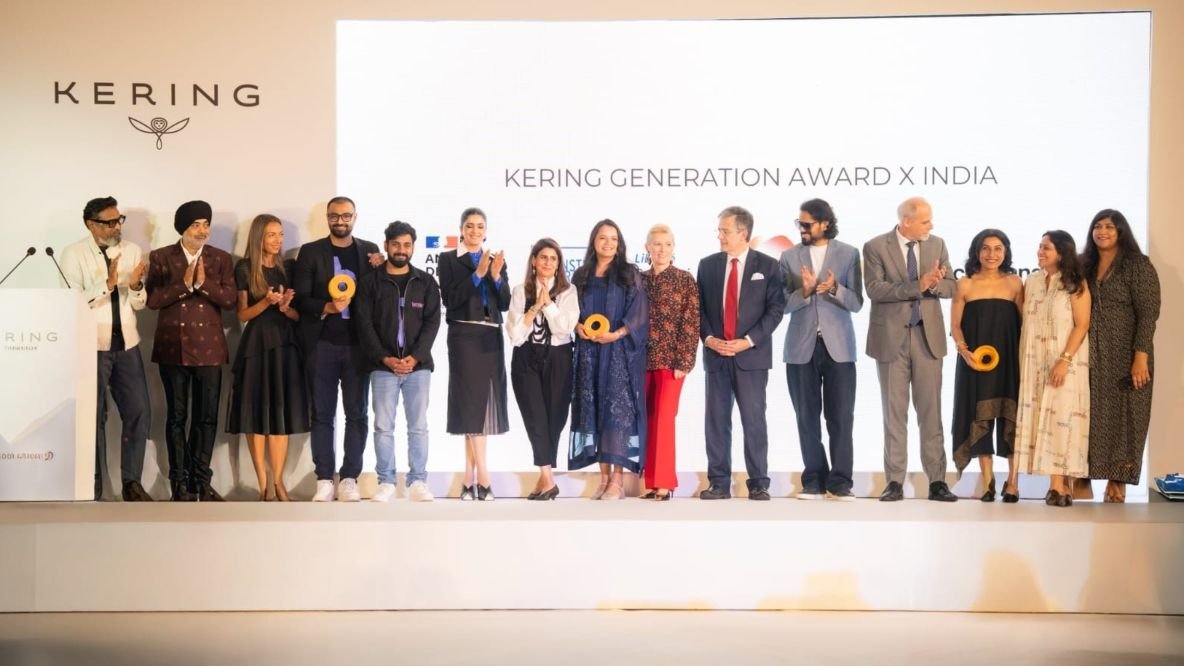
“I believe one of the greatest disservices we can do to sustainability is to define it through a singular, often Western lens, focusing primarily on material innovation, carbon emissions or waste reduction,” says Mishra. “Sustainability must also be understood through its social impact, particularly its ability to create employment, sustain livelihoods and empower communities.”
He adds: “International luxury groups such as Kering bring extraordinary strengths in research, technology and innovation. India brings generations of material intelligence, craftsmanship and community-based production. There is tremendous potential in bringing these two worlds together.”
India has a long history of upcycling, recycling and heirloom dressing, practices that have kept materials in circulation and craftsmanship at the heart of how people dress. “People learn by example,” says Daveu, pointing to the opportunity to create “beautiful ready-to-wear, with strong craftsmanship and a strong savoir-faire”, while maximizing resource efficiency through precision manufacturing. Chandok also sees circularity as connected to India’s history. “Circularity is not an entirely new concept for India. Reusing materials, repairing products and finding value in what already exists have been part of our culture for generations,” he says, adding that a new generation of entrepreneurs is combining that inherited knowledge with technology, material innovation and contemporary business models.
After the prize
Beyond the prize money and mentorship for the winners, Kering’s and the jury’s wider network can also help startups find commercial partners. Previous winners include Melephant, a Chinese startup developing bio-based dyes from organic waste. Its work with Chinese fashion group Ellassay illustrates how connections can help innovators take materials toward commercial applications. The company has also raised nearly RMB 10 million ($1.5 million), and its CEO, Liu Yuanyuan, was named a Tatler Asia Gen T Leader of Tomorrow.
Kering’s network can potentially connect startups with companies and innovators including Dior, Inditex and Studio Sativa. For Malpani, the award marks a milestone in building Without’s operations in India while developing solutions for international markets. “I hope we have our first two plants, our demo plant and our first commercial plant, built in India within the next five years, because we really believe in building in India,” Malpani says. “But we are a company in India made for the world, and this moment is a milestone that makes me really feel we’re on the way.”
However, scaling a new material takes time. Daveu points to the long process of moving from an initial conversation to integrating a material into a luxury supply chain. “It takes nearly 10 years between the first contacts, the fact that we have identified the startup and we have this kind of exchanges to be sure that the raw material has the quality to be integrated in our supply chain,” she says.
“Most of them would like to become really global. We are also able to create cross-fertilization between the previous winners and themselves, so we create a kind of network. Yes, it’s a network, but more than that, they can become part of a community of innovators in sustainability,” says Daveu. She believes the network connecting the startups with previous winners is one of the award’s most important assets, supporting their ambitions for global growth.
Whether these innovations make their way into the collections of Kering’s maisons will be the real measure of the award’s success. Daveu says Kering will return to India, signaling that this first edition is just the beginning.
Disclosure: Sujata Assomull was a member of the jury for the Kering Generation Award India.
