

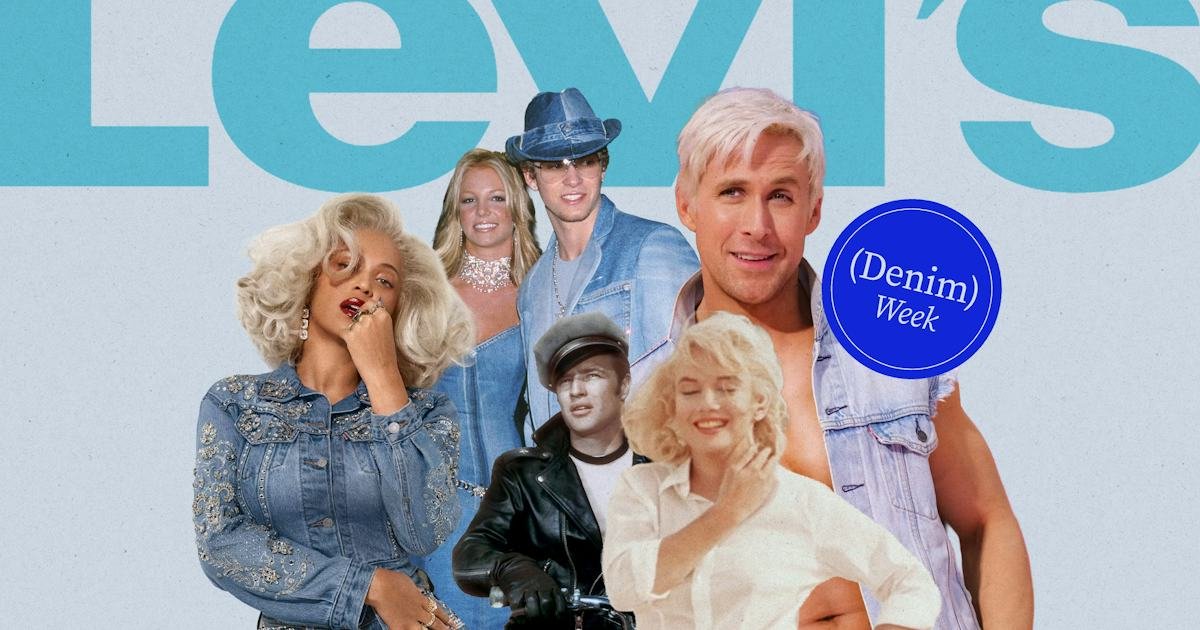
Chances are, the words “blue jeans” conjure a specific image. For some, it’s Bruce Springsteen’s famous backside on the cover of Born in the U.S.A. For others (especially millennials), it’s the magical shape-shifting pair passed between four best friends in The Sisterhood of the Traveling Pants or Britney Spears and Justin Timberlake’s matching double denim at the 2001 American Music Awards. Countless moments like these exist in denim’s pop culture history, but what makes them particularly interesting is that so many of them trace back to Levi’s.
When Levi Strauss and Jacob Davis teamed up to patent the first pair of riveted jeans in 1873, they probably didn’t expect Levi’s to become the cultural behemoth it is today. After all, the jeans were born from a customer request to Davis, a tailor, for sturdier work pants. He came up with the idea of reinforcing them with metal rivets and reached out to Strauss, his fabric supplier, to partner on the patent. More than 150 years later, the humble Levi’s jean has become a force of its own, woven through American culture and connecting workers, cowboys, rebels, artists, actors, musicians, and an entire pantheon of creative visionaries with the same blue thread.
For decades, Levi’s jeans — then called “waist overalls” — were seen strictly as workwear for miners, railroad workers, farmers, ranchers, and cowboys. In the 1920s, the company leaned fully into its Western association by sponsoring rodeos and rodeo riders, and by the 1930s, it had made the cowboy its brand icon, using the imagery in its ads. Around 1937, it created its first separate Western Wear line. Then, in 1939, John Wayne wore 501s as the Ringo Kid in Stagecoach, the film that made him a star and made Levi’s an essential part of the rugged cowboy uniform in Hollywood Westerns.
But the cowboy Hollywood sold was only part of the story — even the word “rodeo” comes from the Spanish rodear, which means to round up. “Long before Hollywood romanticized the American cowboy, Mexican vaqueros established many of the ranching, roping, and riding traditions that shaped the American West,” says celebrity stylist Tiffany Briseno, who has worked with Shawn Mendes, Kane Brown, and Brothers Osborne. “That vaquero history is how I personally view Western culture as a whole. It’s rooted in Mexican heritage, craftsmanship, and tradition.” For her clients, that means mixing vintage denim, traditional Western elements, and modern pieces without tipping into costume territory. Levi’s, she says, is key to striking that balance: “I love Levi’s because it feels authentic and lived-in. It works across different artists and styles without feeling forced.”
Even today, getting Western denim right means looking past the movies. “The familiar cowboy look has been shaped by Hollywood as much as by history,” says costume designer Janie Bryant, who dressed the Yellowstone prequels 1883 and 1923. For the former, she skipped denim entirely in favor of wool, linen, and silk, and instead “saved denim for 1923.” By then, “jeans and overalls were established work clothes in the West, and the silhouettes were becoming more familiar to us as Western wear.” She used Levi’s throughout the series and designed Spencer Dutton’s (Brandon Sklenar) jeans herself, wanting “the denim to feel right for his character and his life, rather than like a generic costume choice.”
Marlon Brando filming The Wild One in 1953.Michael Ochs Archives/Moviepix/Getty Images
In the 1950s, Levi’s went from cowboy uniform to rebel garb, thanks in large part to Marlon Brando in The Wild One (1953), who strutted through the film as a biker gang leader in a leather jacket, white T-shirt, and a pair of 501s. Nick Guzan, writer and blogger behind BAMFStyle, sees Brando’s look as a cultural touchpoint that transformed denim from workwear into rebelwear. “It was the right place, right time, and right actor,” he says. “Brando was having his own breakthrough moment, and Levi’s had recently modernized their 501 jean into the post-World War II design that remains more or less the same today, rather than the pre-war jeans produced earlier in the century that had suspender buttons and a rear cinch instead of belt loops. This solidified their cultural staying power.” Heritage helps too. Levi’s was the denim pioneer, and while rivals Lee and Wrangler “certainly earned their own prestige,” says Guzan, they’ll always be “the Pepsi to Levi’s Coca-Cola.”
Two years later, James Dean helped perpetuate the denim-and-rebellion connection in Rebel Without a Cause. But as Guzan points out, Dean’s iconic red windbreaker and white T-shirt were paired with Lee Riders, which fans often mistook for Levi’s. “Brando and Dean definitely shared a role in popularizing denim through the ’50s, but it was Brando in those red-tab Levi’s that launched a moment while Dean sustained it,” Guzan adds.
By the late 1960s, jeans had fully escaped their cowboy-and-greaser connection, and few characters captured that shift better than Don Draper. In the Mad Men finale, set in 1970, Bryant traded his signature suits for a Levi’s denim jacket and 501s, a look she calls the “Texas tuxedo” (some call it a Canadian tuxedo). “Don’s suits had been a kind of armor throughout the series,” she says. “By the finale, he’s been stripped back, and the denim lets us see him in a different way.” The Levi’s connected him to a “more American, workwear kind of look, while still feeling unmistakably like Don. I loved that the final image could be so simple and still carry so much meaning.”
For Bryant, who grew up around her family’s yarn business, that range is exactly what makes Levi’s so useful as a costume designer. “The same pair of jeans can feel hardworking, rebellious, polished, or completely relaxed depending on how it’s worn,” she says. “Levi’s has a strong identity, yet it gives you room to make the look personal.”
There is something sartorially supernatural about a pair of Levi’s. They somehow manage to be both completely accessible and pure fantasy at the same time. Anyone can buy the same 501s Brando wore, and when you put them on, you get a little of the myth along with the denim. Celebrity stylist Mark Avery, who works with Ryan Gosling, has been chasing that feeling for decades. “Weirdly, even when I was in punk bands, I wanted to look like Dwight Yoakam,” says Avery. He’s “always gravitated towards being a bit of a spectacle dresser, but rooted in what feels authentic,” so Western wear let him stand out without ever feeling “like a costume or disconnect to who I actually am.”
For Avery, denim’s rebel streak clicked with The Outsiders (1983), Francis Ford Coppola’s adaptation of S.E. Hinton’s novel about teenage greasers. The film reflected his own working-class upbringing back to him “in a light that was as equally brutal as it was romantic.” Denim had always been a necessity, but suddenly it meant something else. “My double denim, painted-on jean jacket, or ripped-up 501s were not a sign of economic limitation but a flag of rebellion,” he says. “A head-to-toe message that I was aligned with a counterculture that was simultaneously all-American and anti-establishment.”
Rebellion wasn’t just for the boys, though. Marilyn Monroe donned Lady Levi’s 701 jeans in her final film, The Misfits (1961), cinched and rolled in a way that made workwear look downright glamorous. That formula — a crisp white shirt and broken-in Levi’s — became its own kind of chic uniform, passed down to fellow style icons like Carolyn Bessette Kennedy (known to love her Levi’s 517s) and Hailey Bieber (a longtime Levi’s fan). A 501 formula even made its way to Silicon Valley — Steve Jobs famously paired his custom black Issey Miyake turtlenecks with New Balance sneakers and Levi’s 501s.
Meanwhile, Levi’s also became a rock ‘n’ roll staple. Springsteen’s 501s were so central to his everyman image that his denim-clad behind, shot by Annie Leibovitz, became the cover of 1984’s Born in the U.S.A., or it was simply because E Street Band drummer Max Weinberg voted for that cover because “that was the view I always saw…” he once joked.
Levi’s haven’t just appeared on album covers; they’ve made it into the songs themselves, from T. Rex’s “Hot Rod Mama” to Taylor Swift’s “Cardigan,” and Waylon Jennings “Mammas Don’t Let Your Babies Grow Up to Be Cowboys” to Ginuwine, who name-checked Levi’s in 2003’s “In Those Jeans.” In 2024, Beyoncé and Post Malone released “Levii’s Jeans,” prompting Levi’s to briefly add an extra “i” to its name on Instagram. As Briseno puts it, “Levi’s crosses into rock, Americana, and just about every other genre.”
Michael Jackson’s custom-fit Levi’s jeans, worn as part of an outfit on the 1996 HIStory World Tour in Budapest, Hungary.
(+)
Courtesy of Juliens Auctions
(+)
Courtesy of Juliens Auctions
And then there was the King of Pop, Michael Jackson, who made black Levi’s 501s a signature part of his style. When Julien’s Auctions was hired to clear out Neverland, “there was a ton of Levi’s jeans in his house,” says Marin Nolan, co-founder and executive director of Julien’s. “He always wore Levi’s jeans.” Amid the glitter gloves and embellished jackets, the jeans kept Jackson grounded. “He liked them because he could move in them,” Nolan says. “And he felt that the fans could relate to him more” since they were likely wearing jeans to his shows, too. However, because Jackson’s costume designers, Michael Bush and Dennis Tompkins, had to take the jeans apart, add elastic, and rebuild them to fit his body, they ended up costing thousands of dollars. (One of the pairs will be featured in Julien’s Auctions’ “Michael Jackson: The Fashion Legacy Auction” taking place on December 7.)
Years later, Levi’s helped create one of pop’s most memorable couple moments. When Britney and Justin decided to match in denim for the 2001 AMAs, stylist Steven Gerstein had Timberlake’s suit remade from vintage Levi’s, based on a Costume National suit Timberlake wore on the cover of NSYNC’s Celebrity.
But the most valuable pair belongs to grunge rock history. Kurt Cobain owned a pair of distressed, patched-up 501s, reportedly a gift from Babes in Toyland drummer Lori Barbero. He wore them numerous times, including in the “Heart-Shaped Box” music video, at a concert at NYC’s Roseland Ballroom, and at the 1993 MTV Video Music Awards, which he attended with his wife Courtney Love and his daughter Frances Bean. In 2023, the jeans sold at Julien’s Auctions for $412,750, about 40 times their estimate, earning a Guinness World Record as the most expensive jeans ever sold. The brand had little to do with the price, of course. “Typically, with Kurt, he would cut labels out of anything,” says Nolan. “He did not support corporate branding in any form…But of course, they’re indisputably Levi’s.”
Kurt Cobain’s Levi’s jeans.
(+)
Courtesy of Juliens Auctions
(+)
Courtesy of Juliens Auctions
The buyer, collector Tom Coyne, remembered Cobain wearing them at the VMAs and knew they were something special. He was “in awe” when he first saw them in person at the Hard Rock Cafe in NYC. “I had looked up pictures of when Kurt wore them on multiple occasions and noticed that many of the rips and stains were original and easily matched to important photos and videos,” he says. Owning the jeans is a “very surreal experience, especially since it is an important piece of music history that is so definitive of both his style and presence,” he says. “It is something that inspires me every day and is not so different from acquiring a piece of original art from a generation-defining artist like Basquiat or Warhol, who was well ahead of his time.” And if they went back to auction tomorrow? “They’d sell for over a million,” Nolan says.
If $412,750 sounds absurd for a pair of jeans, collector Brit Eaton would argue we’re nowhere near the top of the market. The Colorado-based vintage dealer has spent nearly three decades buying and selling vintage denim. He estimates he has around 30,000 pairs of Levi’s jeans stocked away in his warehouses, along with what he calls “pretty much the best collection in the world of early denim, like 1800s denim.” He sees it as a smarter bet than most stocks. “It’s a tangible item I can hold in my hand,” he says. Demand keeps growing because of who’s wearing it. Fans spot a star in a vintage Levi’s jacket, go looking for a similar piece, and discover that the real thing costs $2,000. “I don’t think the young people think of it as an investment,” he says, “but they’re not afraid to spend some money on their wardrobe to look cool.”
Heath Ledger on set during the filming of Brokeback Mountain in 2004.Jeff Vinnick/Getty Images
Costume designers have always reached for Levi’s, too. Marit Allen put Heath Ledger and Jake Gyllenhaal in Levi’s pieces for 2005’s Brokeback Mountain. (Ledger’s pair sold for over $21,000 in 2013.) Almost Famous costume designer Betsy Heimann scoured the California coast for vintage Levi’s 501s and 714s for Stillwater and the Band-Aids, while Katherine Dover put Matthew McConaughey in a Ted Nugent tee and pale peach Levi’s in Dazed and Confused. When Stranger Things costume designer Amy Parris needed multiples of ’80s pieces, Levi’s made them from vintage patterns. More recently, Charlene Akuamoah dressed Off Campus’s Hannah in a Levi’s denim jacket, the quintessential college-student outerwear.
Avery, who works both as a stylist and set costumer, brings that punk-meets-Western edge to his work with Gosling, from a custom Levi’s jacket for The Fall Guy press tour, inspired by the crew jackets handed out as wrap gifts on film sets, to Ken’s denim vest in Barbie. “When we cut the sleeves off the Ken Levi’s jacket and made it a vest,” Avery says, “that just was instant character personified.”
Courtesy of Warner Bros.
More than a century after a tailor first riveted a pair of work pants, Levi’s still means something different to everyone who pulls them on. That’s what Avery took away from his heroes: “It wasn’t always what they wore but how they wore it — style,” he says. “Same as a guitar, punk took the same instrument made famous by rock and country and approached it completely differently.”
And while it helps to have Brando, Springsteen, or Cobain as a reference, Avery’s advice is simple: “As much as icons can be inspirational, the way you find your fit, style, wash is by trying on lots of stuff and seeing what looks and feels authentic for you.” After all, as Nolan puts it, “We can all wear a pair of Levi’s.”
(Stay Up To Date)
Become A Style Insider
Join The Zoe Report’s exclusive email list for the latest trends, shopping guides, celebrity style, and more.
