

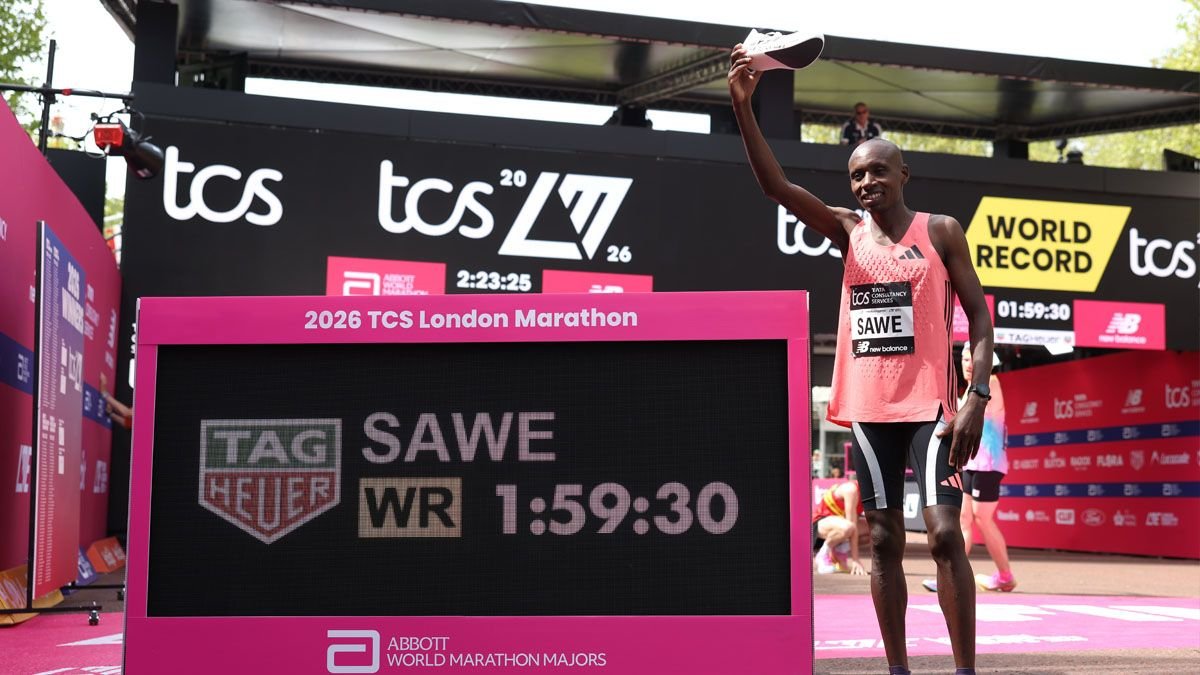
Last Sunday, not one, but two athletes broke the sub-two-hour marathon record at the London Marathon. Both wore Adidas’s new Pro Evo 3 supershoe. Sabastian Sawe set a world record of 1:59.30; Yomif Kejelcha came in second, just 11 seconds behind. Tigist Assefa also set a new women’s world record of 2:15.41 wearing the same shoe. Even Nike, Adidas’s main competitor, congratulated Sawe. Adidas generated $11 million in media impact value (MIV) at the London Marathon, driven primarily by the men’s and women’s records, per Launchmetrics.
Adidas may be dominating London’s headlines, but it was far from the only brand to have a presence at the city’s marathon, or Boston the week before it. From legacy players like Nike and Adidas to challenger brands On and Hoka, performance running brands have been on a tear, activating on a longer and larger scale in an attempt to capture the booming marathon opportunity that was all but solidified when Harry Styles ran both the Berlin and Tokyo marathons last year, before appearing on the cover of Runner’s World last month, interviewed by fellow marathoner Haruki Murakami.
The number of runners signing up for World Marathon Majors is higher than ever, with applications up year-on-year across all seven cities (Tokyo, Boston, London, Sydney, Berlin, Chicago, and New York). In London, ballot applications exceeded 1.13 million, up 36% on the 2025 record of 840,318. On Sunday, 59,830 runners crossed the finish line, up from 56,640 the year before. All in all, marathons are a big business opportunity.
Sabastian Sawe broke the world record in Adidas’s new supershoe.
Photo: Courtesy of Adidas
It’s one that’s ballooned well beyond race day, performance brand execs agree. “The marathon has moved from being a single race day moment to a multi-layered cultural platform,” says Patrick Nava, general manager at Adidas Running. “Ten years ago, success was largely defined by podiums and performance validation, largely confined to the running niche. Today, the marathon sits at the intersection of elite sport, mass participation, culture, and innovation storytelling.”
More brands are responding to marathons as they shift from performance events to cultural platforms with bigger programming (shakeout runs; pop-up hubs; weekend-long programming) that caters to more people (elite runners; casual runners; running crews; sideline attendees). The rise of run clubs has driven brands to develop a more creative, grassroots and cultural presence, says Alice Crossley, deputy foresight editor at strategic foresight consultancy The Future Laboratory. “People used to look forward to race day, but now there’s a whole cultural run-up,” she says.
