

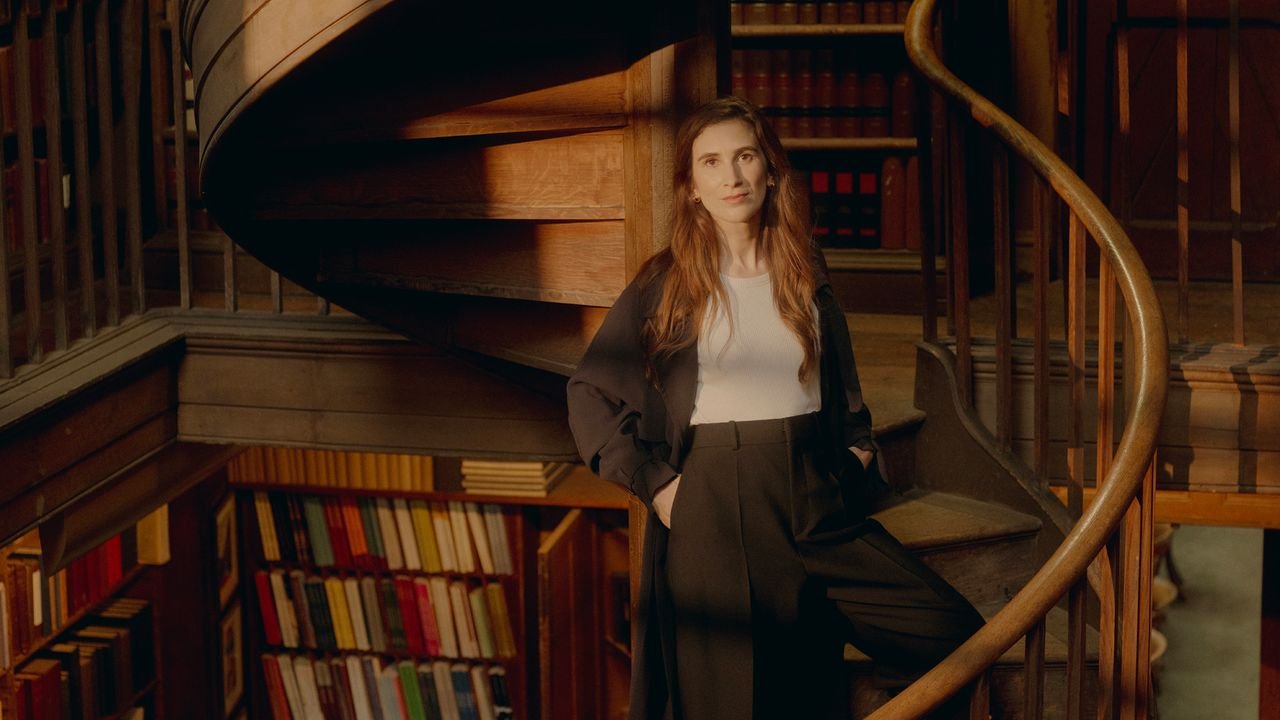
Her early years were spent in Harare, Zimbabwe, a childhood she describes as “a huge, great thrill.” Days were lost to climbing trees, brushing up against lizards and monkeys, and “water scorpions in the swimming pool.” There was, she says, “this sense that the world was lit by the presence of living things that were unknown, but beautiful.” This awe seeps into her writing, constantly. In The Neverfear, she describes a newborn unicorn so vividly that you can imagine a child wishing it were real.
The author’s formative years were also shrouded in grief. When Rundell was 10, her older foster sister, Alison, died after a period of illness, an experience she sees as the “shaping incident of my childhood.” There was a distinct before and after. “I adored her,” she says. “She was somebody I very much wish that I knew as an adult.”
“People always ask, ‘Do you write for 10-year-olds because you were 10 when your sister died?’” Rundell says. “I don’t think it’s as simple as that.” But she allows that she read hundreds of books while Alison was in the hospital; she consumed them with an appetite she describes as “physical.” “I’m sure it isn’t a coincidence that I write for exactly the age I was when books felt most urgently needed, and shaped my imagination, and gave me such a sense that there would be something beyond catastrophe.”
She has, at this point, released 15 books. In Impossible Creatures, much of the action centers around global disaster and existential threat: the magic that sustains the mythical beasts is being sucked from its source; masked bandits are terrorizing the islands. “It would be the height of injustice and rudeness to offer a child a story and give them only a moral,” she says. But the parallels between her plots and ecological realities are intentional. She wants children and adults to take these ideas seriously.
Max Mara coat. Ralph Lauren Collection turtleneck.
Photographed by Tori Ferenc, British Vogue, August 2026.
“Climate change is the most urgent moral question that we face as a generation,” she says, leaning forward. “We know that we’re currently heading [towards] anywhere between 2.7 and 3.5 degrees of global warming. We know that any more than two could be catastrophic to the earth’s ecosystems. And we know that we have the material and the technology to change it.” Fantasy, she believes, is a “shorthand for thinking about large world problems.” She wants her books to be “about adventure and love and jokes, but just to have running through them a thread of what I think is the biggest human question.”
