

You pretty much always know what you’re going to get with a Martin McDonagh movie—sharp, acerbic writing, madcap set pieces, big twists, and hilarious performances from a crew of talented stars. This formula carried his last offering, the funny and sad, Colin Farrell-led The Banshees of Inisherin to nine Oscar nominations in 2022. His latest is Wild Horse Nine, another odd-couple two-hander which, like its predecessor, just premiered at the Venice Film Festival. Come awards season in 2027, I suspect this is a contender we’ll still be talking about.
Much like Banshees, Wild Horse Nine boasts stunning, expansive landscapes, mysterious and beautiful animals (wild horses this time, in place of fan favorite Jenny the donkey), and a deep sense of pathos—but much more so than with the former, I was surprised by how this new film won me over emotionally. It’s a laugh-filled romp, the kind of movie that lets you kick back and hang out, reveling in its glorious ’70s aesthetics and painterly cinematography. But then it swerves off-road, into more serious and thoughtful territory, trudging through darker themes which chime with our dystopian present. Ultimately, it’s a film that stays with you.
Our setting is the Chilean capital of Santiago, and it is 1973, not long after the election of the nation’s popular president, Salvador Allende, the first Marxist to be in office in a liberal Latin American democracy. That, naturally, doesn’t sit too well with the CIA, who are laying out a plot to oust him. This will become the Chilean coup, the violent military overthrow of the government that saw dictator Augusto Pinochet come to power, while leftwing opposition was all but extinguished.
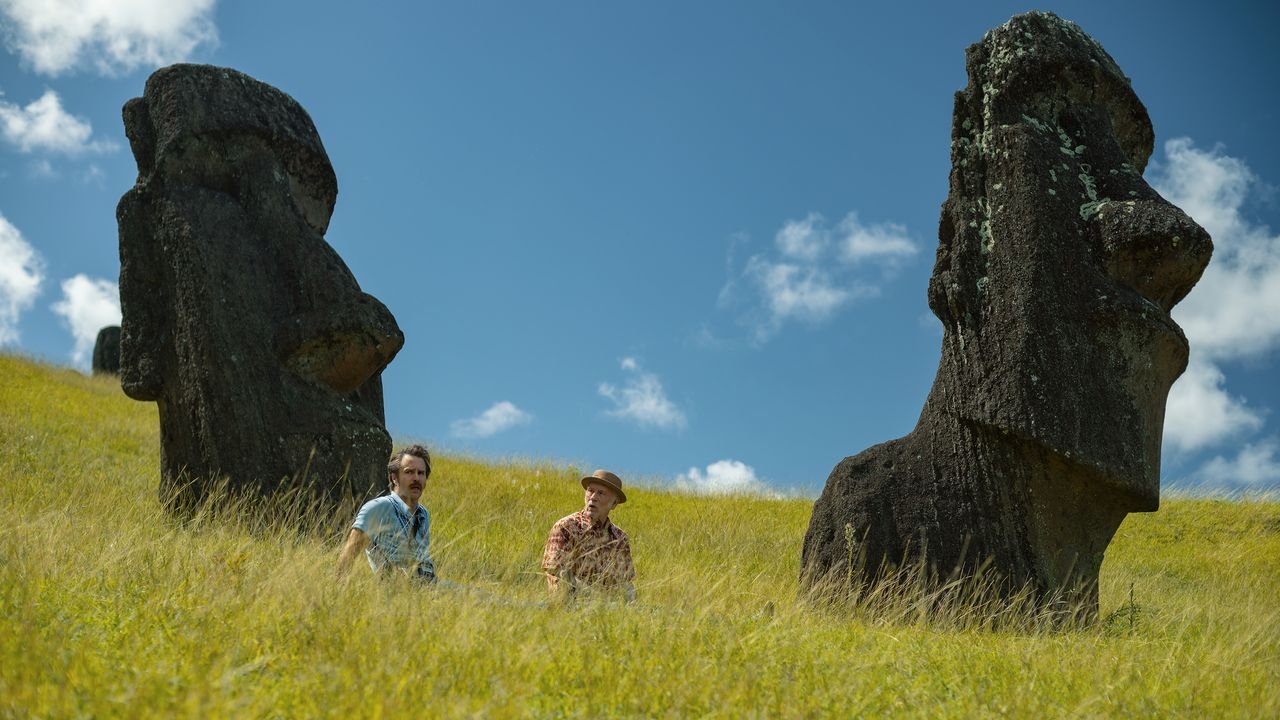
John Malkovich as Chris and Sam Rockwell as Lee in Wild Horse Nine.
Photo: Diego Araya Corvalán
