

Frequently asked questions
Why do you need a heat protectant?
Heat protectant creates a buffer between the hair fiber and direct heat from a blow-dryer, straightener, curling iron, hot brush, or other styling tool. “Heat protectants are the barrier between your hair and direct heat,” says Katelyn Ellsworth, hairstylist and founder of The Roslyn salon in San Diego, CA. Depending on the formula, film-forming polymers, silicones, oils, humectants, and proteins can help spread heat more evenly, slow moisture loss, smooth the cuticle, and reduce the dry, brittle feeling that repeated heat styling can cause.
That does not make hair invincible. You should still use the lowest effective temperature, avoid repeated passes over the same section, and make sure hair is completely dry before applying a flatiron or curling iron. But if hot tools are part of your hair care routine, a dedicated thermal protectant is one of the simplest ways to reduce preventable damage.
Do heat protectants really work?
Yes, though no formula blocks 100% of heat damage. Heat protectants coat the hair with ingredients that create a temporary barrier between the strand and a styling tool. They may also condition the cuticle, reduce friction, and help hair retain moisture, which can lead to a smoother, longer-lasting style with less frizz and breakage over time.
Even coverage matters as much as the product itself. Apply the amount recommended on the label, concentrate on mid-shaft and ends, and comb the product through when appropriate so that you do not leave unprotected sections behind.
How damaging is heat for hair?
Heat styling can damage the hair cuticle and weaken the fiber underneath. “Heat styling tools strip the hair of its natural oils, leading to dry, brittle strands that are prone to breakage and split ends,” says Dr. Chacon. With frequent or prolonged exposure, hair can lose strength and elasticity and begin to look dull, rough, or frizzy.
To minimize damage, Dr. Chacon recommends applying a heat protectant before blow-drying or styling and making sure hair is fully dry before using a flat iron. Temperature matters, too. Fine, bleached, chemically treated, or already-damaged hair generally requires less heat than thick, healthy, or coarse hair.
Is heat protectant better than leave-in conditioner?
For heat styling, yes (unless the leave-in conditioner explicitly states that it provides thermal protection). Leave-in conditioners are formulated primarily to hydrate, detangle, soften, and reduce frizz. Some also contain heat-protective ingredients, but many do not specify that they have been designed or tested for use with high temperatures.
A dedicated heat protectant is formulated to create a more uniform barrier against hot tools, often with film-forming polymers, silicones, proteins, oils, or a combination of those ingredients. You can use both products if the directions allow layering, but apply lightweight formulas and avoid oversaturating the hair.
Is heat protectant spray or cream better for your hair?
The best format depends on your hair type, density, and styling method, says Cavalcante.
- Spray: Usually best for fine or thin hair because it distributes easily without adding much weight. Sprays are also convenient for dry-hair touch-ups before a curling iron or flat iron.
- Cream: A good choice for dry, damaged, curly, or frizz-prone hair that benefits from extra moisture and smoothing.
- Serum: Offers targeted slip, shine, and frizz control. Lightweight serums usually work across hair types.
- Oil: Often suits thick, dense, or coarse hair that needs both thermal protection and shine, though fine hair may require only a drop.
What steps should you take before straightening or curling hair with a hot tool?
Detangle first, then apply heat protectant evenly from mid-shaft to ends, Cavalcante advises. If the product is designed for damp hair, blow-dry your hair completely before using a flat iron or curling iron. If it is designed for dry hair, work in sections and wait for any visible moisture from the spray to evaporate before using the tool. Sizzling or steam can be clues that your hair is still too wet. Choose the lowest temperature that achieves your desired result, especially on fine, color-treated, bleached, or damaged hair. Try to make one controlled pass rather than repeatedly clamping or curling the same section.
What is the difference between thermal protectant and heat protectant?
There is no meaningful difference. “Thermal protectant” and “heat protectant” are interchangeable terms for products formulated to help shield hair from the high temperatures generated by blow-dryers, flat irons, curling irons, hot brushes, and similar styling tools.
Can you use heat protectant on dry hair?
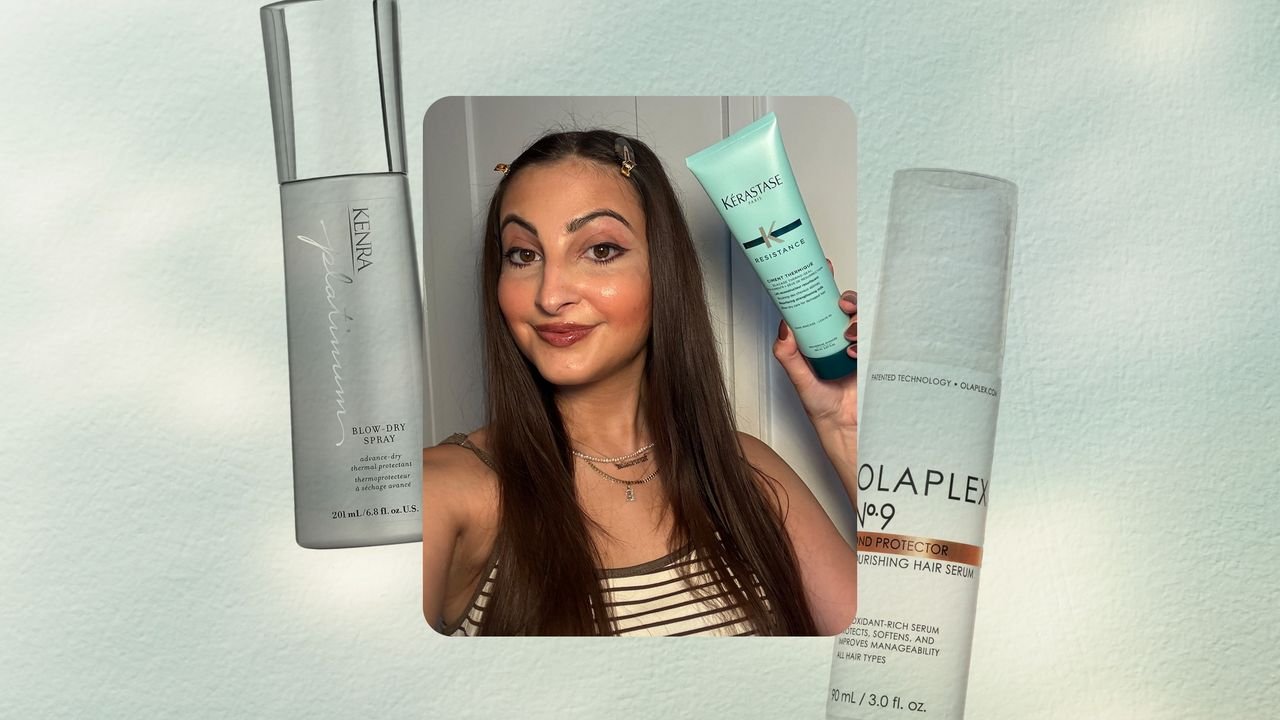
Only if the product’s directions say that you can. Some heat protectant sprays are designed for dry-hair application before a curling iron or flat iron. Other options, including Olaplex No. 9, Color Wow Dream Coat, Briogeo Farewell Frizz, and Kenra Platinum Blow-Dry Spray, are formulated to be used primarily on damp hair before blow-drying. Always follow the label instructions, and avoid placing a hot iron on wet hair.
Is it bad to put too much heat protectant in your hair?
Too much heat protectant is unlikely to harm the hair, but it can leave strands greasy, tacky, heavy, or overly damp. Plus, it could prevent a style from holding. Start with the amount suggested on the product label, adjust for your hair length and texture, and distribute it evenly. More product does not necessarily mean more protection. The goal is uniform coverage, so take the time to distribute the formula.
How we tested heat protectants
To narrow the field to these eight winners, Glamour editors and contributors tested 32 heat protectants on fine, thick, curly, color-treated, frizz-prone, and damaged hair. We evaluated each spray, serum, cream, and oil for ease of application, absorption, texture, and how evenly it distributed through damp or dry hair. We then styled with blow-dryers, flatirons, curling irons, and brushes, paying close attention to whether each formula prevented a scorched or brittle stiffness—and left strands sticky, greasy, or weighed down.
We also assessed softness, shine, frizz control, static, tangling, and how long a style lasted (humidity and sweat cut down the list considerably!). Our team consulted board-certified dermatologist Dr. Anna Chacon and professional hairstylists about how heat protectants work, which ingredients and formats to look for, and what they love about their favorite products.
