

The designer and his business partner Giancarlo Giammetti provided a top-level crash course. “The immersive experience of doing the Vanity Fair piece knocked me out,” Tyrnauer says. “I mean, I didn’t realize that there were probably the better part of 100 women right off of the Piazza di Spagna, sewing multi-$100,000 dresses by hand in very cinematic, stark white laboratories, and they became objects of fascination for me, as much as Valentino and his full-color Meissen Swan and boiserie world.”
Before his reporting was done Tyrnauer told Giammetti, “I think this is a movie.” For one thing, over the course of the assignment he had discovered that “Valentino’s press had been a million miles wide and one centimeter deep. I mean,” he says, “there was nothing in all of the almost half century of journalism that talked about the real story, which was the story of the marriage between Valentino and Giammetti. And the baby was the company.” And for another, “I knew that the movie would be good,” he says. “I didn’t have jaded eyes. I didn’t go in as someone that had hung around them. I had never been around a couture house. I’d never spent a lot of time with a European god of fashion. I’d seen every Fellini movie, but to actually see a real-time Fellini movie unfold in front of you, in the world of Valentino—I just ate all that up.”
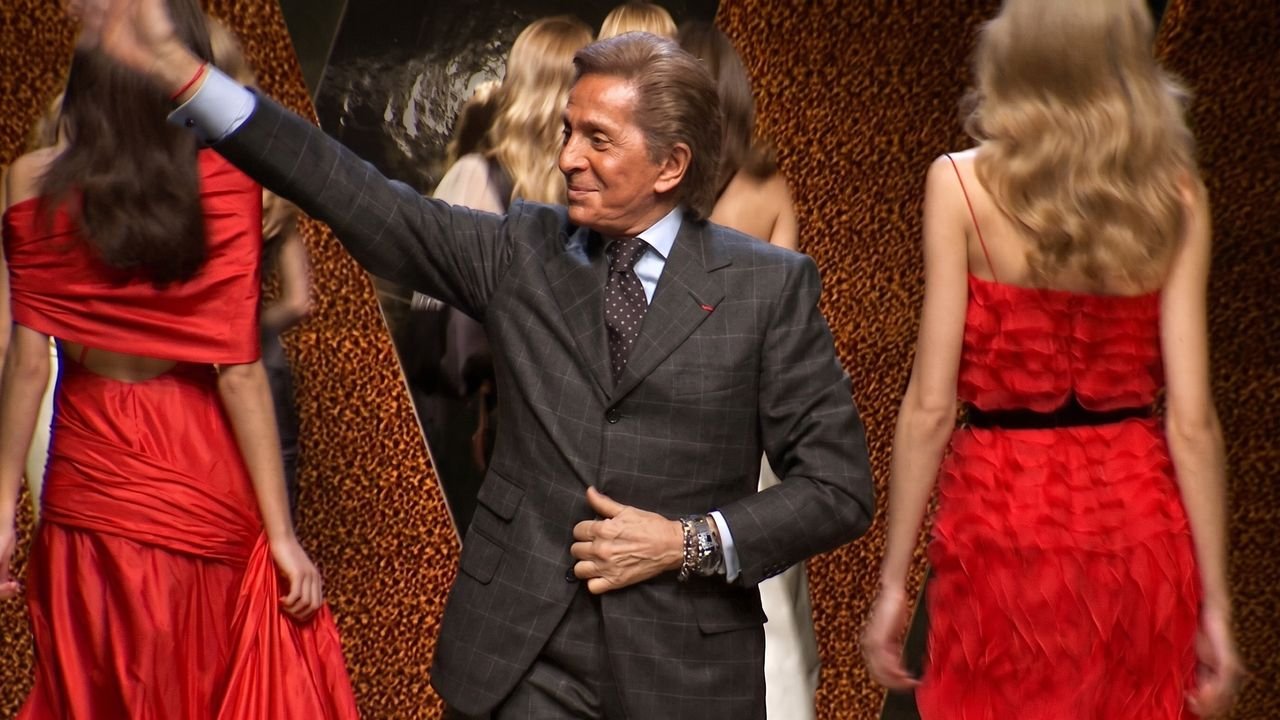
Tyrnauer set out to make a cinema verité documentary, in the vein of the genre’s masters Albert and David Maysles, Frederick Wiseman, and D.A. Pennebaker. He kept his day job while shooting, and between seasons, he’d write features for the magazine; then, two weeks before a collection, he’d show up in Rome with cameras in tow. He was with Valentino and Giammetti on-and-off for two years and captured the designer’s 45 anniversary show and retirement.
“Their world—it’s a court, like all the greats of that period, like Yves Saint Laurent and Pierre Bergé, like Lagerfeld. So you become not quite a courtier, because you’re the resident alien. But in that Italian way, you get swept up in the dramas of all the relationships. I became a kind of willing pawn, well, I think unwitting, but a volunteer pawn in the complex relationship between Valentino and Giammetti, and frequently you see this in the film.”
In one particularly memorable scene, Tyrnauer recalls, “Valentino is literally like hitting the camera lens to push it away. And we become part of the action unfolding; it’s a moment when he’s kind of seeing his life flash before his eyes because he’s going to look at this museum collection of his whole career, and I think it was a mortality thing. Of course, he lived like many, many, many years after, long into the future.”
Giammetti himself recalls another incident. “Making the film was actually much easier than it might seem, especially when you consider how many different moments of our lives it captures. Matt had an extraordinary ability to find his way into very private moments without ever making us feel that he was intruding. After a while, you simply forgot that the camera—and the microphone—were there. I remember once finding myself in the bathroom and suddenly realizing that I was still wearing a live microphone. That probably tells you how completely we had become accustomed to his presence.”
Giammetti, Tyrnauer, and Garavani.
Photo: Theodore Alexandre / Courtesy of Tyrnauer Media
