

Have you ever tried buying a Glastonbury ticket? Or tried to get a Centre Court seat on finals day at Wimbledon? Were you one of the millions frantically refreshing your browser to secure a spot at the Eras Tour? Well, consider those practice runs. The final boss of hard-to-get tickets landed this July, when slots for the Bayeux Tapestry at the British Museum went on sale.
The frenzy was unprecedented for a museum exhibition, with 80,000 people joining the virtual queue; the show sold out almost immediately, generating over $3.4 million in day-one sales. (I’ll be back in the virtual trenches on October 21 when the next batch drops, ready to risk carpal tunnel.)
It isn’t hard to understand why the show is so feverishly popular: the extremely fragile 70-meter stretch of 11th-century embroidery, depicting the historical events surrounding 1066 and the Battle of Hastings—arguably the central moment in Britain’s national mythology—was most likely stitched by skilled Anglo-Saxon needlewomen based in Canterbury, yet has spent the best part of a millennium housed in Normandy. While the museum there undergoes a renovation, the tapestry has been shipped back to England with the utmost care, where it has already received visitors including King Charles and the Macrons. It is, to put it mildly, a very big deal.
So you can imagine my disappointment at not getting a ticket. And you can, in turn, imagine my delight when, in the British Museum’s online gift shop, I stumbled upon a wealth of treasures that could rival the museum’s own Sutton Hoo haul.
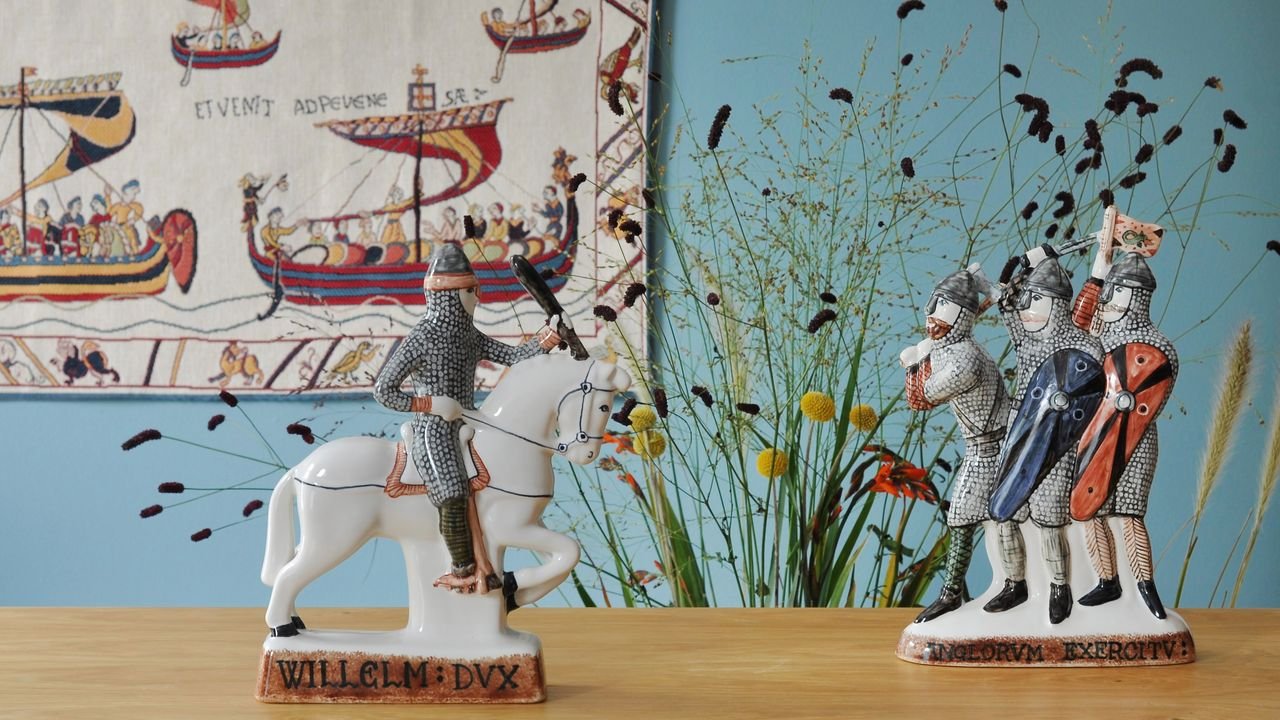
My eyes first lit up over a set of ceramic ornaments showing Anglo-Saxon soldiers preparing for battle, their chainmail rendered with the same intricate textures as the tapestry, and a jacquard wool scarf made in Scotland, decorated with William the Conqueror’s longships and charging horsemen. Who needs to see the tapestry IRL when you have high-speed broadband and poor impulse control?
