

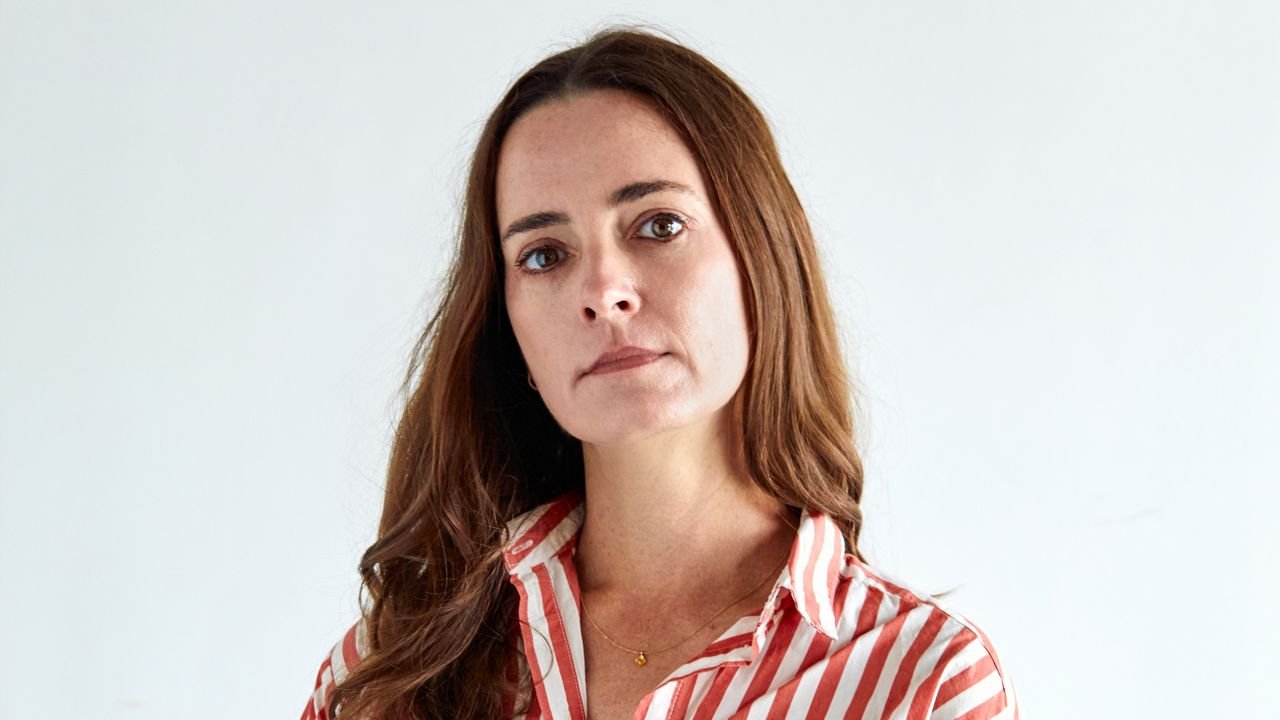
At the beginning of the pandemic, author Ellen O’Connell Whittet was preparing to publish her first book and give birth to her first child. By the time her memoir, What You Become in Flight, hit shelves that April, Whittet had told her entire life story—including her challenges with an eating disorder and a ballet career cut short—with no idea what lay ahead.
When Whittet experienced an act of obstetric violence during her already arduous labor, she knew that she would one day write about it. But, she realized, the story would perhaps be better told in a work of fiction. The result is Book of Hours, out today from Dzanc Books, in which Whittet weaves together the violence that she experiences at the hands of her doctor with her protagonist’s visions of canonized saints.
“I am very clearly not the person that I’m writing about,” she says. “But [that] I could give the experience to somebody that feels like justice.”
Here, Ellen O’Connell Whittet speaks to Vogue about how her Catholic upbringing informed her experiences with pregnancy, what it meant to fictionalize her own story, and finding new paths to justice outside of the law.
This conversation has been edited and condensed.
Vogue: When did you know that you were going to write about your birth experience? When did you feel ready to write about it?
Ellen O’Connell Whittet: I think I knew right away. Whenever anything big happens to you when you’re a writer, you’re like, “Well, I’m going to write about this somehow.” A complicating thing is that I was involved in this lawsuit against the OB after the baby was born, so I couldn’t talk about it while that was going on. I was aware that if we settled, there would be an NDA so that I could not talk about it afterwards.
We filed this claim as medical battery and sexual battery because the statute of limitations had already passed for just medical malpractice. We went through about two years of this lawsuit before the judge finally said this was actually medical malpractice. So the lawsuit was dismissed, which always makes me feel a little bit embarrassed. I don’t have that further validation from another institution, from the legal institution, that what I experienced happened or was bad enough to do anything about.
But my lawyer really quickly said, “The law is one avenue for justice, and there are a lot of other avenues for justice that maybe actually would be more satisfying to you. You’re a writer, and now you can write about it.” And when I think about what justice means in a delivery room, I think it means autonomy. It means listening to a patient. It means minimizing things that might feel upsetting or violent while a woman or birthing person is going through an incredibly intense, life-changing, physically altering circumstance that’s really scary. And so, in a way, that feels like justice. I think part of what made me know that I could write about this is that it would be another way to advocate for women.
