
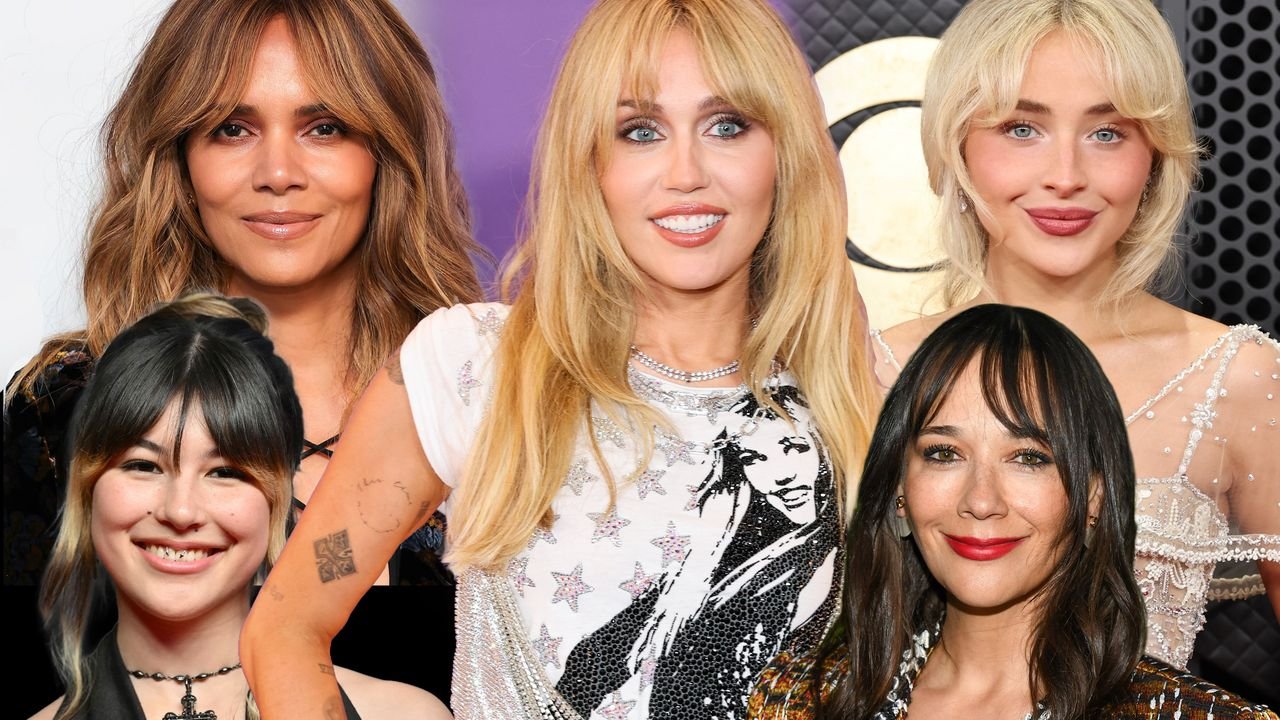
Once upon a time, there were Brigitte Bardot’s thick, piece-y bangs. Next came Farrah Fawcett’s angelic, flipped-out fringe. Then Sabrina Carpenter became the unofficial ambassador for curtain bangs with her signature, voluminous, face-framing style. Now, the classic look is ubiquitous on red carpets and social media. Stars like Nicole Kidman, Jodie Turner-Smith, and Chappell Roan have shown just how universally flattering curtain bangs can be, regardless of hair length or texture.
Curtain bangs have stood the test of time not only for their versatility but also for being surprisingly low-maintenance. Compared with other types of bangs, they don’t have the dreadfully noticeable, awkward, growing-out phase. They simply “curtain out from the middle” even more as they get longer, blending naturally into the rest of your hair, says Rubi Aguilar, a New York City hairstylist, who’s worked with Courtney Cox, Kaia Gerber, and Paloma Elsesser. Plus, they’re becoming softer, less meticulously styled, and more effortless than ever, according to British hairstylist Carl Bembridge.
Ahead, stylists explain exactly what qualifies as curtain bangs, how to achieve them based on your hair type, along with recommendations for which products to reach for to style your new look.
Meet the experts:
In this story:
What are curtain bangs?
Curtain bangs are a “long, face-framing fringe that typically hug around your brows,” explains Aguilar. They’re cut shorter in the middle and longer on the sides, with the longest parts hitting the top of the cheekbones, she adds. Depending on how they are cut, curtain bangs can enhance the natural symmetry of your face and complement other features, says Brian Christopher, a Los Angeles-based hairstylist.
Which face shapes and hair types work best with curtain bangs?
A major reason curtain bangs are so popular is that the look suits everyone, regardless of face shape, says Bronwen Robinson, a hairstylist at Suite Caroline in New York City. The right hairdresser will customize the length and shape to highlight your facial features in the most flattering way, taking into account your hair texture and growth patterns, Aguilar says. “The worst is a stylist who will talk you out of a style instead of educating you and finding a creative way to cut the style you’re excited about,” she adds.
If you have textured or curly hair, seeking a stylist skilled in dry cutting is essential for the most flattering curtain bangs. Curls tend to shrink as they dry, Christopher explains, so this technique helps gauge how they’ll fall. Cutting while they are dry also lets the stylist give each curl individual attention for the softest, most consistent curtain bangs, adds Los Angeles hairstylist Karen Arechiga.
Face-framing layers vs. curtain bangs: What’s the difference?
The difference lies in length and styling. “Curtain bangs are typically shorter, flare toward the ends, and are styled with a little more volume, especially at [the roots],” explains Lacy Redway, a New York City-based hairstylist and spokesperson for Unilever hair-care brands. “Face-framing layers are cut with an overall longer, gradual slope and can be styled with or without volume.”
