

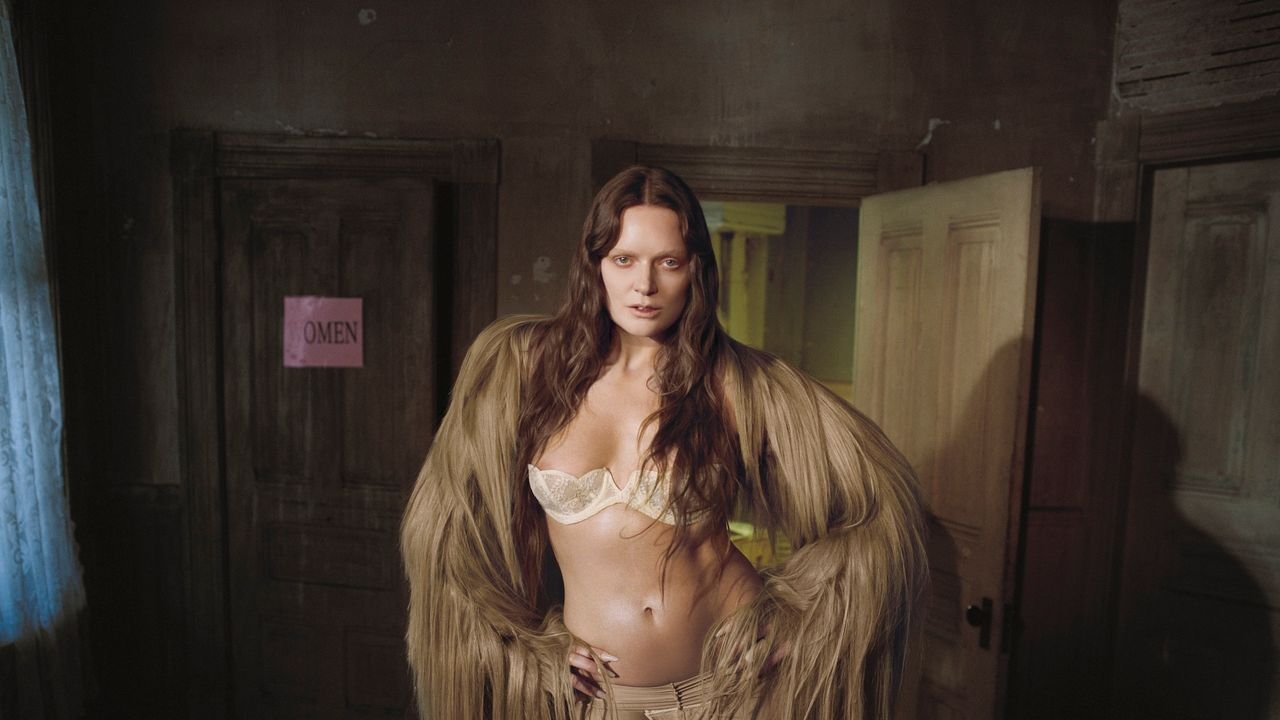
When I speak to Tove Lo, she has just landed in New York. She’s DJing a New York Fashion Week party before heading to Nashville, where she will begin preparing to get back onstage. It has, somehow, been almost three years since she finished touring Dirt Femme, and she has missed it more than she realized.
There is the discipline of it, she says: building a set with her band, training to do something extreme night after night. But there is also its opposite. “The unleashing you have to do of mind, body, soul, and voice is so powerful,” she tells me. When she finally returned to the rehearsal room, something clicked. “I was like, Oh wow, this is that thing…I need this to feel leveled.”
That tension of discipline and abandon, control and release is the right place to begin with Tove Lo—real name Ebba Tove Elsa Nilsson—who came to pop with her neon-glowing 2014 debut Queen of the Clouds, a heady, radical-feeling soundtrack for feeling both vulnerable and voracious on the dance floor—a genre in itself these days. Her sixth album Estrus, out today, represents a more mature inflection of honesty from the sad=girl-pop pioneer.
The word “estrus” refers to the period when a female mammal is in heat, and the album begins with an even neater mission statement: “I’ve got a lot of feelings but no solutions.” The four years separating Estrus and 2022’s Dirt Femme—her first album released independently—is the longest she’s ever taken between records; she deliberately resisted rolling immediately into the next phase of the album-tour-album cycle. “It was such a magical journey of doing it on my own terms,” she says. “It was a lot of work, but I felt energized by it. I felt like, I’m going to need a second before I even try to recreate whatever this was.”
She returned to the studio with Ludvig Söderberg, her longtime collaborator, at the end of 2024, and for a month, nothing worked. Lo panicked. “We couldn’t get a single song that felt right, and that has never happened to us,” she says. “Did I suddenly have nothing to say?”
The problem, she eventually realized, was that she was trying to write from the outside in: “I wrote from that place of how I wanted to be perceived and not from what I needed.” Söderberg told her to come back when she was ready, “to just be real.”
Six months later, she picked things up again in Sweden, staying at the summer house she has returned to since childhood. “I think I need to be somewhere that is more where I’ve been also not an artist, if that makes sense,” she says. LA is “kooky and dark and weird,” a place where she’s made some of her best, most anthemic music, but every version of herself has existed in Sweden: childhood summers, burnout, falling in love, breakups, grief. “It calms me, but it also brings everything up to the surface at once.”
Lo is now more than a decade into a career that began with the startling candor of mega hit songs like “Habits (Stay High)” and “Talking Body.” “If I had a song take off on that level again, I would actually handle it way better now. I could probably enjoy it way more,” she reflects. She has been famous long enough to have lived through several versions of the pop star people imagine her to be. Yet when she initially tried to account for that history—to ask herself who Tove Lo ought to be at this point—it stopped her writing altogether. “My strength actually lies in writing very unaware of how I’m being perceived,” she says. “I have to return to the girl in the bedroom, to whatever feeling is most urgent, embarrassing or inconvenient, and describe it before she has the chance to sanitize it. A lot of feelings that you’re not supposed to admit to, or aren’t meant to share in the public.”
