

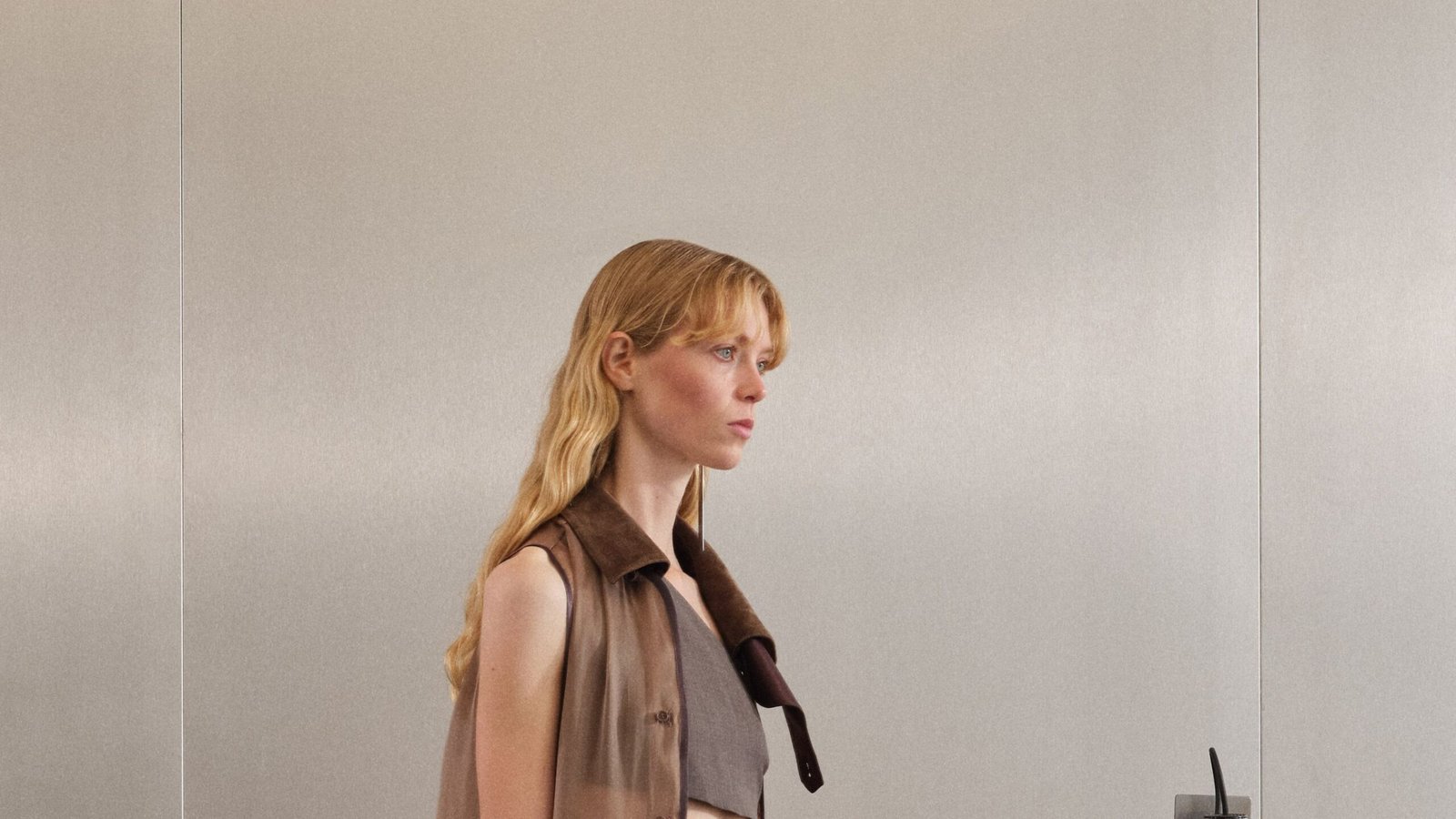
For Ilenia Durazzi, a collection extends beyond the clothes to include the people and creative exchanges around them. Her seasonless moodboard featured women whose personality and independence transcend time, as well as women who actually wear Durazzi: friends, artists, and members of her creative circle.
That community has a physical home at The Atrium, Durazzi’s Milan space, which this season became part exhibition, part studio, part residency. Artists occupied different corners, creating small autonomous worlds. Durazzi is less curator than host, allowing different languages to coexist and occasionally collide. The program will continue with exhibitions, a book fair, and other projects throughout the year.
It made for an apt setting for “Assemblage,” the collection’s title. The idea appeared in the clothes and in the prints, a new departure for the brand. In burgundy and icy tones, they took fragments from the artists’ environments while remaining entirely designed in-house. “We don’t use art as decoration,” Durazzi said. The clothes are meant to amplify the wearers, rather than turn them into a walking exhibition.
Her established codes—equestrian references, leather, tailoring, uniforms—were similarly lightened for summer. Fluid silk contrasted with exceptionally thin nappa; raw-edged eel skins created subtle relief; reworked silk mimicked leather texture without its weight. Tailoring was long and lean, with seams and construction left just visible enough. A gilet separated from a jacket; harnesses and straps detached and reappeared elsewhere.
A small men’s offering translated the same codes into softer tailoring, Texan boots, cut-outs, and two-tone treatments. The shirt-jacket, a recurring staple, captured a softened, relaxed approach to tailoring that can be worn loose, sleeves rolled, or reconfigured. It recalled an earlier Durazzi gesture in which jackets were secured with leather straps, an incidental detail that has gradually become a code.
If assemblage is ultimately about putting disparate things together, Durazzi’s proposition was less about accumulation than about controlled coexistence: different materials, disciplines, references and personalities sharing the same space without one overpowering the other. These clothes left room for the person wearing them, which may be their most sophisticated construction of all.
