

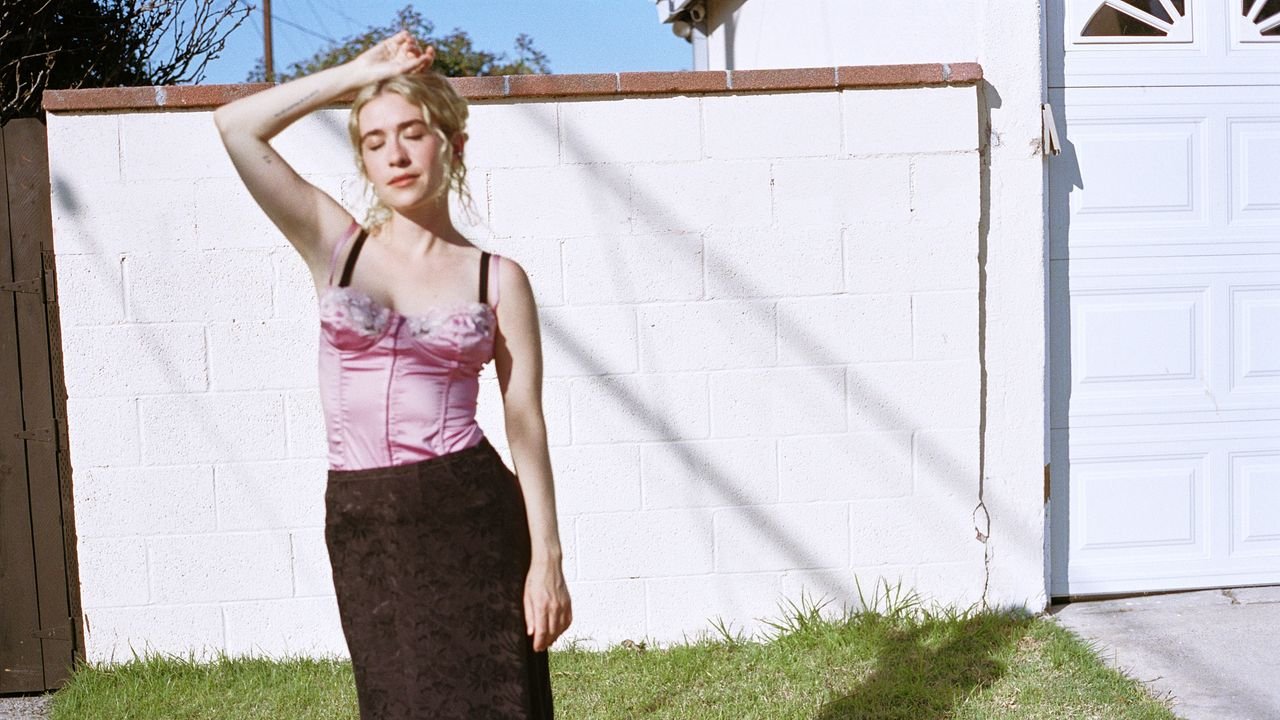
The body is a central motif and a tool she continues to grapple with. “My relationship to my voice is one of the most complicated things in my life,” she says. Teitelbaum sang constantly as a child and was praised for it enough that it got tangled up with her identity. “It was also kind of my life support when I was feeling bad,” there for her during intense personal loss, she says. The difficulty is that this particular instrument changes according to hormones, environment, weather, sleep, hydration, and, sometimes, for reasons beyond explanation. For someone who likes control, standing in front of a crowd with that degree of biological unpredictability can be unnerving.
So, she is consciously attempting to stop demanding perfection from it. “Recently I’ve been trying to see that unknown, that factor of so much unknown, as an exciting thing and a place for me to be able to connect to people,” Teitelbaum says. Instead of walking onstage thinking something could go wrong, she is trying to think: none of us knows exactly what is going to happen. That philosophy could describe Violins as a whole. Even Teitelbaum’s collaboration with Rothman, now three albums deep, thrives on knowing when and when not to surrender control. She generally arrives with her songs fully formed. He is one of the very few people permitted to question a lyric—and even then his success rate is questionable. When Rothman objected to the phrase “shrimp cocktail” in one song, Teitelbaum refused to budge. “I was like, ‘But that’s my order. I love shrimp cocktail.’ So I kept it.”
Outside the studio, she has been reading—Valley of the Dolls, Madonna in a Fur Coat, the Irish novel Sunburn—and deliberately getting herself away from screens. She drives to Malibu despite living nowhere near it, sees friends and family, journals, and tries to cook. “I’m a terrible cook,” she says. “I’m getting better.” She likes the simple physicality of it: working with her hands, doing something that exists away from the endless abstractions of a life online.
There is another transition approaching, too. Teitelbaum is 29 and nearing 30. “Turning 30, I think, comes with a lot for women, especially women in entertainment, and the value of you based on your body and how that value changes when you’re not in your 20s.” She has thought about it, she says, but it doesn’t weigh especially heavily.
Why would it? “I feel happier than I have ever been,” she says. “My life feels more stable than it has ever been.” Given the choice between youth and accumulating self-knowledge, there is no contest. “I would make the trade any day to continue to be 29, 30, 31, et cetera, and know myself more. I don’t ever want to be 22 again. Ever.”
In December, Blondshell will take Violins on tour, beginning in Amsterdam and finishing in Dublin—that city where one of its earliest songs first appeared. Teitelbaum has already begun introducing much of the record live, and she loves the peculiar alertness that comes before songs settle into muscle memory. “I’m enjoying this push to be super present,” she says.
