

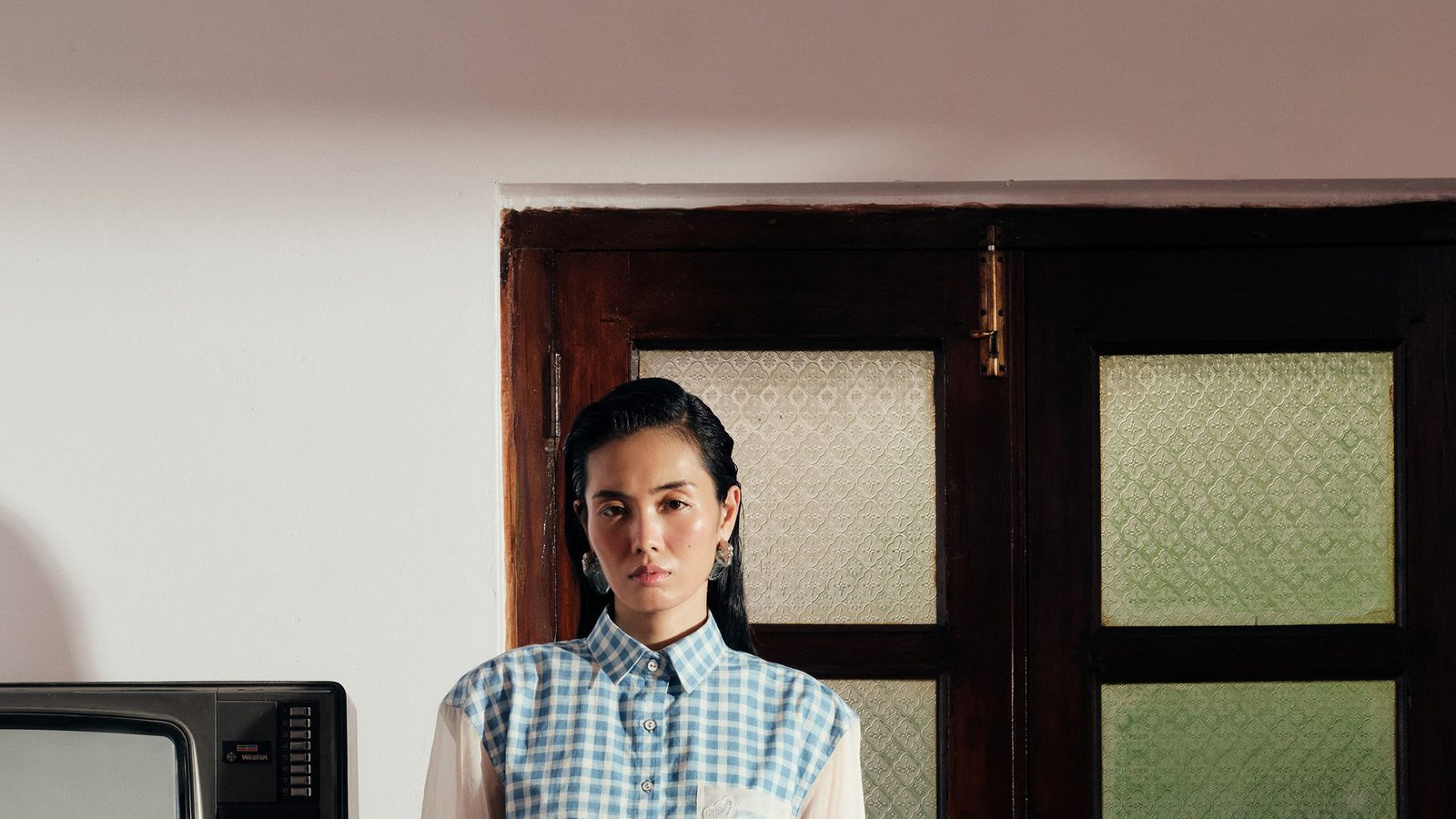
Rahul Mishra’s starting point for this season’s AFEW collection was a house: not a grand ancestral haveli, but the kind of Indian family home assembled over decades, where nothing quite matches and everything has a story. He was thinking about a generation raised away from India, for whom memory can arrive secondhand, in family photographs, a mother’s sari, a father’s oversized shirt, a crocheted television doily, a piece of furniture that somehow survived several homes. “A house can have as much personality as a person,” Mishra said.
For the collection, he imagined a young woman returning to such a house after years abroad. She doesn’t dress up as her mother, or attempt a retro revival. She simply carries a few things forward.That distinction gave the collection its charm: memory was there, but with no sentimental gloss.
Seventies and ’80s masculine tailoring came through in oversized shirts and wide trousers, while gingham, stripes and checks—familiar codes of domestic interiors—were shifted into bustiers, translucent layers and fluid separates. Black shirting took on a sensual edge; white cotton was given sculptural volume; pleats opened unexpectedly on the sides of a Kurta to reveal a printed landscape. Flowers appeared across shoulders, sleeves and sheer dresses, sometimes as three-dimensional appliqué, sometimes as if they had simply escaped from an old textile.
The most intriguing details were those that blurred the line between clothing and domestic memory. Lace and crochet recalled tablecloths, curtains and television covers, translated into delicate handwork. Embroidery was deliberately fragmentary, appearing in concentrated passages before fading into the garment, like recollection itself.
There was a point behind all this sentiment, too. Mishra is rather critical of contemporary interiors becoming a kind of global showroom, with the same furniture and objects recurring from Delhi to Dubai, London to New York. Earlier homes were accumulated rather than coordinated: a chair belonged to somebody, a cabinet came from somewhere, an embroidered textile carried the hand of its maker. “Nothing necessarily matched,” he observed, “yet together these things formed an identity.”
That imperfect accumulation translated well to AFEW. The clothes mixed tailoring with delicate craft, shorts with embroidery, transparency with flowers, and familiar silhouettes with unexpected interventions. As Mishra put it, the effect was “of the present,” distinctive, and handcrafted without turning precious.
