

Jacques Wei took over a 1928 villa designed by László Hudec, the Hungarian-Slovak architect behind some of the city’s most distinctive buildings. The neoclassical house, Hudec’s final work in Shanghai, had been abandoned long enough to acquire a certain romantic melancholy. Wei saw an opportunity. Digging into the past, he found, can be surprisingly good for the future.
Symbols and motifs drawn from the ancient crafts of Chaoshan found their way into a collection that Wei described as an ‘Oriental forest,’ filtered through what he called Sinic Fauvism. The foliage grew exuberantly, the colors ran riot, and traditional brocades played off sharp tailoring in a spirited exercise in contrasts. Working with artist Tang Haiqing, Wei transformed the villa’s rooms into different parts of a woman’s inner life, with paintings and vivid colors setting the scenes. It was part historic house, part imaginary boudoir, part deluxe botanical fantasy, where even gardening seemed to call for sky-high stilettos.
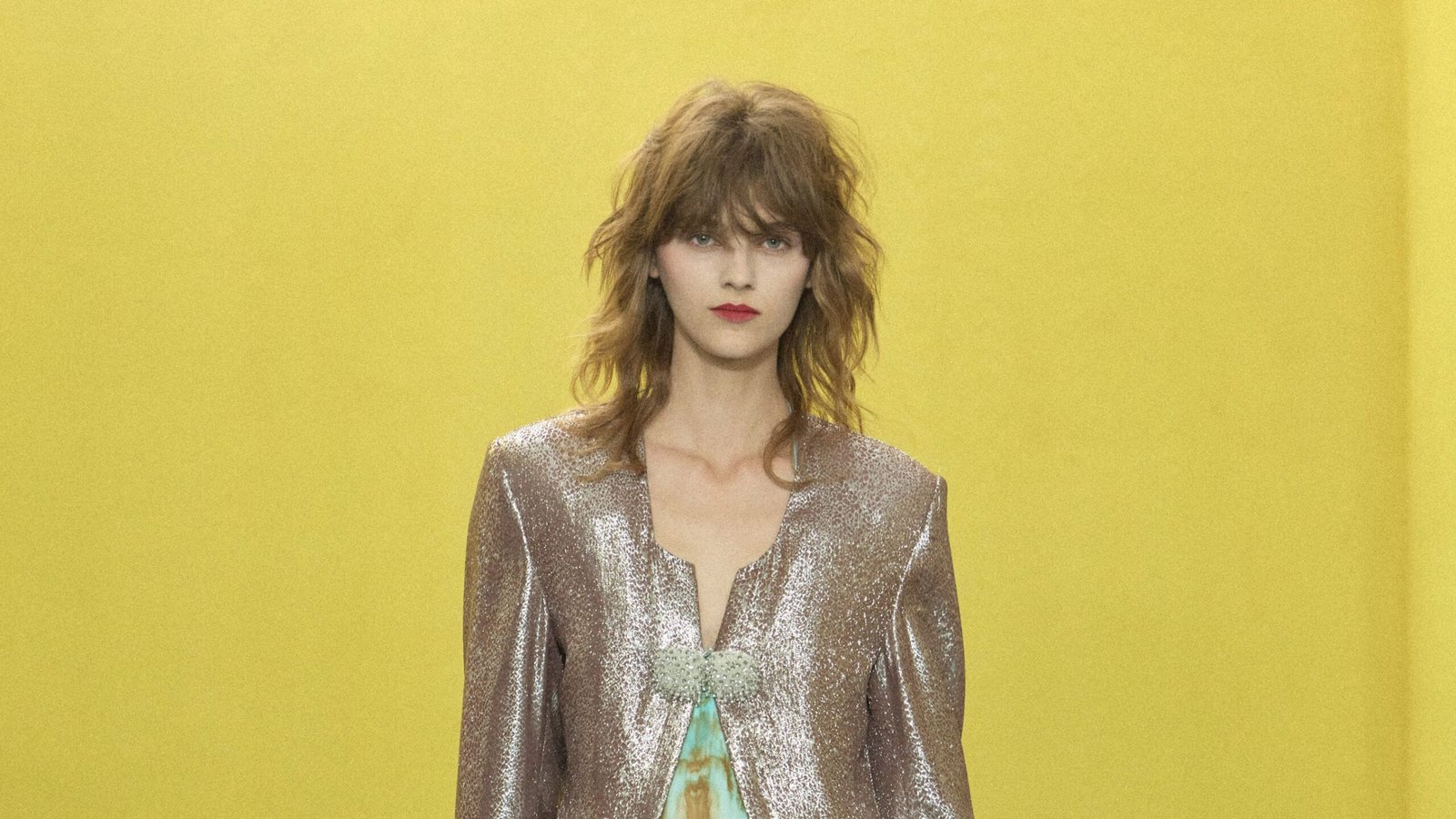
A full arsenal of glamour and seduction was on display, but without the heaviness that can make dressing up feel like a contractual obligation. Slender evening slip dresses were lavishly fringed with feathers, jackets had undulating hems and bejeweled buttons, and vinyl miniskirts were edged with lace. Silhouettes were sexy yet easy, with an artsy eccentricity that kept the diva from becoming a caricature of herself.
Wei wants his woman to feel as though she owns the place. In these surroundings, the fantasy seemed entirely reasonable. The villa’s faded grandeur only enlivened the designer’s appetite for color, ornament, and life. Wei has spent previous seasons searching for the clearest expression of his design identity. Here, he seemed to have found a more confident groove, allowing his Chinese heritage to jibe with today’s taste for theatrical dressing.
