

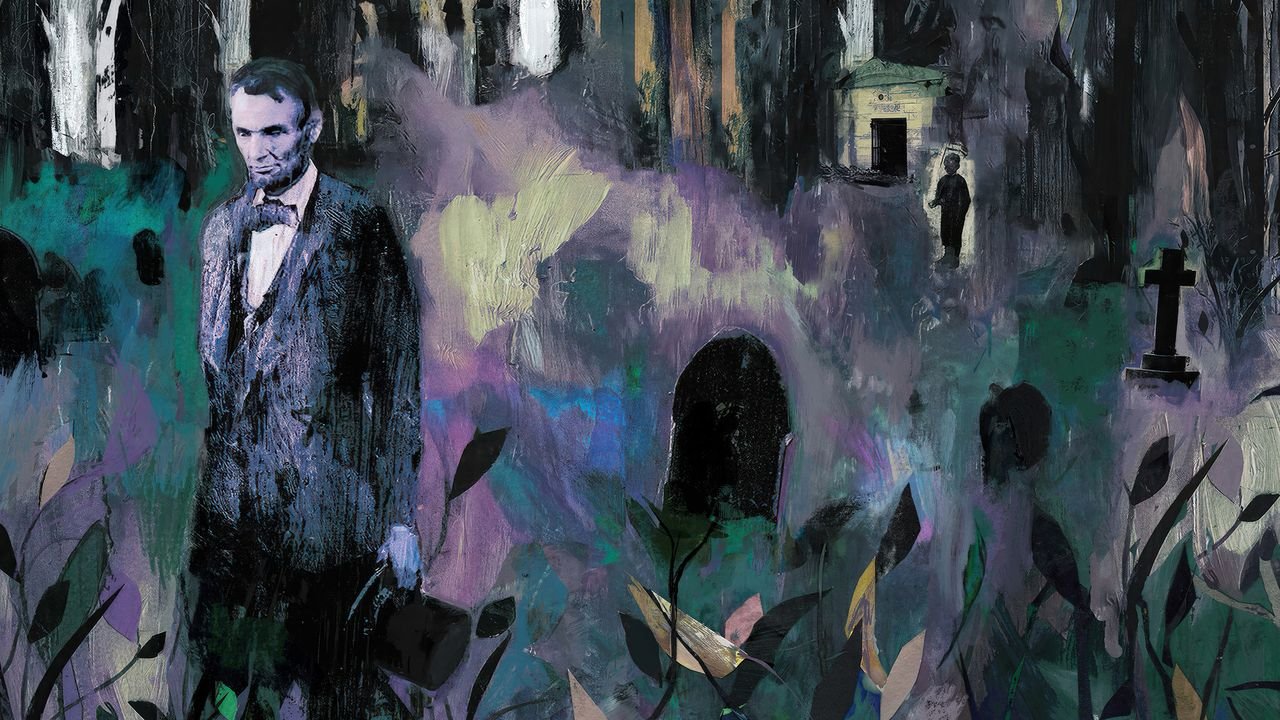
To many readers George Saunders’s Lincoln in the Bardo—a ghost story about Abraham Lincoln’s grief over the death of his young son—already felt operatic: the chorus of eclectic characters, the theatrical monologues. “The book started out as a play,” Saunders tells me of his 2017 novel. “You’re constantly bombarded with these voices. It naturally fit the stage.” So when the composer and pianist Missy Mazzoli reached out to the author for the rights to adapt it, she didn’t have to do much convincing. “It was basically me saying, ‘Oh yes, please,’ ” Saunders recalls.
The Metropolitan Opera’s production—which opens at Lincoln Center on October 19, with music by Mazzoli and a libretto by Royce Vavrek—has Peter Mattei as Lincoln and superstar countertenor Anthony Roth Costanzo in a featured role. The show also marks the first world premiere in the Met’s modern history of an opera composed by a woman. Mazzoli tells me that her work is shaped by a childhood spent watching MTV and listening to indie rock in the 1980s and ’90s. “The music videos in that era were so theatrical and over-the-top—they spoke to me as a young person about what I was feeling,” she says. “That’s always how I approach opera. People think of it as this elitist, inaccessible art form, but it doesn’t have to be that way.”
“The future of opera depends on stimulating new audiences,” says the Met’s general manager, Peter Gelb, “which is why we have been commissioning more new works than anyone else, in terms of big companies.” Under his tenure, the Met also commissioned, in 2021, its first Black composer, Terence Blanchard, and Gelb has sought out unconventional directors who might bring new perspectives. Opera, he explains, is “like Broadway on steroids.” Here, the Tony Award–nominated theater director Lileana Blain-Cruz will be directing. “My job was really to combine the density of George’s world with the musicality of Missy’s universe,” she tells me. For her, the heart of the piece is “that simultaneous deep loneliness, loss, being in a kind of purgatorial realm, and also this deep propensity for light and love and humor.”
Mazzoli, a certified death doula, tells me that much of her work is about “empathy and being able to sit beside someone. I essentially had to ‘doula’ all the characters, imagining what their preoccupations might be.” The music she created is sweeping and emotionally heightened, but also playful and often funny. (“Given that it was opera, I just wanted to make sure that it would be comic,” Saunders notes.) Characters will move amid a set that evokes a luminous, otherworldly landscape swathed in shades of purple, green, gold, rust, and blue, an eerily bright graveyard where strange things are bound to happen. Mazzoli says she wants viewers to contemplate their humanity and the state of the country when they attend the show. “I hope that people come out with more questions than answers, that it generates discussion about the role of presidents and the role of strong leaders.”
