

Grace Snell went from bondage to bum rolls with barely time to change. Fresh off Pillion, director Harry Lighton’s leather-clad biker romance, she was hired to dress Georgia Oakley’s Sense and Sensibility the day after her interview, with nine weeks to pull it off. It was also her first period film.
In case your Austen is a little rusty, Sense and Sensibility, Jane Austen’s first published novel, follows the Dashwood sisters after their father’s death leaves their family broke and banished to a modest cottage in Devonshire. Elinor (Daisy Edgar-Jones) is all sense, quietly carrying a torch for the reserved Edward Ferrars (George MacKay). Marianne (Esmé Creed-Miles) is all sensibility, falling hard for the dashing Willoughby (Frank Dillane) while the steadfast Colonel Brandon (Herbert Nordrum) pines patiently from the sidelines. Oakley directs from a script by novelist Diana Reid, following Ang Lee’s 1995 classic, which won Emma Thompson an Oscar for her screenplay and earned Kate Winslet her first Oscar nomination. The new version hits theaters this week, on October 16.
Snell felt the pressure. She’s a “big Jane Austen fan,” has read the novels, and grew up watching (and rewatching) Lee’s film, so she knows how protective Austen fans can be. “A lot of the fans have ownership over her work and a deep connection to it,” she tells TZR. Her solution was to tune it all out and design it “completely seriously, from my perspective.” The result is a Sense and Sensibility that looks almost nothing like the one in your head, and that’s on purpose.
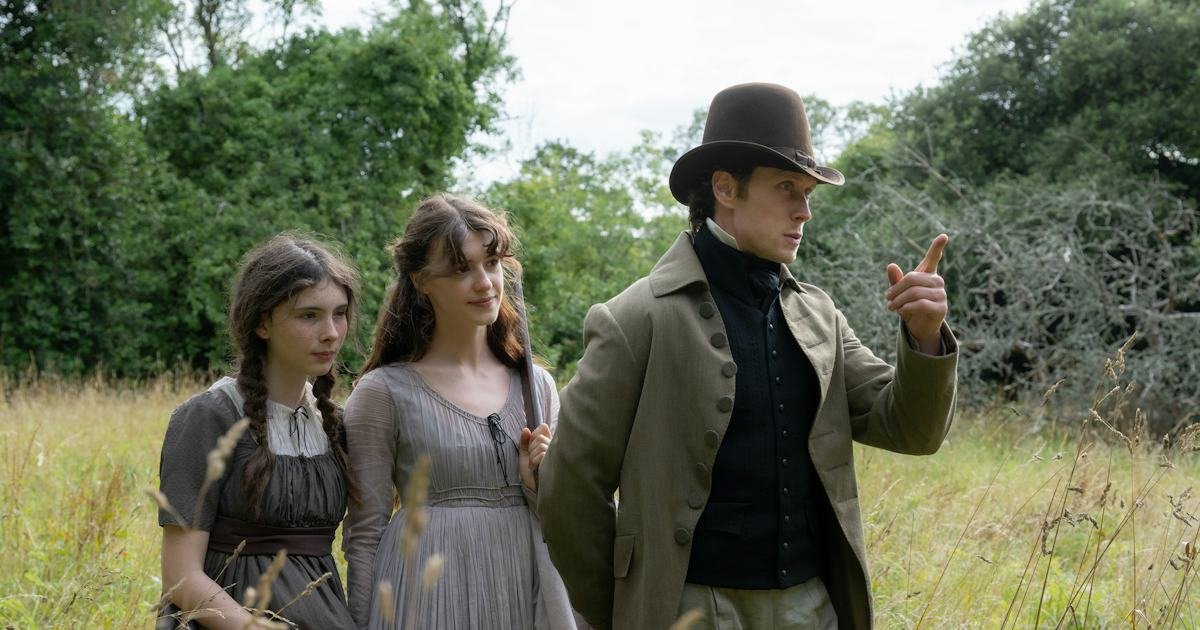
Oakley’s brief was mostly a list of what the film wasn’t: no bright colors, no capped sleeves, and minimal bonnets. The goal, Snell says, was “presenting Austen in a way we haven’t seen Austen before,” down to the disheveled hair, “dirty fingernails,” and dresses not quite done up properly. Oakley was especially interested in the social structures of the time — the working class and the newer, emerging middle class — which posed a costume problem. Most surviving Regency garments are pristine, kept by families who were rich and privileged enough to preserve them. “It’s the missing classes,” Snell says, “whose garments were worn to death and thrown away.”
The film is set in the late 1790s, the sartorially awkward stretch before the Regency column dress fully took over — a transitional period also referred to as the Late Georgian era. Snell brought on a dress historian to research the mourning period and social classes, while she dug through archives to examine garments herself. One in particular caught her eye because it was remade from existing fabric, a little 18th-century upcycling moment. Back then, fabric cost more than labor, so a dress would be restyled, resized for a sister, and worn until it fell apart. “That was quite interesting, the journey of clothing,” says Snell. “I started thinking about how the sisters would share clothes, and that was quite important for the ethos of the film.”
Courtesy of Focus Features / © 2026 FOCUS FEATURES LLC
The transition shows up in the underpinnings first. The matriarchs, Mrs. Jennings (Fiona Shaw) and Mrs. Dashwood (Caitríona Balfe), still wear tight, pointy 18th-century corsets, plus bum rolls, padded cushions worn at the back to create volume. But even as empire dresses began bringing waistlines higher, women kept the bum rolls anyway, causing them to ride up higher than the bum and form an odd silhouette. “There’s about five years in fashion history where this bizarre shape happens, where everything is high but bigger, and then it just completely drops to the column,” says Snell.
The sisters were each fitted for a corset, but Creed-Miles preferred to play the carefree Marianne without one, which Snell admits “isn’t necessarily historically accurate,” but felt right, especially when she was at home and in an intimate setting. On the opposite, Elinor stays laced throughout. “What’s incredible is the revolution that happens — women don’t need to be as bound at all,” says Snell. “Someone once said to me that the Regency revolution, that silhouette, is akin to the miniskirt in the 1960s, and how drastic that was. Everyone was in these column dresses and lost their crazy corsets.”
Snell decided to balance all the historical accuracy with a modern feel by pulling styling references from ‘80s and ‘90s catwalks. The Comme des Garçons 1994 Metamorphosis collection, with its boiled-wool jackets over big skirts, became her touchstone. “That is Sense and Sensibility. It’s tailoring with dresses, so that was really inspiring to me,” she says. Romeo Gigli’s hitched-up skirts for Callaghan made the moodboard, as did Galliano’s Fallen Angels show, where models walked in soaking-wet clothes, useful for a heroine like Marianne, who spends much of the film in the rain. “With Austen, we often imagine everyone pristinely put together, so I like things to sometimes not quite work, and to look self-styled, or that they don’t quite go, or they’ve made mistakes,” she says. “Everything doesn’t need to look completely perfect.”
Beyond their silhouettes, color sets the Dashwood sisters apart, and the head-versus-heart divide is literally dyed in. Marianne’s dresses are a pale, sunny yellow, dyed with elderflowers, while Elinor’s are lavender, dyed with logwood. “I like the fact that Elinor was dyed with wood and Marianne was dyed with flowers,” says Snell. “I think that’s kind of sense and sensibility for me.” The two colors sit opposite on the color wheel, and complement each other.
Marianne dresses like a romantic, and Snell imagined her heroine as Lady Emma Hamilton, or even Marie Antoinette cosplaying her cottage life at the Hameau de la Reine. She also gave her an eclectic taste for “vintage,” which in the 1790s meant the 1760s and ‘70s. In one scene, she wears a bonnet lined with golden fabric that casts warm light on her face, but when heartbreak hits, she stops caring what she wears. On the other hand, Elinor’s clothing is defined by “lots of tailoring and precise decisions.” Snell thought a lot about how the two sisters were balanced onscreen. “Often you’ll see Marianne being the light and Elinor being the dark, sort of optimism and pessimism. I considered them as yin and yang, almost — these two halves of what they will hopefully give to each other.”
Courtesy of Focus Features / © 2026 FOCUS FEATURES LLC
And the sisters do. By the end of the film, they’ve rubbed off on each other, in both temperament and wardrobe. In the final scenes, when Marianne talks with Brandon, she’s wearing one of Elinor’s dresses, with her own frilly scarf on top. “It’s a nod to her, but she’s still doing it her way,” says Snell. Elinor, meanwhile, runs after Edward, undone, her waistcoat open, dress muddy, scarf loose, hair falling down. “She’s freer, she’s given in to her sensibility, and she’s following her emotions for the first time.”
The sisters aren’t the only ones dressed to match, or clash. When Edward visits Mrs. Jennings’ house, and Elinor asks why he’s tormenting her, they’re both in blue. Snell wanted Edward to feel blue without being “too corny,” but didn’t plan for Elinor to match. “I was like, ‘Oh, fuck, they’re having a really horrible conversation, and they’re both in blue.’” She chalks it up to a combination of good prep and subconscious planning, since they wanted the pair’s palettes to feel like they “really do belong together.”
Marianne and Willoughby, by contrast, share a “kind of magpie eye” and like things to look a bit more expressive. “There needed to be this invisible thread between the two, so that they look like a couple you’d meet at a festival or something, and you’d be like, ‘Oh yeah, of course, those two are going to end up together and have this affair that’s not going to last.’” For the hop scene, he wears a burnt-red moleskin jacket, and she wears a big pink bow — a color clash Snell loves. At the ball where he breaks her heart, his waistcoat is studded with tiny sequins, the “flourishes” Snell gave to his wardrobe to show his attraction. Beside him, his fiancée, Miss Grey, wears a hand-painted 17th-century Chinese silk gown, made to look “extremely expensive” next to Marianne’s simpler, Grecian (and Galliano)-inspired dress.
She’s read the social media comments where people have complained that the costumes are all gray or “too dark,” but that was intentional. This is a family in mourning that has lost its money, so they save color for when it counts, like the hop, which is “so much color and joy.” But maybe the critics would come around if they knew where those colors came from.
Marianne and Elinor’s elderflower and logwood-dyed dresses weren’t a one-off. Every color in the film actually came from natural sources, including gallnuts, madder root, and rust and iron for darker shades. The taffeta in Elinor’s standout bonnet, which she wears in the gallery scene and which also appeared in Vogue, was dyed with walnuts. For Snell, using naturally-sourced dyes is personal. She studied it at university, and has kept it up as a hobby ever since. “I think it’s fascinating as a way to keep us connected with our past and our history and what we used before to get our color,” she explains. “Color is really, really important, and I like to use it in a controlled way.”
Working with natural dyes felt very powerful for Snell. “It does feel like alchemy,” she says. “It does feel like magic.” And so did the set. With a woman directing, writing, and producing, and a cast of mainly women, Snell felt “this understanding, this kind of language that you share.” At one point, her whole team synced up, literally. “I think there was a point where we were all on our periods. It’s like, this is brilliant,” she laughs. Her first period film, in every sense.
(Stay Up To Date)
Become A Style Insider
Join The Zoe Report’s exclusive email list for the latest trends, shopping guides, celebrity style, and more.
