

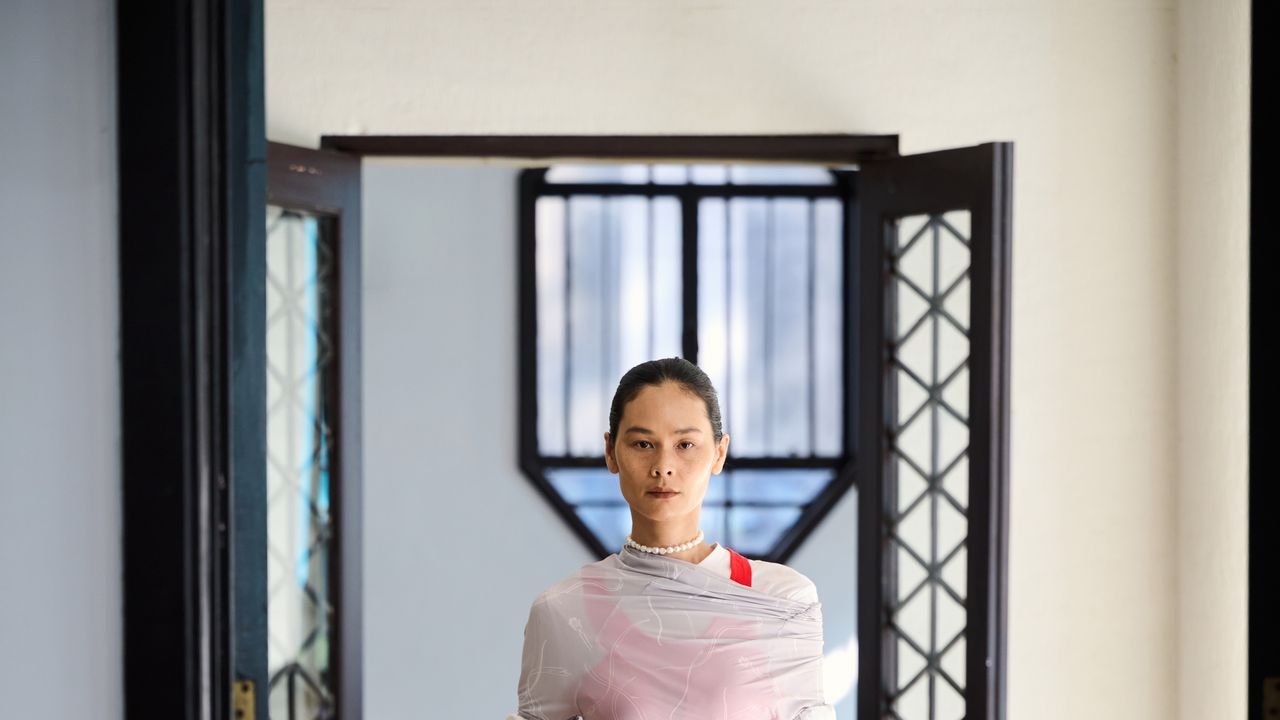
That momentum is not accidental. Since 2015, Shanghai Fashion Week has been developing an ecosystem that brings together presentations, showrooms, and business opportunities, explained Landon Du, SWF Projects Director. The main venue generally requires designers to have at least two years of experience, with applications assessed by a committee comprising industry professionals, media, showroom owners, and buyers. Labelhood, by contrast, offers a more open platform for emerging names.
Showing a collection is hardly an inexpensive exercise. Production, models, styling, lighting, and public relations all have to be paid for, and sponsorship rarely covers the entire bill. Many of the designers on the calendar have therefore already established retail businesses in China, with some reaching multibrand stores internationally.
What makes this particularly interesting is that the business infrastructure supports creative independence. Liu pointed to China’s production capabilities and developed e-commerce channels as advantages that allow young labels to reach consumers without first having to build an elaborate international distribution network. Designers can grow through online sales and multibrand retail before opening their own stores. In other markets, that journey can be considerably more arduous.
The commercial awareness does not, however, mean that the clothes are merely an exercise in consumer appeasement. One of the most compelling developments, according to both Liu and Du, is the growing engagement with Chinese heritage, craftsmanship, and traditional techniques. Designers are looking beyond familiar cultural references to explore processes preserved by families and communities, including traditional dyeing and embroidery. The challenge is to bring these practices into the present without turning them into museum pieces.
Liu cited Kinyan Lam, which works with traditional dyeing techniques from rural areas in southwestern China, and Samuel Gui Yang, whose work approaches Chinese aesthetics with a contemporary sensibility. For Abbie, the appeal lies in the way craftsmanship is integrated into clothes that can actually be worn. He spoke of designers devoting months to intricate embroidery, sometimes at a level comparable to couture, while creating pieces intended for everyday life. The distinction matters: these are not necessarily precious objects designed to be admired from a safe distance, but expressions of craft that remain accessible to younger customers.
