

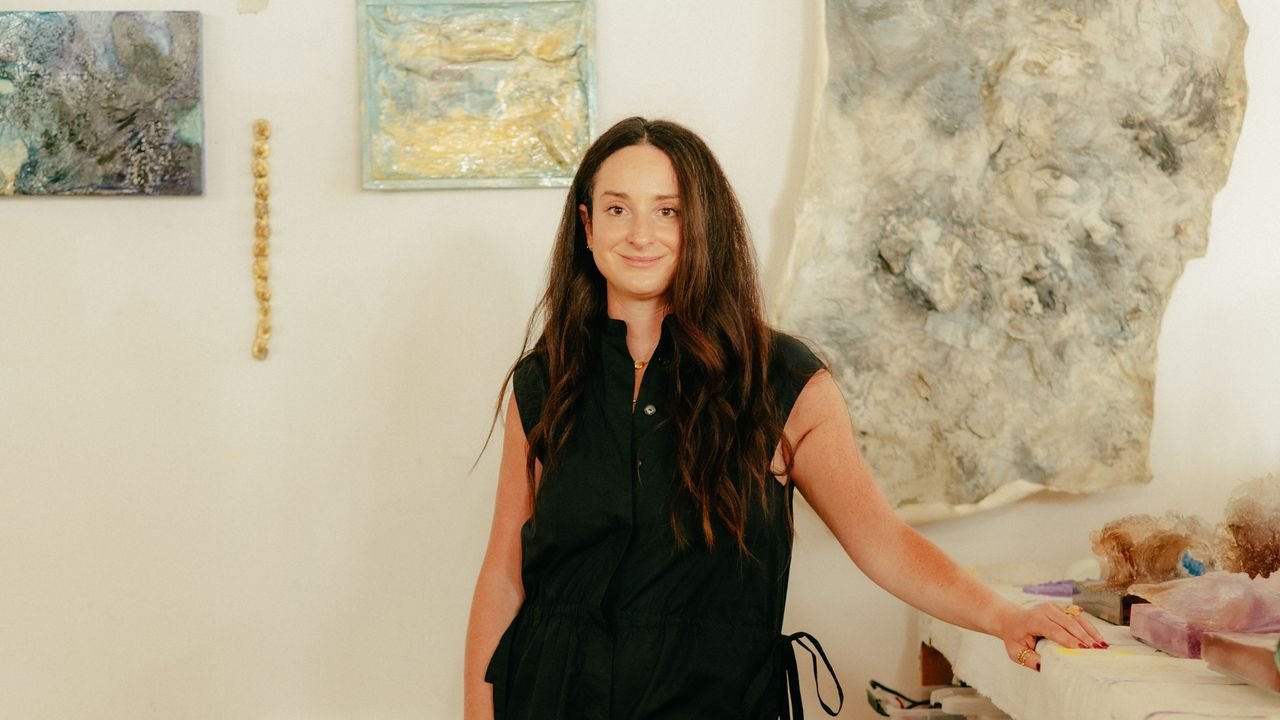
The show, which variously brings to mind the celestial sculptures of Lee Bontecou and the arresting imagery of Louise Bourgeois, has two components: wall works made from copper alloy, granite, and black marble that borrow the aesthetics of early cave drawings to depict volcanic maps and tectonic plates; and glass sculptures centered on the ancient Judean date palm, a once-extinct tree scientists were able to regenerate from nearly 2,000-year-old seeds, and the Joshua Tree, which is threatened by climate change.
Photo: Timothy O’Connell
Saget has a broader interest in legacy and inheritance. As the daughter of the late actor Bob Saget, she inherited not just a famous last name, but also the example from an early age of what it looks like to be an artist. Now, almost five years after his death, a documentary about him is in the works. “He was a true artist,” she says. “He was like jazz, just like this constant creation. Being surrounded by that has made it seem very normal to be constantly creating.”
In 2019, she traveled to India for the first time, spending a month in a small village at Art Ichol, a residency for artists working in bronze and stone. Saget has gone back almost every year since to make her work, which involves a 6,000-year-old process called “lost-wax casting.” She works with a team to carve into stone and use wax to make a print of its surface. She then builds a mold around the wax and stone, and constructs a kind of sweat lodge out of bricks and mud to steam out the wax, leaving a cavity for molten metal to be poured in. Every step of the process is manual.
Saget has had a lifelong interest in spirituality, but it wasn’t until the last decade, when she found the Path of Soul Transcendence, that she began to pursue it more seriously. “Honestly, my whole life, I was looking for something,” she says. “The experience of the path is really surrendering to the spirit that I am, that everybody is, and the reality that everything is one.”
It’s an idea essential to her practice, which is rooted in how materials interact with each other. “I just had the sense that when heat breaks everything down, it’s all ultimately one,” Saget says. “The center of the earth, or how volcanoes are also obsidian rock, and how all these materials are basically everything. It seems like it’s totally separate, but when it’s heated, it reveals it’s not.”
