
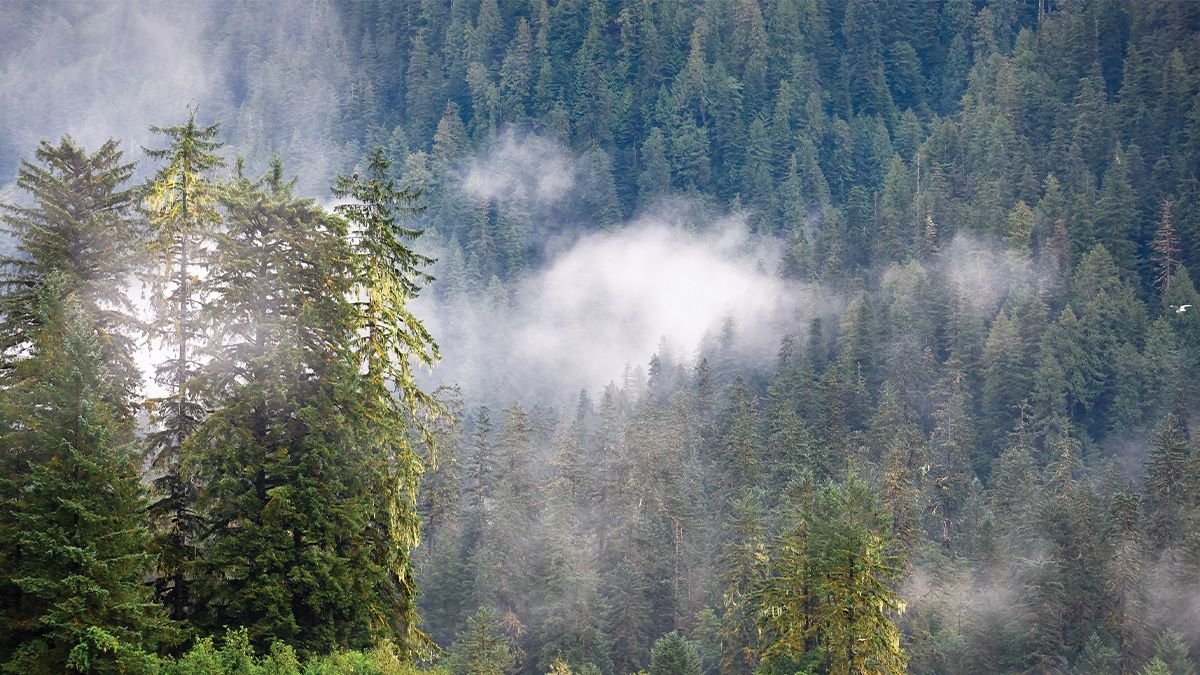
Now, thanks to fashion brands joining anti-logging campaigners at a crucial moment, 85% of it is legally protected from deforestation and logging, the First Nations whose territories overlap with it are co-decision makers in its conservation, and there is a $120 million fund helping them transition to conservation-based economies. This is a rare example of fashion rallying around nature restoration and using its purchasing power for good, in partnership with other industries. Experts say it’s a blueprint the industry could apply elsewhere.
This “seismic” win took decades to achieve, says Nicole Rycroft, founder and executive director of non-profit Canopy, which works to conserve ancient and endangered forests around the world. While anti-logging efforts in the Great Bear Rainforest pre-date Canopy, the non-profit joined the campaign at a critical junction, leveraging fashion industry partners including H&M and Zara, to secure the groundbreaking land use agreement when momentum was slowing. “Canopy was one of several organizations that started working with international corporate customers of forest products coming out of that region to send a very clear signal that we don’t want to be sourcing from clear cuts of massive, ecologically critical, temperate rainforests, and we don’t want to be sourcing from spirit bear habitat,” she explains.
A decade on, Vogue Business invited Rycroft to reflect on what the Great Bear Rainforest can teach fashion about nature conservation, and using its purchasing power for good.
Logging happens at the beginning of the supply chain, several steps upstream from where brand traceability programs tend to stop. With such a complex, sprawling supply chain, and such a small number of brands on the hook to comply with traceability regulations, few brands have visibility beyond Tier 1 (garment manufacturing) or Tier 2 (fabric production). Logging would come under Tier 4. That’s why meaningful action starts with traceability, says Rycroft, so brands can understand where their deforestation risks are.
But brands don’t need a direct link to deforestation to make a difference in conservation campaigns. “Even if it’s not a direct or immediate sourcing link, the adjacency is really relevant,” says Rycroft. “Brands are still seen as important even if they’re not existing customers, because there is the potential for them to be future customers.”
