

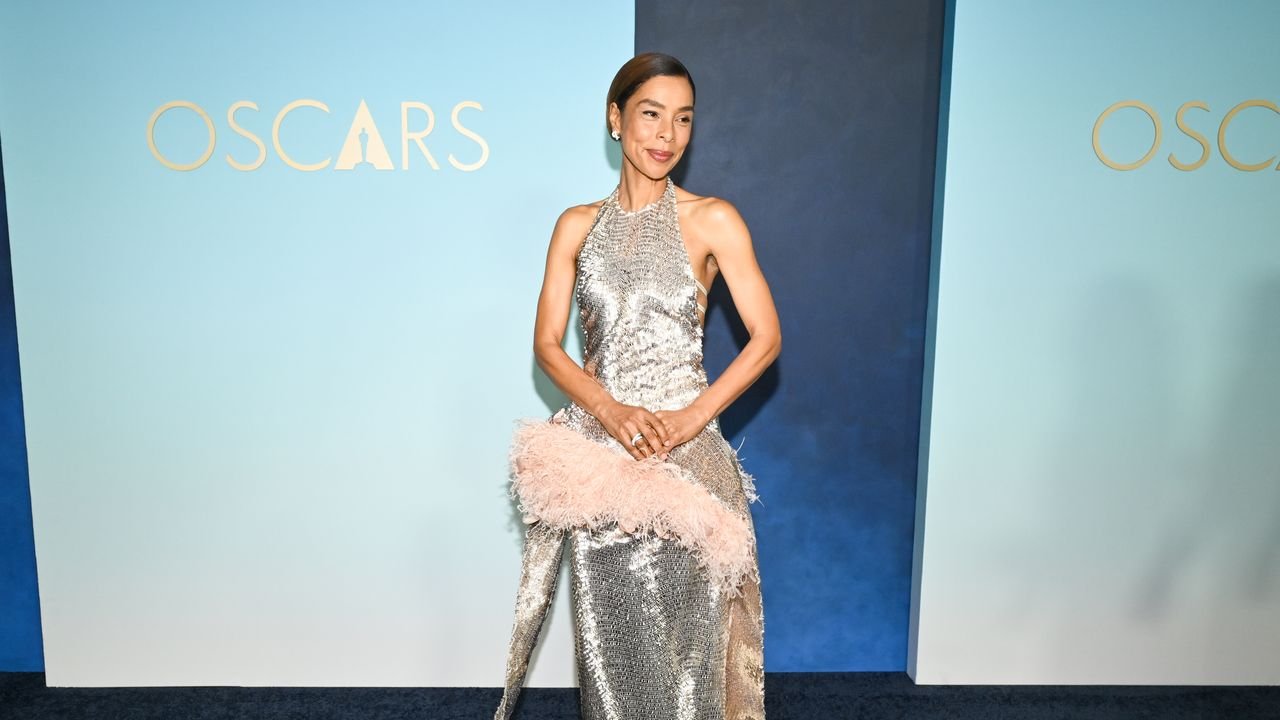
Mouse, out now, is a coming-of-age story set in 2002 Arkansas, in which the teenage Minnie (Katherine Mallen Kupferer) develops a complicated relationship with her best friend’s mother (Okonedo) after an unexpected tragedy. Meanwhile, Clarissa—in limited theaters December 18—transposes Virginia Woolf’s novel Mrs. Dalloway to contemporary Nigeria, a project that brought Okonedo to a country she hadn’t visited in two decades. (Her late father, whom she was mostly estranged from, moved back to his home country when she was young.)
Filming in Lagos proved consequential in ways that extended well beyond the work itself. “The journey I had in Lagos was so immense, personally and professionally, that I remember thinking on the wrap day that even if nothing else happens with this film, I’ve already gotten everything I wanted,” she tells Vogue.
Both films were made on tiny budgets, and as Okonedo points out, a conversation about one inevitably opens up a conversation about the other. So we talked about both.
Vogue: Let’s start with Mouse. How did it come to you? What was it about your character, Helen, or about the directors that made you say yes?
Sophie Okonedo: I didn’t read anything about them. I read the script completely cold. By the time I got to the end, I rang my agent and said, “I’m absolutely doing this. I don’t know who’s directing, I don’t know what’s happening with the film, but I’m doing it.” So he sent me their last film, Ghostlight. It’s such a brilliant film, and it was made for pennies. These are two really interesting filmmakers who are talking about America in a way I haven’t seen—very quietly. There are no explosions, no big movie stars, and it’s deeply significant. Kelly’s writing is subtle and real. But films like this can slip by without anyone noticing. I have to galvanize everyone and get them behind it because I think it’s so good.
