
Wells: With Breakthroughs, I thought, You know what? This could be a really good designation for products that are in a whole different category. That was, to me, the pinnacle, if you had a breakthrough product. It could be something that was simple, like a mascara wand made from plastic rather than nylon to remove clumps, or more complicated, like Living Proof having MIT scientists figure out a solution to common hair issues. [Editor’s note: Cover Girl Lash Exact Mascara won in 2006 and Living Proof’s No Frizz range won in 2008.]
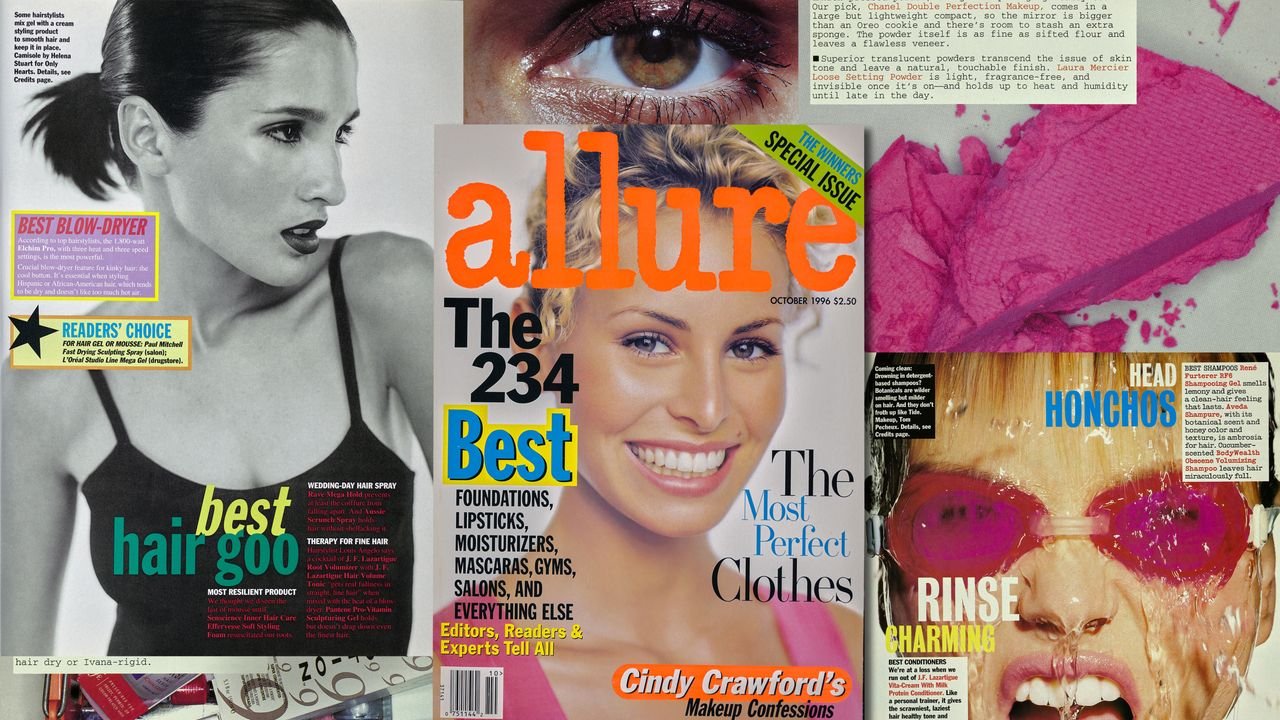
Perrotta: Around the same time, in 2007, we decided to split Best of Beauty and Readers’ Choice into two issues, because there was so much information now that we had Breakthroughs as well.
Wells: Readers’ Choice had always been part of the Best of Beauty Awards. We sent out questionnaires to readers, and they were open-ended.
Tung: I remember those ballots, I think I wrote one at some point.
Wells: It was interesting to have our choices and the readers’ choices juxtaposed in the first couple of issues, but then I thought, There’s enough to have each of those stand on their own. I also thought that our readers are experts in their own right. I mean, they know a lot, and so I felt like it was fair to have their expertise be held up and revered and not just footnoted.
Berger: When you think about the creator economy and tapping into your audience and your customer, we did that very early on.
Perrotta: After Breakthroughs, Readers’ Choice was a breeze; except at one point we realized that some companies—the ones that use direct selling [Editor’s note: multi-level marketing]—were getting the people who worked for them to flood the ballots. We wondered why these brands were sweeping every single category, so we ran through all the data, and it turned out that they were creating new email accounts and voting many times. So one year we were very late with getting the Readers’ Choice winners done and in the layouts because it took so long to weed through and find out who the real votes were.
Wells: As we went along, we added more product-specific categories. When beauty products became so expensive—enormously expensive skin-care products, designer lipsticks—we decided, “Well, as editors it’s easy for us to love a really expensive product because we’re not paying for it.” So we added the Splurge category, recognizing that some people could pay for that, but a lot of people can’t. Then we also added the Steals category, because it’s always great to be able to go to the drugstore and buy something that’s really good.
When we started, there was no such thing as a category of “serums.” There were no “essences.” There was a moment where there were anti-aging products, and then that category was renamed and recast. Then you look at the hair-care category and how that has become so enormous, with scalp care and all that. It’s really interesting, because the beauty business was so much smaller when we started than it is now, and you can track that through Best of Beauty.
