
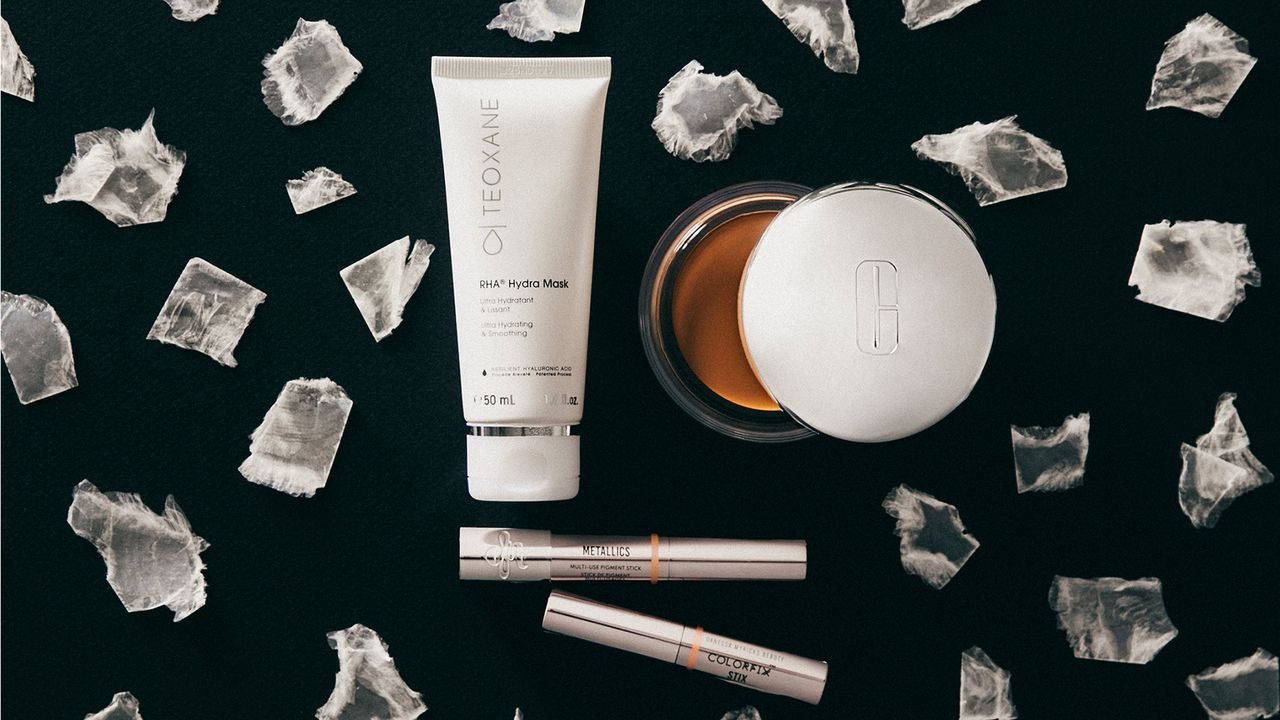
Getting a high level of hydration while maintaining a light and elegant feel, though, required the addition of glycol and glycerin, which, again, can both feel tacky on the skin. (Peslerbe had eliminated the idea of lipids, which can feel oily or heavy, because she wanted a light, transparent gel.) “To incorporate a very high percentage of glycol [specifically], which could be a sticky, heavy molecule, we had to fine-tune the perfect percentage with other ingredients,” says Peslerbe. The sweet spot was about 15% glycol, balanced out by the refreshing, crisp feel of a menthol derivative called menthyl lactate, which in turn was balanced out by soothing aloe. (Invigorating menthol derivatives can be hard for skin to tolerate at times, though Dobos notes menthyl lactate is one of the gentler options.)
Okay, so now we have glycol, glycerin, the free-floating hyaluronic acid in Teoxane’s RHA, plus other sugar-derived, water-capturing molecules to treat skin to moisture that would not rinse away. Would they play well together? Eventually, yes. “We tried 30 formulations over eight months,” says Peslerbe. In clinical testing of the final formula, participants had a 20% improvement in hydration 30 minutes after rinsing off the mask, and an 8% increase a full eight hours later. (Those measurements were taken using an instrument called a corneometer.) “It delivers on its promise of a deep quench after a relatively quick 10-minute home treatment,” says Dr. Geraghty. “I absolutely agree that it reduces roughness, dullness, dryness, and tightness, something that can be difficult to achieve for rinse-off masks that are left on the skin for a relatively short time.” Making good on its long-lasting claims with clinical testing is a notable point of difference in and of itself, says Dr. Geraghty, because “so many other over-the-counter [skin-care] products don’t conduct or release any research at all.”
The combination of RHA’s hyaluronic acids with the humectants in Teoxane RHA Hydra Mask makes this “more interesting than a standard hydrating mask because it doesn’t rely on generic humectants alone,” says Dr. Gohara. “The crosslinked and non-crosslinked hyaluronic acid combination creates both immediate hydration and a structured water-retaining film, for better smoothing, more durable hydration, and stronger support for barrier function than a typical ‘wet blanket’ mask that just floods skin with glycerin and washes away.” Teoxane’s mask can also help make skin look younger with all that newfound moisture. “It’s great for softening, smoothing, and plumping skin—especially in crinkly or thin-skinned areas, like around the eyes,” explains Dr. Geraghty, and it can help reduce the look of crepiness.
“It has a very nice texture, virtually no smell, and was gentle on my eczema-prone skin,” says Allure’s managing editor Alessandra Foresto. “It’s clear, so you can run out and get coffee while you’re wearing it, and I could definitely put makeup on right after rinsing it off.” Dobos likes using the mask in place of moisturizer, especially when she wants a bare canvas for makeup. “This is a smart formulation design: a rinse‑off mask that performs more like a leave‑on treatment, but doesn’t interfere with sunscreen or makeup,” she says. The ingredients themselves may not be new, but pairing them with Teoxane’s RHA—and achieving eight hours of hydration with a light formula—makes this a more luxurious treatment than other masks Dobos has seen.
Best Breakthroughs
Preservé by Motiva
Breast augmentation has ranked as the second most-frequently performed plastic surgery procedure (behind liposuction) for three years running, according to annual data collected by the American Society of Plastic Surgeons. And now many of the country’s most well-respected surgeons are adding an entirely new surgical technique to their breast augmentation repertoire. Preservé by Motiva enables surgeons to preserve (hence the name) more of a patient’s natural breast anatomy while placing implants. In most cases, patients don’t need general anesthesia as they do with other breast augmentation surgeries. It’s most often done under mild sedation, like what you’d have while getting your wisdom teeth removed, says Troy Pittman, MD, a board-certified plastic surgeon in Washington, DC, and New York City. (Dr. Pittman is a Preservé procedure trainer for Motiva and serves on the company’s advisory board.)
