

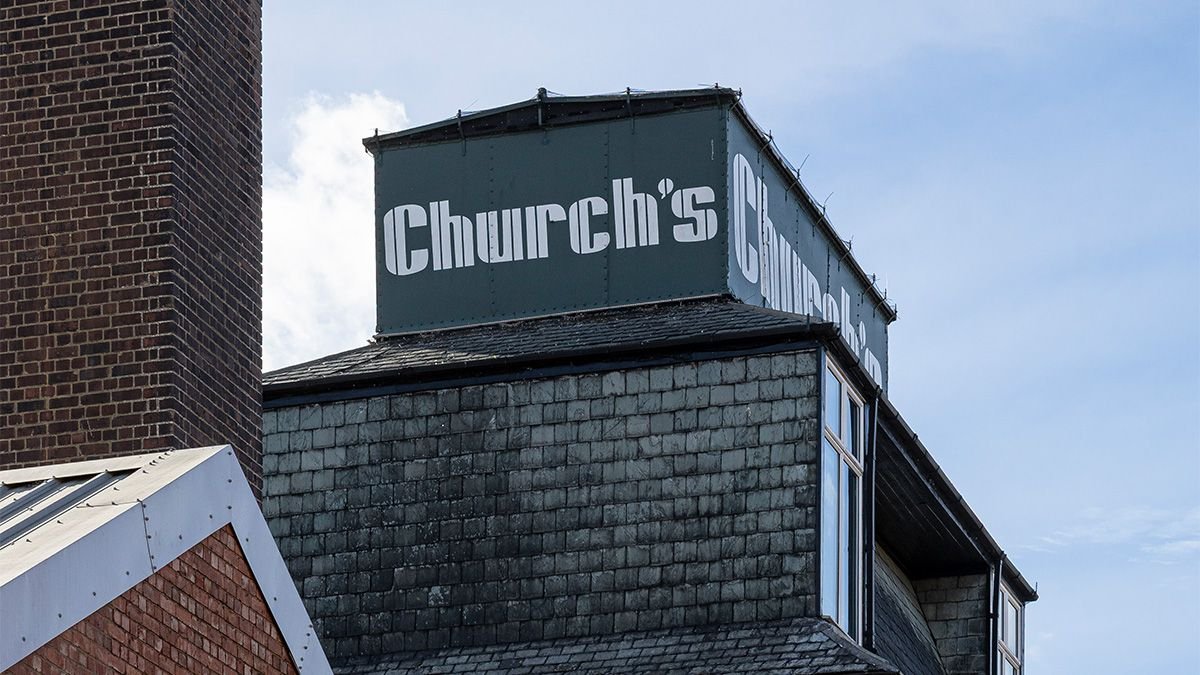
Church’s currently employs 137 people in manufacture at its St James Road factory, where production still moves through the sequence of specialist rooms established by the Church family: clicking (cutting), closing, lasting, making, finishing and polishing. During our tour, which is attended by editors from Italy, Japan, and the US, we dive deep into the technicalities of traditional English shoemaking as “Boogie Shoes” by KC and the Sunshine Band plays over the factory tannoy.
One former apprentice, now full-time, is installed at her station applying color by hand to shoes from Church’s apogee line, the Crown collection: she stands out both for her casual mastery of the spray gun and the finery of her full punk look. Upstairs in the archive Simon Hill shows shoes she has engraved and decorated. Apprentices are encouraged to experiment, Hill says, because that creative freedom develops skills that can later feed back into production.
Manzatto points to the Crown and Royal collections, whose shoes can take 12 weeks and more than 320 processes to complete, as proof that clients will pay for exceptional workmanship when its value is properly communicated. “If you come out with exceptional products, and of course, if you’re able to share with your clients what it takes to create these products… there is no price resistance.”
Yet Manzatto emphasizes that his strategy is not to turn Church’s into a fashion brand dependent on constant novelty. “The vast majority of our sales come from continuity products,” Manzatto says. Seasonal product remains important, but the perennial offer drives the business “by a large extent”. Manzatto says many of its newest customers come specifically to buy the iconic Goodyear-welted shoes for which Church’s is best known.
Alongside the vintage machines on the factory floor are new screens recording workflow that bear the Prada Group logo. Following Church’s partial integration into Prada Group’s wider processes, Manzatto says it can now “look to scale up again”. He identifies womenswear as one area of opportunity and suggests that North America is likely to be the first major focus from 2027. “We aim to do more and better of the same,” he says, “to become even more established, even more recognized, even more iconic, even more English.”
