

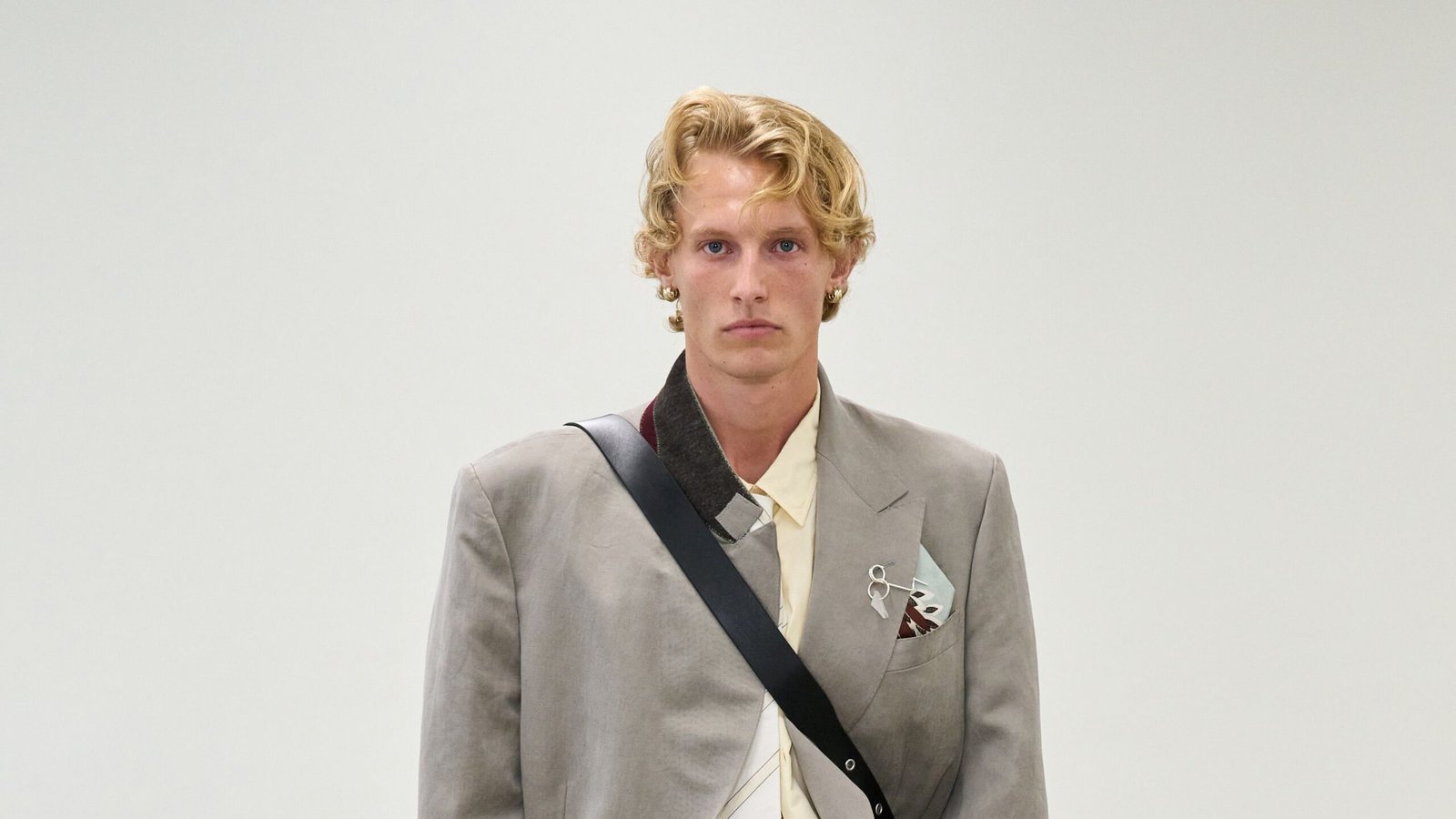
Not so long ago, suits were quotidian, the vernacular of masculine dress. “But now it’s, ‘Oh, suits.’ Even people are called ‘suits.’ It’s the CEO or whatever, it’s heavy. But it used to be so normal to wear a suit. My father never didn’t wear one; my grandfather too.” As Paul Smith said this backstage, he reached into his (suit) jacket and extracted a sheaf of black-and-white photographs. They showed Smith himself, aged perhaps six, paddling in the waters of a very British-looking beach. He wore a romper-style swimsuit and stood knock-kneed, with an expression of mild terror, beside his fully suited, tied and hatted grandfather, who had somehow managed to roll his trousers up to mid-thigh and was pointing theatrically toward the horizon.
Today’s show was full of snapshots drawn from Smith’s past. Look 19’s utility shirt in soft, washed silky cotton was the refreshed facsimile of a lemon cotton original from spring 1996. Look 21’s high notch lapel, three-button jacket was reincarnated from spring 1990. The brown suede and black leather field jacket in Looks 18 and 28 respectively was transported from fall 1999. The ties, as well as some of the clothes (including the show-highlight matching trench and shirt with striped shorts and slouchy buckled leather slippers in Look 17) were fashioned in fabrics revived in Como from vintage Smith tie designs.
The pebbles on our seats and pinned knick-knacks worn by the models pointed to the beachcomber approach of designers Sam Cotton and Helen Holmes as they drifted through Smith’s archive for inspiration. If a majority of the suiting, outerwear and knitwear was archive-inspired, today’s design team had also carefully restored, reimagined and re-articulated it. The tailoring—a symphony of putty—was rendered in precisely textured and overwhelmingly airy fabrics: Panama, mouliné, seersucker and a Scottish-made tropical weight wool. Further quirky Smith-ian details included green glass eyes used as buttons on the sleeves of the mock-crock jackets (first made for David Bowie in 1982). “It’s about personality,” Smith said of this excellent and highly characterful collection.
