

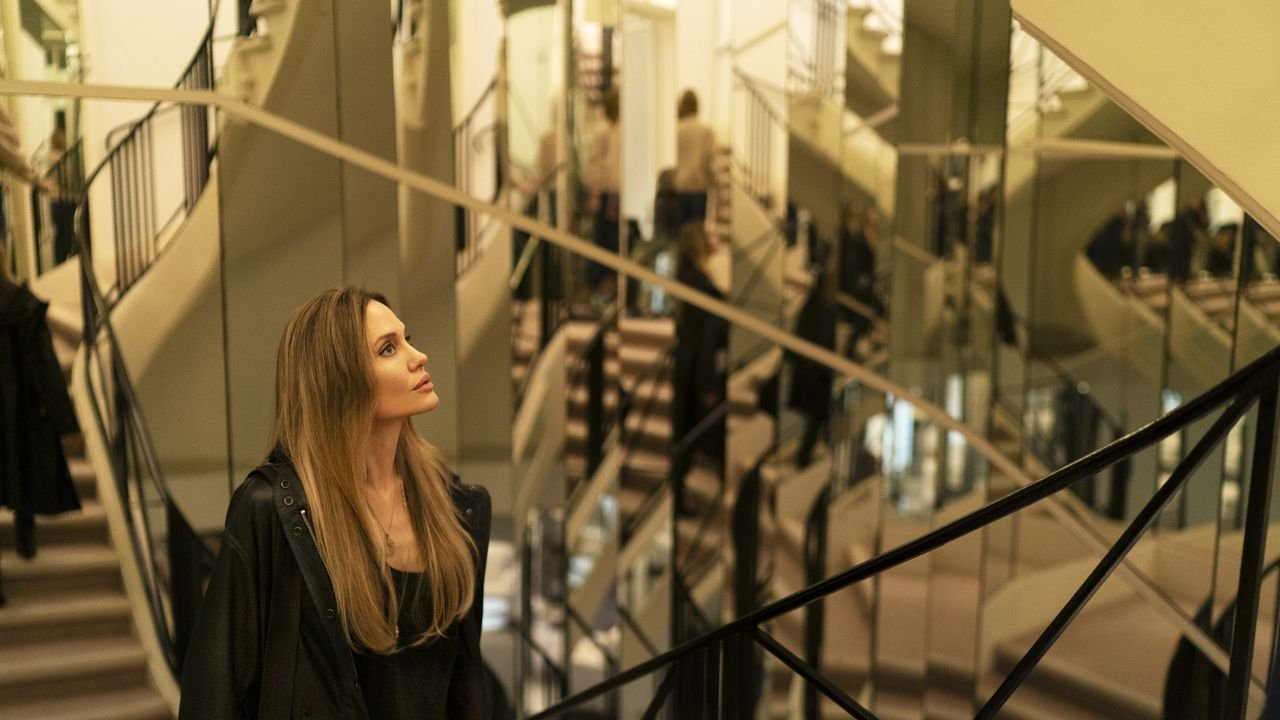
Early on in Couture, the fictional fashion film starring Angelina Jolie, there is a moment when a finished gown is met with applause from the atelier that constructed it. It’s the kind of small, private ceremony that most of us will never witness, and it’s also why director Alice Winocour spent a year and a half embedding herself backstage at shows during Paris Fashion Week before writing her script. In doing so, she was able to observe the women behind the scenes who are rarely the subjects of attention themselves.
That instinct—to turn the camera away from the runway and toward the workroom—is the subversive heart of Couture, in theaters Friday. The movie follows a bit of a meta narrative: Jolie plays Maxine Walker, an American director making a fashion film who receives a breast cancer diagnosis mid-shoot. The film effectively takes its structure from the craft it canonizes, creating a portrait of an artist through the women with whom she interacts. Jolie’s own mother, Marcheline Bertrand, passed in 2007 from ovarian and breast cancer; in 2013 the actor had a preventive double mastectomy after testing positive for the “faulty” BRCA1 gene.
It would have been simple, Winocour notes, to tell this as her own story, as the film is loosely drawn from her experience with illness. But her choice, she says, was a political one: to present identity as fragmented, and to find power in the many roles women are asked to play. “I had the feeling of doing a dress, following the threads of these different lives and the detours [life takes],” says Winocour. “And I wanted to show what’s behind the perfect images of fashion—the life of workers.”
Couture is the first narrative film ever shot inside Chanel’s haute couture atelier, and that access—not to mention the permission to erase every logo—grounds the film, unexpectedly, in a communal act of creation. Winocour found herself drawing parallels between the surgeon’s marker tracing pre-operative lines on a body and the chalk lines pinned across a mannequin. “I felt this in the atelier, that there is so much concentration, it’s so constant, it’s almost like surgeons at work,” explains Winocour. The comparison lands because Winocour treats both crafts as a kind of devotion to something that won’t last. “It was, to me, this idea of the fragility of life, which is the center of the movie.”
Photo: Couture
