

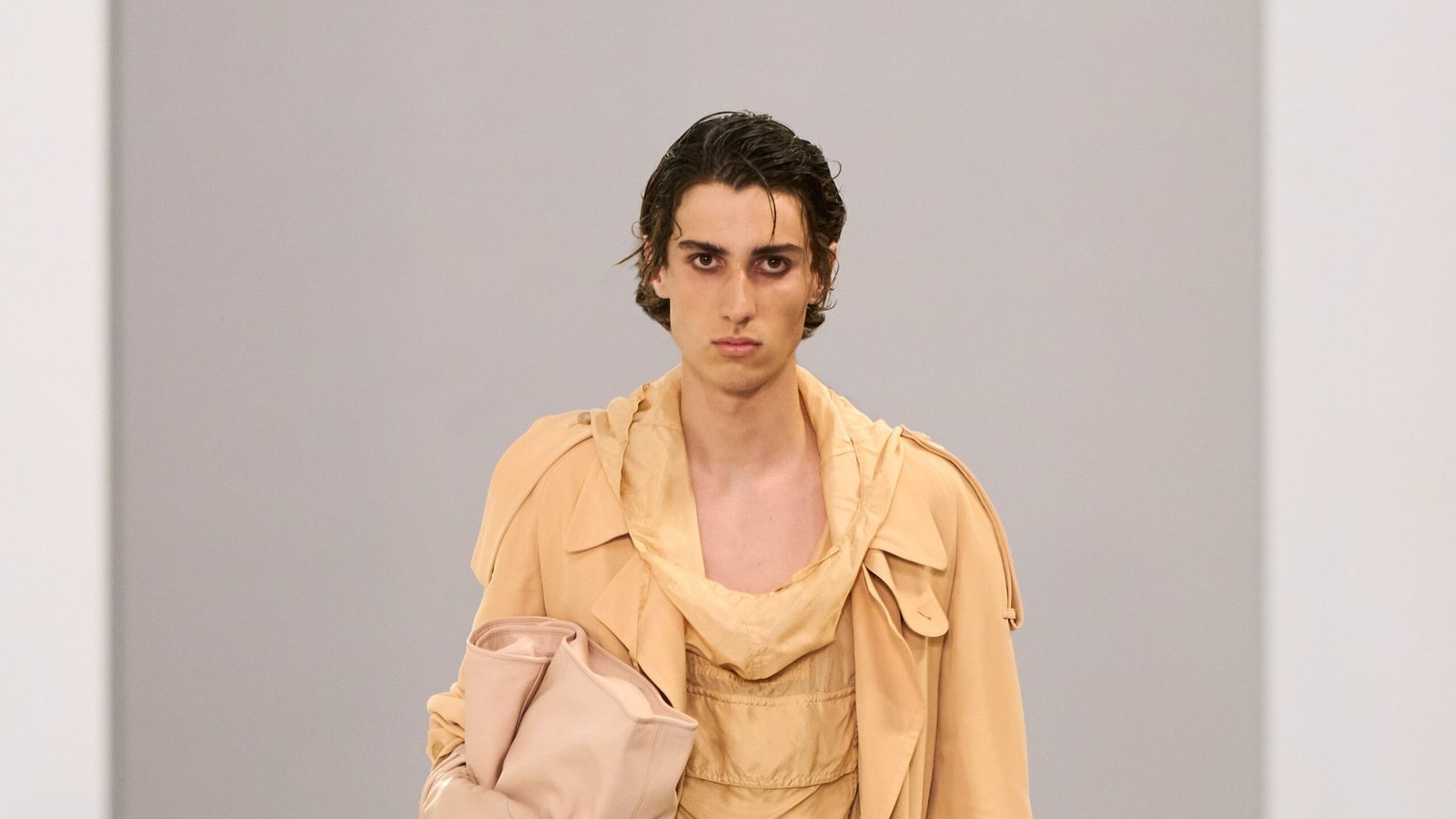
Fluttering barely-there layers. Washes of pale color. Silk cargo pants with an easy, airy volume. Unlined duster coats flying over wrinkled crepe semi-sheer shirts and short shorts. A whole variety of lightweight parkas to sling on top.
Julian Klausner was one designer for whom the scorching heat of Paris turned out to work totally in his favor. His lyrical, utterly lightweight collection for Dries Van Noten—his third menswear show since he’s stepped up as creative director—was entrancing to behold even in the 100-degree heat. And somewhat because of it: how on Earth to dress to withstand a summer climate apocalypse is a matter troubling everyone.
Klausner’s solution was imagined from his reading of Stéphane Mallarmé’s “L’Apres Midi d’Une Faune,” a poe, he said was lying around Van Noten’s studio in Antwerp. Very quickly he and his team were thinking about the tale of a half-human, half-animal waking from a dream in a forest; and Debussy’s music inspired by it, and Nijinsky’s choreography of it for the Ballets Russes. “We started the season with the desire, the wish to do something that feels light, that feels delicate.”
At a moment when many menswear designers have been talking about softening things up and making things with a more gentle attitude, Klausner has an advantage: he comes from the womenswear side of Van Noten. At first, his lack of experience in menswear intimidated him a bit. “I approached it kind of on tip-toes, not knowing exactly what I was able to do, or how it would feel in the first season,” he remembered. “But In a way, I benefited from a sort of freedom. I had nothing to lose, I just thought, try it out. I worked with the men’s team, who had been my colleagues, but I had never really worked with them. It’s new, it’s kind of the same game, with slightly different rules, different toys. We had fun with it.”
The transference from womenswear into menswear showed up all over. “We looked at the world of lingerie, thinking what lingerie can mean to menswear, and that informed a lot of the fabrication.” The idea of embroidered camisoles for men grew from the gauzy pailletted and embroidered camisoles at the beginning to the daring idea of backless chiffon halters and, finally, a DVN printed scarf, tied on the body with ribbon straps.
With wisps of feather blowing in their hair, Klausner’s models embodied the mythic-nature theme of the show, and its underlying erotic and queer romanticism. At one point, a model clutched a leopard spot bag with a single leopard-spotted gloved hand. Forest prints and jacquard patterns grew on coats. Sky prints covered utility parkas. On the feet of some wore pink ballet shoes.
The Van Noten brand’s reputation for color and print is in very good hands with Klausner. At a time when a feminized, more daring exploration of expressive fashion is filtering into menswear, this show resonated beautifully.
