

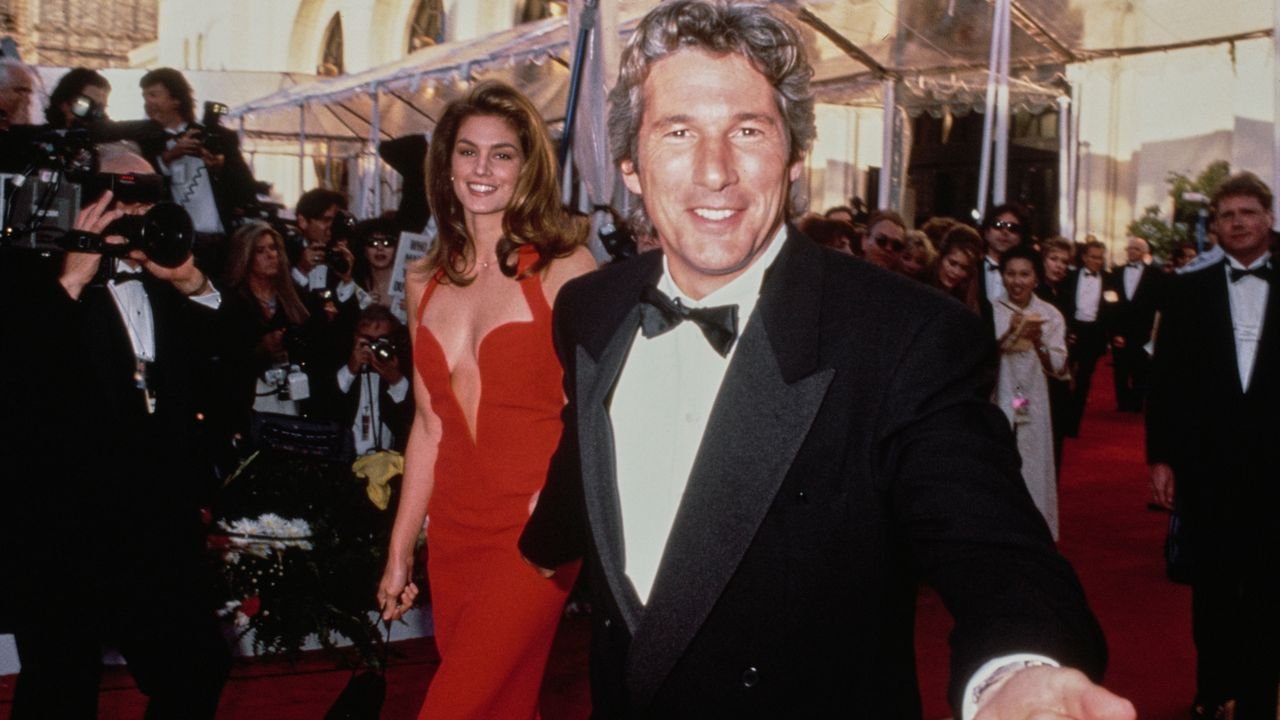
In honor of Vogue’s September 2026 cover, featuring The Shards co-stars Kaia Gerber and Homer Gere, we’ve reached back into the archives to resurface a very special cover story from 1992. Yes, we’re referring to the one in which Richard Gere and Cindy Crawford—then a year into their marriage—talked about life and work as two halves of a true ’90s power couple. And, needless to say, the joint profile is very much of its time. The (first) Bushes were still in office, though not for much longer; Crawford was anchoring an MTV talk show; and Brooke Shields and Debra Winger are referenced in the most dated ways imaginable. (There’s also a Magic Johnson cameo!)
Of course, Crawford has now been married to Kaia’s father, Rande Gerber, since 1998, while Gere was married to Homer’s mother, Carey Lowell, from 2002 to 2016 before marrying his current wife, Alejandra Silva, nearly a decade ago. So, all’s well that ends well—but indulge us in a bit of ’90s nostalgia and revisit the full story below.
“The Model and the Movie Star,” by Julia Reed, was originally published in the November 1992 issue of Vogue.
For more of the best from Vogue’s archive, sign up for our Nostalgia newsletter here.
It is Monday morning, Labor Day, in Los Angeles and no one—certainly no one famous—is working except for a small mob crammed into a tiny room on the fourth floor of Maison Sofitel where Cindy Crawford, supermodel, rising television star, and wife of Richard Gere, is being made up. She is being made up on Labor Day in Los Angeles because she is about to tape a segment of MTV’s House of Style, a wildly successful, six-times-a-year, half-hour show that has made Cindy the network’s most popular personality, prompted MTV comedian Denis Leary to demand the creation of—tongue-in-cheek—C (Cindy) TV, and motivated her to seriously consider giving up modeling for broadcasting. The segment is being rushed into production so that it can air on Wednesday, the day of the MTV Awards, at which Cindy will be a presenter and a preshow commentator. Her producer, Alisa Bellettini, is very wound up. Cindy’s blood sugar drops after five, Bellettini explains officiously—and “entre nous,” of course. There are lots of interviews to tape; we must all stick with the program. The subject is the paparazzi, and the interviews include one with the Los Angeles bureau chief of the National Enquirer, which has just published paparazzi shots (taken with a long lens from a boat) of Vogue’s own photo shoot of Cindy and Richard on the beach.
Cindy, who is not wound up at all, is concentrating on choosing a look that will send the right signal to the National Enquirer. She knows that even though she’s doing the interview, the tabloid will use the opportunity to put her on its cover. First she is handed a pinstriped Ralph Lauren suit, very businesslike. Then comes a ruffled purple chiffon Anna Sui blouse. “Brilliant!” shrieks the mob in the hotel room. “Too Elvis,” Cindy says and takes it off. Much discussion about blouses ensues: what about the Armani linen, does anyone have a plain white T-shirt? Finally, she goes with an extremely low-key Brooks Brothers blue-and-white stripe belonging to Bellettini, who also offers “some very fabulous YSL cuff links.” “No, thank you,” says Cindy, who rolls up her sleeves instead. “That’s more me.” The hair, too, announces Syd the Hairdresser, will get “the smooth professional look.” It is pointed out that Brenda Starr always had glamorous hair. “Yeah,” says Cindy, “and look what that role did for Brooke Shields’s career.”
If there is one thing that Cindy Crawford is in absolute control of, it is her career. At twenty-six she has made no Brooke Shields-like miscalculations, and she won’t. In addition to having appeared in almost every major fashion magazine in the world and hosting her own MTV show, she has a five-year, $7 million contract with Revlon, her own exercise video that, she says, “takes Jane Fonda further,” and an enormously successful pin-up pose calendar from which half of her proceeds go to research and to help the families of patients with leukemia, the disease that killed her brother when they were growing up in De Kalb, Illinois. She and her mother pick up the check together, and “Mom decides where to spend the money.” One year they bought beds so that parents could sleep in their children’s hospital rooms because “Mom remembered what it was like to sleep in a chair.” I tell her that’s wonderful, and she agrees: “That kind of calendar has totally broadened my audience.”
