

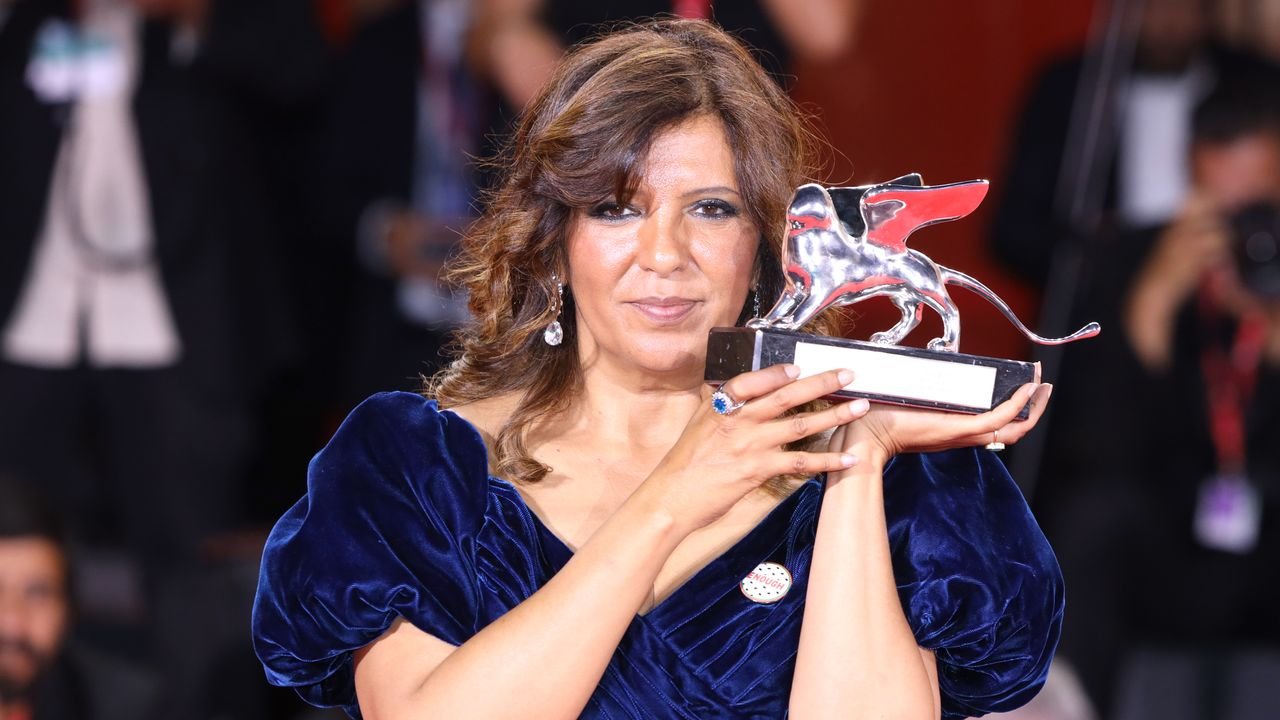
Out of the various talking points that emerged from this year’s Venice Film Festival line-up announcement—most pressingly, where were the Oscar contenders previously rumored to be heading to the Lido?—there is one I’ve found deeply concerning: the 2026 competition roster features only one film by a woman director. This is Danish-Egyptian filmmaker May el-Toukhy’s Woman Unknown, the tale of a housemaid on the precipice of marrying her wealthy, widowed employer. The 19 other movies in contention for the Golden Lion are all helmed by men.
This marks a sharp decline from previous iterations of the showcase. Just last year, there were six women in the 21-strong competition line-up, including Kaouther Ben Hania, who took home Venice’s second-place Grand Jury prize for The Voice of Hind Rajab. There were six women-directed films in 2024, too; five each in 2023, 2022, and 2021; and a whopping eight in 2020.
Over the last decade, there has been significant progress made on this front at Venice: only seven women have ever won the Golden Lion in its 77-year history, but three of those victories have come in the past few years (Chloé Zhao for Nomadland in 2020, Audrey Diwan for Happening in 2021, and Laura Poitras for All the Beauty and the Bloodshed in 2022). Since the late 2010s, several women have also led the competition jury (Isabelle Huppert, Julianne Moore, Cate Blanchett, Lucrecia Martel, Annette Bening); before then, that particular honor had only gone to five women since 1935.
However, these successes don’t negate the situation in which the festival finds itself this year—and it’s essential that we don’t dismiss this current predicament as an anomaly.
The festival’s artistic director, Alberto Barbera, would certainly like us to think of it as such. Speaking to The Hollywood Reporter in the wake of the line-up announcement, he insisted that he was “actually desperate. I would love to be able to find more female-directed films to put in competition. But it simply was not possible, for many reasons. The number of films made by women has decreased… And the quality of the ones we saw was not such that we could put them in competition.”
He added that he believes it’s “a temporary negative situation. I hope next year [it] will improve again, [that] we’ll get more films made by women and the quality will improve. It’s difficult for us to understand. But we are at the end of a chain that we don’t control. There are choices made by the producers, by financiers. It’s a matter of the budgets [being given to female directors]. I’m very sorry about the situation but there was nothing we could do. We don’t want to select the competition on the basis of gender, but on the quality of the films.”
Yes, it’s true that in a beleaguered, uncertain, risk-averse, financially depleted movie industry, the number of women-directed projects is declining across the board and Barbera can’t change that. But other things are within his control. Look at Venice’s line-up beyond the main competition, for instance, and you’ll find a very different story—in the “Orizzonti” section, for emerging filmmakers, eight of the 19 projects are helmed by women. Per Variety, two of these films, Alina Marazzi’s The Girl with the Leica and Rubaiyat Hossain’s The Difficult Bride, were understood to have been considered for the main competition at some point. Then there’s Anuparna Roy, who scooped this section’s best-director prize just last year for her debut feature, Songs of Forgotten Trees, and is back with her second, Lovers in the Blue Night. Could she also have been upgraded to the main competition? If Barbera was so “desperate” for female representation, might not he have found a way to include these titles?
