

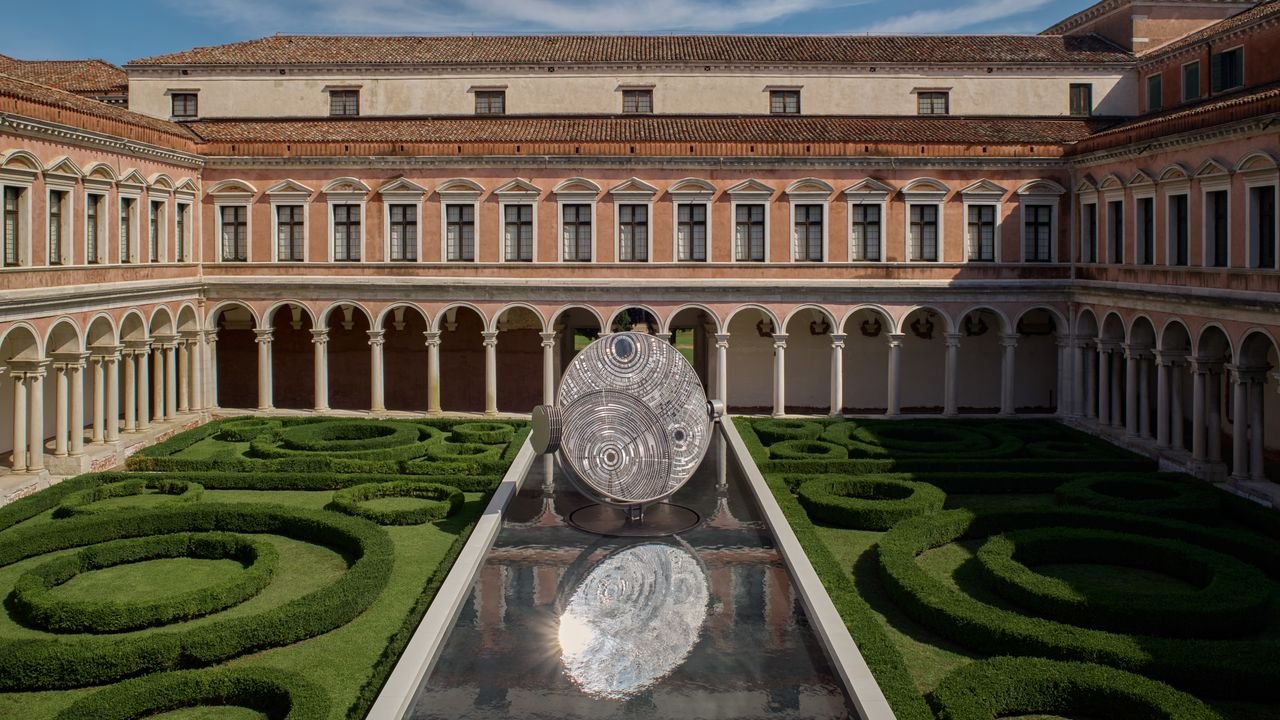
It all starts with a hand. In a darkened, cavernous room on the island of San Giorgio Maggiore, a film shows a hand reaching out across a black backdrop, followed by the other appendages of makers welding, carving, brushing, hammering, drilling, tracing. In the process, the room itself is illuminated, revealing a workshop deserted in a hurry by its artisans, clay, sawdust, fabric, paper, and paint scattered across the atelier workbenches. Heading down a corridor, the faces of the makers are displayed in portraits lining the walls, hall-of-fame style: the 500 or so people behind the 700-plus works assembled for this year’s biannual Homo Faber exhibition in Venice.
“It draws your attention to the process and practice and intense dedication of time contained within every masterwork you are about to see,” says Es Devlin, the co-curator of the biennial, titled “An Island of Light,” that I’m visiting on a baking-hot September morning in Venice. (The show runs all the way through to September 31 at the Fondazione Giorgio Cini, if you’re planning a trip.)
Photo: Giulio Ghirardi / Courtesy of the Michelangelo Foundation
There sure are masterworks. In the third room you enter, titled “An Alphabet of Objects,” an enormous circular shelving unit housing dozens of objects with elaborate silhouettes, lit from the center to cast shadows on the walls in a nod to Plato’s cave. Many of the most arresting pieces appear as one medium, only to reveal themselves on closer inspection as entirely another: a vessel by the Emirati sculptor that looks to be made of delicately filigreed stone or marble is actually constructed from paper; a vessel by the French artist Jacques Monneraud that seems to be taped together cardboard, but is actually a ceramic; a sculpture by the Japanese artist Junko Mori that you’d believe to be blackened pine cones is, actually, wrought from steel. These material bait and switches only deepen the thrill of discovery as you wander from room to room.
