

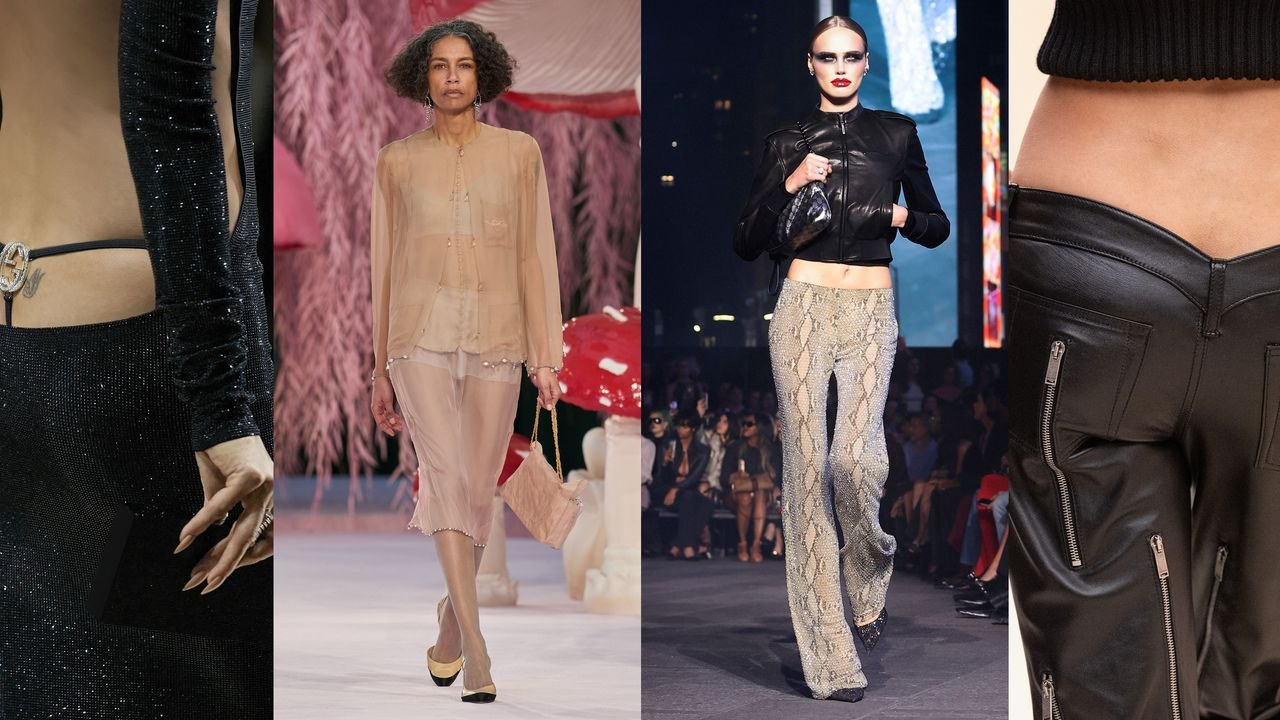
Doomscrolling on my phone in the back of a cab, I see sex everywhere. I see a Gucci thong at the center of a Tom Ford–era mood board, a debate over whether Zoë Kravitz might bring back the butt cheek, and the oft-revered runway images of early Prada’s penchant for anything sheer. Through my screen, the fantasy is glossy and instantly legible—sex as something that can be screenshotted, shared without context, and understood within half a second. But then the car door opens, and I look up; the most alluring women I see in real life are dressed nothing like this at all.
The contradiction matters because clothes now have to function in two economies at once: the algorithmic economy, where overt signals of sex appeal travel at lightspeed, and the lived economy, where women are still getting dressed for the texture of their actual lives, somewhere between the mundane and the thrilling. The question is: Does sex still sell if the version of sex that travels most efficiently online is not necessarily the version women want to live in?
Sex has never been more visible—on dating apps, social media feeds, television, music—yet real desire feels increasingly hard to come by. The Atlantic called it a “sex recession.” Vice recently reported on “the great unwanting,” citing a RiseGuide survey in which a majority of Gen Z respondents said they choose social media over sex at least sometimes, if not often. What we’re seeing isn’t a culture without sex, but one where sex is increasingly available as content and increasingly elusive as an experience.
Designers seem to be working both sides of that divide. At Gucci, Demna’s debut cruise collection translated sex into the language of Times Square: sleazy, low-rise snake-print trousers, crystalized surfaces, bare midriffs under cropped leather aviator jackets, and dramatically oversized suits that suggested they had been borrowed from the man you were with the night before, lace lingerie still visible underneath. It was overt and slightly depraved—internet-core sex appeal as a signal you could understand instantly, and exactly the kind of Tom Ford–era Gucci “charge” purists online are always waiting to recognize. (As Demna told Vogue, he wants Gucci to be sexy and hot, which are not one and the same; the former requires that you “show some body.”)
Conversely, Matthieu Blazy’s couture debut at Chanel went somewhere quieter: transparent silk mousseline in barely-there tans and pinks, and bags so gossamer they barely existed as objects. Both worlds sell desire, but in Blazy’s show, sensuality is about the rich interiority of a woman’s world.
For me, sexy is a twinkling Rene Barnes lariat necklace dipping beneath a crisp, creamy button-down from The Row, undone one button lower than would be appropriate for the office, with a beautiful French lace bra underneath that is visible to no one at all. I think of these as sex-neutral clothes: items that aren’t inherently loaded with the intent of seduction, but become sensual through lived context. In other words, the charge of the clothes depends entirely on the woman wearing them.
That may be why sex appeal has become much harder to track on the street than it is through our phones. Online, signals cluster quickly and repeat until they’re durable enough to become trends. In life, desire tends to disperse. One woman’s sensuality might be Pieter Mulier’s Alaïa, another’s Chemena Kamali’s Chloé, and another’s simply the right vintage Levi’s with the right white tee and a perfect pair of flip-flops. The same algorithm that makes sex feel omnipresent has also splintered taste into endless private systems of meaning.
