

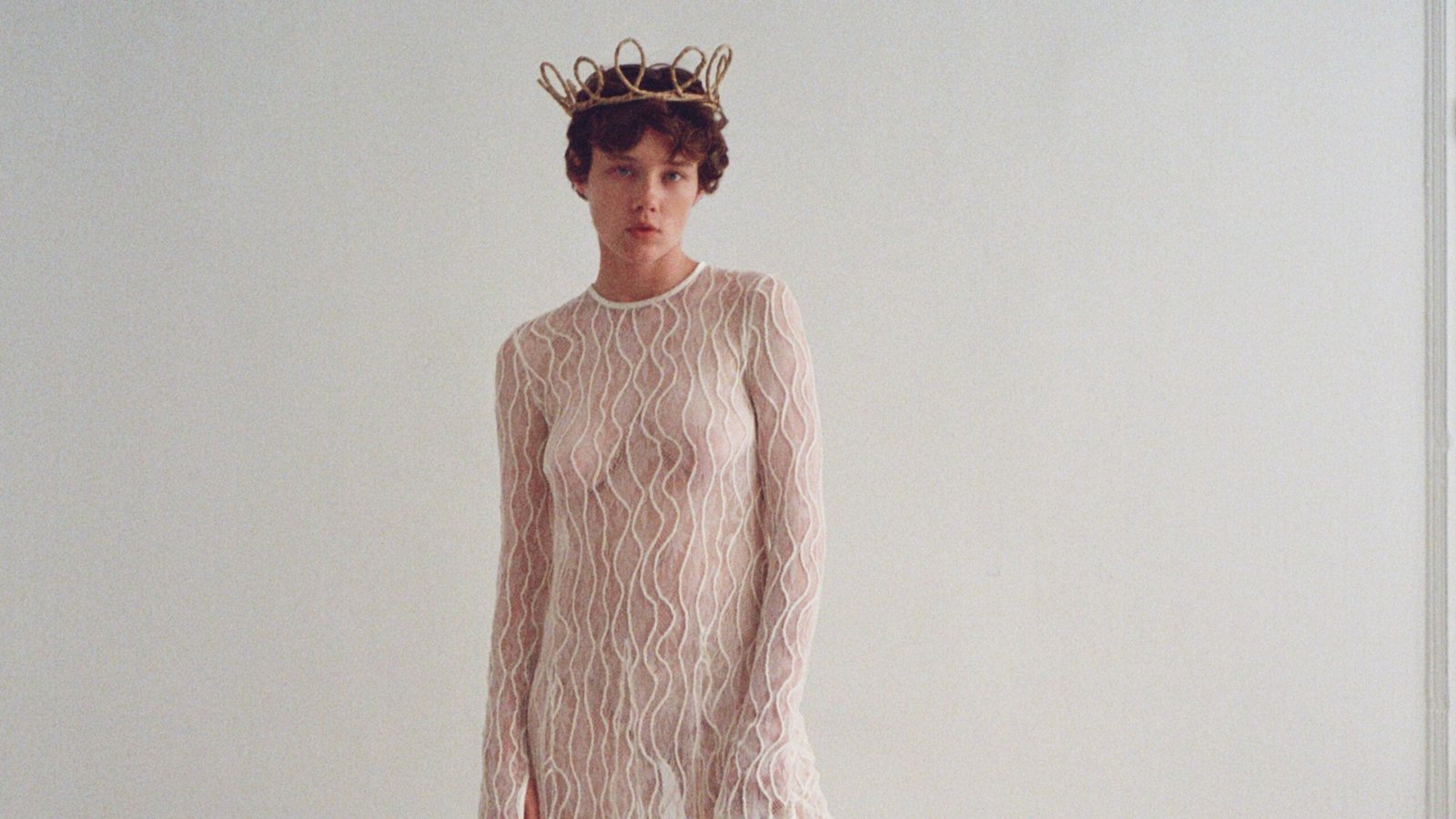
Stephen Biga’s “Roman Empire” is the Middle Ages. He named his brand after a beguiling water nymph from that time who he encountered on a walk-through of The Met. (French author Jean d’Arras recorded her tale in 1393.) In short: Melusine married a human to whom she did not reveal her identity. She made him promise never to watch her bathe; when he did, she transformed into a dragon and departed.
Somehow Biga—a Parsons grad who worked with Rodarte, Proenza Schouler, and most recently Gabriela Hearst—managed to translate this convoluted tale into something fashion lovers could buy into: in a word, romance. His filter is a stained glass window of a Gothic cathedral. The Medieval era is also known as the Age of Chivalry, and Biga’s vision contrasts lovely ladies and gallant knights.
Moving on from the Unicorn Tapestry which informed fall’s line up, Biga landed on Theodore Dryer’s black-and-white 1928 film, The Passion of Joan of Arc as his spring inspiration. This martyr might be fashion’s favorite saint; pop culture likes her too; Hlynur Pálmason released his Joan of Arc this year and Baz Luhrmann is developing one as well. Biga was drawn to the he/she aspects of this historical figure who refused to give up her faith—and the menswear she wore.
The designer is aware that his natural inclination towards prettiness needs to be tempered lest it become over sweet. This season’s main disruption was raw edges, which felt more contrived than arrived at organically through the design process. Edgier, attitude wise, was a jacket made of two soft layers of fabric; it might be paired with Biga’s popular leggings that have a ruffle at the ankle. A pair of pants had a thin burgundy inner belt that created a peeling off the body effect; this was borrowed from a “Thrasher kind of shoelace skateboarder belt from the ’90s,” said the designer.
Biga intends for things to evolve slowly at Melusine and so the brand’s popular “chainmail” (metallic knit) dresses were back, some with new asymmetries. There was a nifty cap-sleeved armor top as well. Most intriguing was a T-shirt and cape hybrid perfect for making sweeping statements in. A poetic, and best-selling, blouse was cut in a print Biga developed from a fabric swatch dating to the 1700s; it also showed up on a ruched dress (available in a solid, too) that raised the stakes on slip dressing.
