

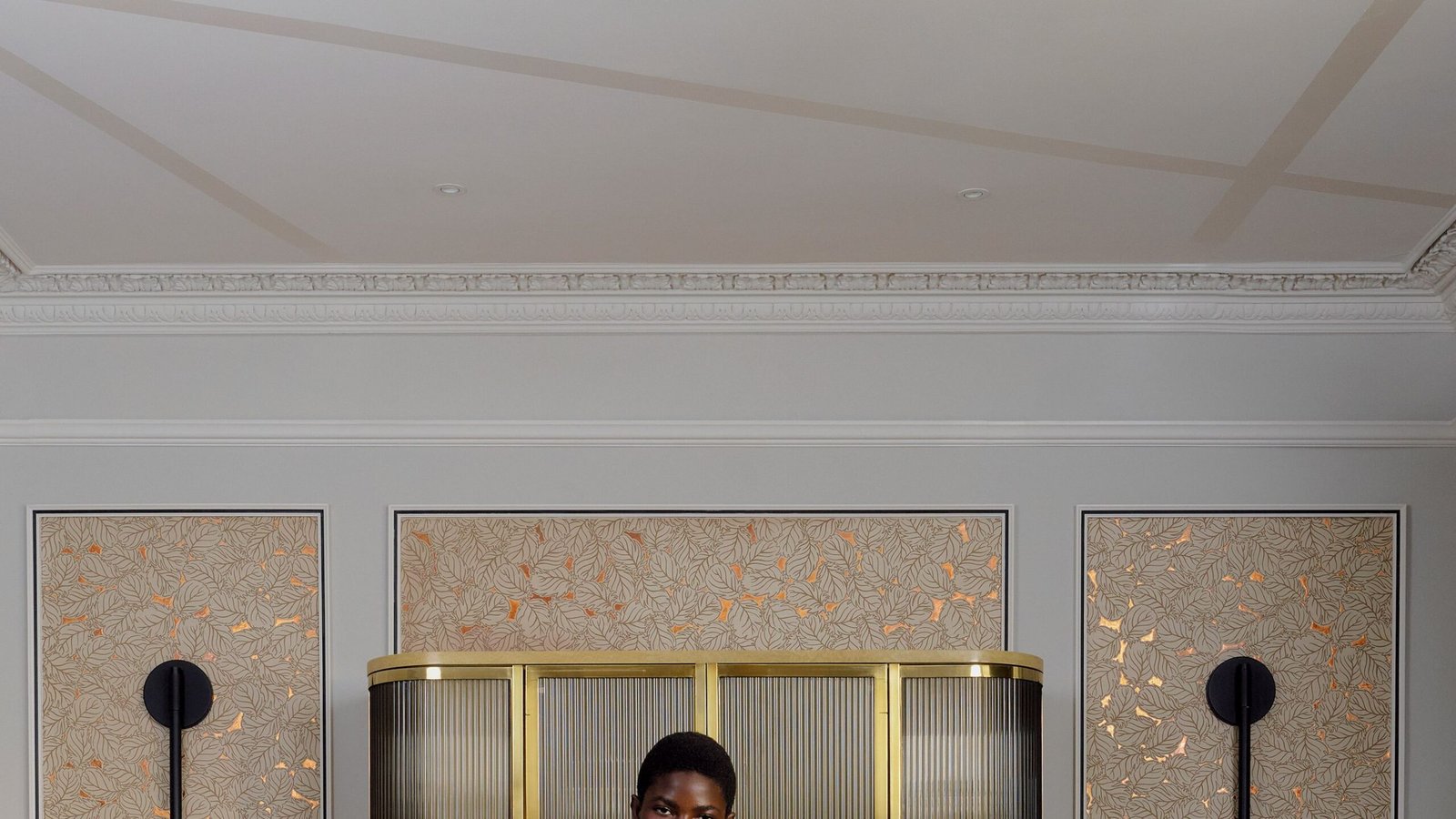
The St. Clement is but the latest addition to London’s world-beating lineup of swish hotels. Though it has only just opened, it has quickly got the tongues of the city’s fashion set wagging, in part because it’s situated in the same complex as the week’s show hub and a number of London’s buzziest designers’ studios. It also has Alex Eagle-appointed interiors and a riverfront vantage, situated at a bend in the Thames that affords views of Big Ben and Tower Bridge from the balcony.
It’s a place that has come to feel like home to Tolu Coker. Or, at least, that was the impression gleaned from the designer’s presentation, staged across a sprawling series of rooms on the property’s upper floors. Entering the living room, guests were greeted with a studio set up that felt meticulously curated yet curiously lived-in: family photos, drooping daisies and annotated moodboards, all arranged just so, as if you were arriving in a home that the cleaner had just finished tidying.
“I want people to be able to connect with it in a way that you would if you were seeing someone at home,” Coker explained in a preview at the Mandarin Oriental in Knightsbridge, the backdrop of the collection’s accompanying imagery. The lavish setting reflected another theme: “I was thinking about the idea of social mobility,” Coker said, underscoring the shift from last season, shown in a restaged version of a football cage on the West London council estate she grew up on (and notably attended by the literal King) to her current luxurious perch.
“Last season was really a reflection of the phenomenon of being in a space that has incubated you, but that you’re also starting to mobilize outside of. This time I wanted to convey this sense of taking your first step into the institution,” she explained. “I think in some ways it’s a reflection of my own journey—this moment where you’ve always identified as working class, but you see yourself walking through certain doors, staying in certain suites. And you realize how the way you dress has evolved based on different spaces you have access into. What does it look like when you get that first exec job and move into a luxury penthouse? Or start staying in these luxury hotels?” Coker pondered. “What pieces of you do you still bring with you into those rooms?” And how do those pieces both reflect and mitigate the feelings around themes of confidence, detachment and belonging that are part of the awkward process of growing beyond one’s preordained station?
The answers to those questions were sported by models that lounged about the suite, leafing through photography books and sniffing flowers with the ‘Hey, welcome to my crib’ ease of someone caught in situ on a Sunday. The structured tailoring that Coker has made a name with returned, but here felt a less ‘done up.’ Barrel-leg jeans and paneled jackets were cut a little looser, reading less of the girl heading to their first big job interview, more of the woman who runs it all, relaxed, yet still refined. While lifted by pops of cobalt and coral, the palette of the clothes hanging in walk-in closets ran a gamut of browns and ecrus—a nod to the need for a sense of groundedness along the ascent to dizzying heights.
Perhaps the most notable introduction to the Tolu Coker wardrobe was an almost caricature-like, floaty femininity: gossamer chiffon blouses, some with tumbling ruffles; a strict, paneled poplin shirt extended into a dress with a hem that puffed and swung almost autonomously thanks to the mass of godet inserts. “She’s starting to feel this sense of becoming more of a woman,” Coker said, “and perhaps stepping into this more institutional idea of femininity and how to perform it.”
Coker is a designer who thinks a lot—and deeply—and what made this presentation feel so noteworthy and successful was her refusal to limit herself to fashion alone to convey those thoughts. “I’m not just thinking about the clothing, but the space, the feeling,” she said. There was a chamber orchestra playing on the balcony; limited edition Air Jordans exhibited with the same reverence as art objects in the living room; and open diary pages displayed at the entrance to each room.
Her deeply psychological approach may sound more akin that of a director, and there’s cause for wondering how sustainable such an expansive yet fastidious approach is for a brand of this size and scale season-on-season. For Coker, though, creating environments that evoke powerful, specific feelings in her audience is as important as making clothes that distill them. “I think about things from every touchpoint,” she said. “The clothes, the space, what I want people to feel and see. And I also think about my consumer. I don’t just want to sell her clothes. If she’s buying into something, it has to be something that she really values, loves and feels connected to because she can see the craft that goes into it.”
