

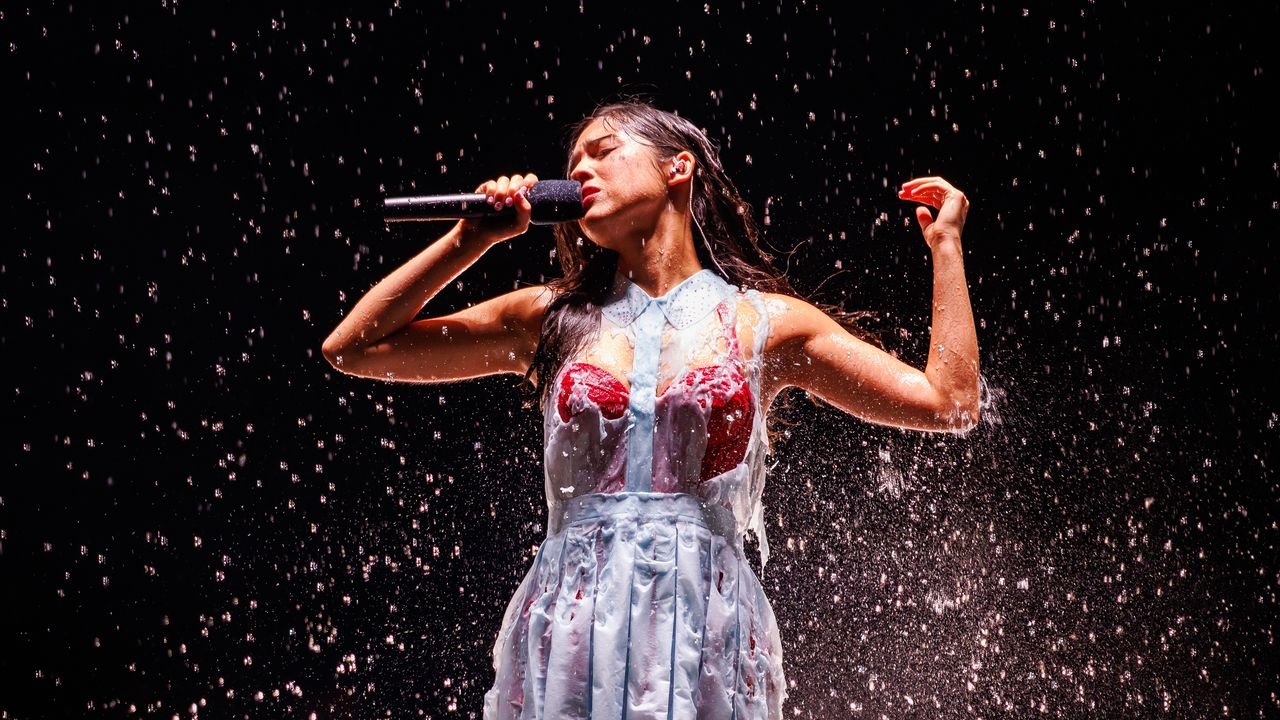
The piece was custom-designed and developed by Hussein Chalayan, and revisits one of the designer’s most memorable runway experiments. For his spring 2016 collection, two models stood motionless in white, military-inflected paper garments before hidden showerheads suddenly released water overhead. Their outer layers dissolved, exposing palm-patterned dresses underneath, punctuated with Swarovski crystals. Chalayan and his team had spent around six months developing the water-reactive material.
For Chalayan, clothing has rarely been a static proposition. The Cyprus-born British designer built his career around garments that move, mutate, disappear, and occasionally seem to defy their own material limits. His Central Saint Martins graduate collection famously included clothes that had first been buried underground and left to decay; later came dresses incorporating mechanical parts, lasers, LEDs, and crystal “pollen,” as well as his now-iconic fall 2000 coffee table that transformed into a wooden skirt. Transformation was not a runway gimmick but a recurring cadence in dialogue with design. His work finds a means of using technology, engineering, and performance to ask what a garment might be capable of beyond simply clothing the body.
The now-iconic fall 2000 coffee table that transformed into a wooden skirt.
Photo: JB Villareal / Shoot Digital
The remote control spring 2000 dress.
Andrew Lamb
