
Frequently asked questions
Can red-light therapy help hair growth?
Clinical studies suggest that red-light therapy at 650 nanometers (nm) can support hair growth in some people. Here’s how it works: It uses low-level laser therapy (LLLT), or LED light, to stimulate the hair follicles, increase blood flow, and energize cells in the scalp. This process, called photobiomodulation, may help promote thicker, stronger hair over time.
“LLLT stimulates follicle cell metabolism by increasing ATP production, reduces inflammation, and helps prolong the hair-growth phase,” says Alan Bauman, MD, a board-certified hair-restoration physician at Bauman Medical. “It’s well supported by research and is one of the most-effective, noninvasive tools for hair regrowth.” The low-level red light (typically 630–660 nanometers) stimulates the scalp and helps with regrowth in sparse areas.
Clinical trials have shown promising results for people with androgenetic alopecia (sometimes referred to as female/male-pattern baldness), which is thinning hair that affects 60% to 70% of the adult population worldwide. Low-level light therapy may also be an effective treatment for autoimmune conditions like alopecia areata or postpartum shedding. That said, results can vary, and consistency is key—you’ll need to use an LED device regularly for several months to see noticeable improvement.
Is there a specific wavelength for red-light therapy for hair growth?
The most commonly studied and effective wavelengths for hair growth fall between 630 and 680 nm, says board-certified dermatologist David Johnson, MD, cofounder of RedliteX. “That is the type of red light that penetrates just deep enough to activate the root hair follicle cells but doesn’t do any harm.”
Some red-light therapy hair loss treatments also incorporate blue-light-emitting diodes (around 415 nm), which may help target bacteria and improve scalp health—especially for those dealing with buildup, oiliness, or irritation which can lead to an unbalanced scalp and hair loss.
What kind of hair growth does red light promote?
LED therapy does not promote new hair follicles. “The technology promotes a longer follicle growth cycle via increased circulation, which delivers much needed nutrients and oxygen creating improved ATP,” says Nelson. So it won’t necessarily create new strands, rather it will increase your hair growth cycle and thicken what’s there.
Do brushes vs. helmets make a difference?
In general, helmets perform better because they can sit on your head and deliver the proper optical output over the treatment time, according to Nelson. “One benefit of the brush over the helmet is that brushes that have the LED diode (aka the little prong that lights up) on the end of the brush teeth are able to penetrate the hair and expose the scalp better than a cap or helmet,” he says. It’s up to your preference as well—if you want something hands free, a helmet or hat is the way to go, versus a brush which will take up a little time in your routine. Whichever method you know you will be able to commit to will be the most effective one.
How long does red light take to grow hair?
You generally need to use red-light therapy consistently for three to four months to see noticeable results, says Dr. Johnson. Some people may see early signs, such as reduced shedding or slightly thicker strands, within the first couple of months, but visible regrowth (especially along the hairline or the crown) can take longer. “That’s due to the cycles of the hair—they don’t go immediately into the growth phase. The follicle must be ready,” says Dr. Johnson, who recommends using red-light therapy “three to four times weekly for 10- to 15-minute treatments.”
How often should you use red light therapy?
Dr. Johnson says to use red-light therapy “three to four times weekly for 10- to 15-minute treatments.”
Are there any side effects to red-light therapy for hair growth?
Health care professionals say at-home red-light treatments are generally safe for all skin types and types of hair loss, especially when used as directed with devices cleared by the Food and Drug Administration. Unlike medications like topical minoxidil or finasteride, heat-based laser treatments, or even hair transplants, red-light therapy is noninvasive—and side effects are rare. “Some people feel a little warmth on their scalp. A few may get slight redness, but it goes away quickly,” says Dr. Johnson. If you’re pregnant, you’ll want to check with your doctor before using any red-light therapy devices.
Dr. Engelman does note that if you have very sensitive skin, “It is possible for too much red light to cause some dryness. It’s also important to note that using red-light therapy devices more frequently won’t actually speed up results. It’s best to use them as directed, and while they won’t cause damage if you use them more often, you won’t see increased benefits. “Also, take into account that at-home devices can vary in power and efficacy, so make sure you do your research,” she advises.
Of course, you should always follow manufacturer instructions and consult your doctor if you have any underlying skin or scalp conditions and are concerned about the effects of red light.
Is red-light therapy better than minoxidil?
Both red light and minoxidil are effective treatments for hair regrowth, and there are pros and cons to each, says Dr. Engelman. “Minoxidil works faster than red light therapy, but it does come with more risks, such as irritation and hair growth in unwanted areas. Red-light therapy has zero to minimal risk, but it works much more slowly,” she notes. Minoxidil also can be a bit messy (IYKYK), so red light might be a better option if you don’t want to bother with the topical foam of it all.
Amy Taub, MD, a board-certified dermatologist based in Illinois and clinical researcher for Kerafactor, says that red light therapy and minoxidil can be complementary, as well. “Combination therapy (LLLT + minoxidil) is superior to either alone, with significantly greater hair density and diameter improvements,” she says. LLLT has essentially no reported adverse effects, whereas minoxidil can cause contact dermatitis, transient shedding and unwanted facial hair in women, she says.
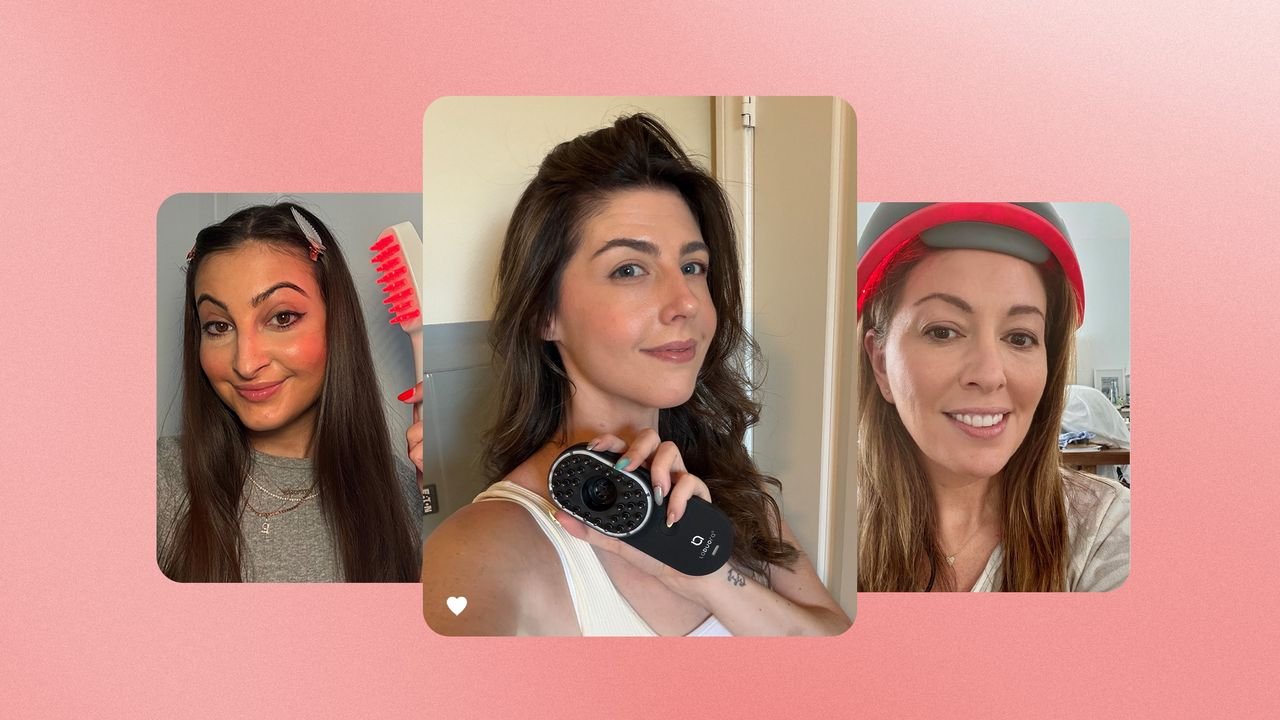
Here at Glamour, we’ve been diligently testing red-light therapy devices for almost two years, focusing not just on face masks for skin care benefits but also on gadgets specifically designed to promote hair growth. We’re always on the lookout for the latest and greatest, and during this time, our editors have tried more than a dozen red-light therapy devices for hair growth—including helmets, hats, and brushes.
We evaluate each one for comfort, ease of use, and effectiveness, paying special attention to practical details like session length, portability, fit, how well the device integrates into a busy daily routine, and the science behind the technology. This hands-on approach allows us to provide honest, real-world feedback so you can make an informed decision before investing in a device—often a few hundred dollars or more.
