

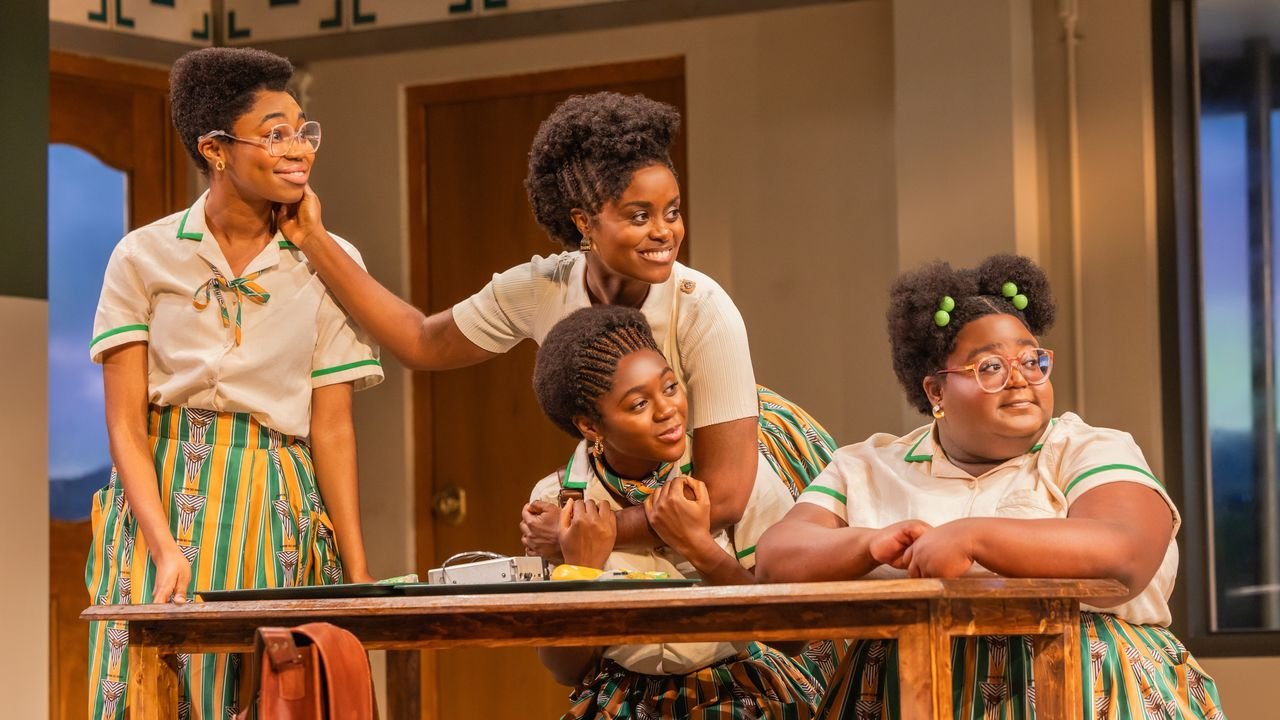
“I think our mean girls would probably eat Regina George for breakfast, lunch, and dinner,” Jocelyn Bioh, author of School Girls; Or, the African Mean Girls Play, tells Vogue over Zoom in mid-September.
School Girls, which first played off-Broadway in 2017 and will reopen at the Samuel J Friedman Theatre on September 28, centers a lively crew of boarding schoolers as they prepare for the 1986 Miss Ghana pageant. The group’s leader, Paulina (Denée Benton), harbors high hopes of snagging the crown. That is, until Ericka (Jasmine Amy Rogers), a new girl with lighter skin and a finger on the pulse of American coolness, relocates from the United States, upending the social hierarchy. What follows is a vibrant and energetic commentary on class, colorism, and character.
School Girls is set at Ghana’s Aburi Girls Boarding School, the same institution Bioh’s mother attended in the 1980s. Private family lore became public in 2017, when Bioh forgot to erase a lighthearted playwright’s note from an early draft, accidentally outing her mother as a former mean girl. “She was like, ‘You told The New York Times I was mean?!’” remembers Bioh. “I was like, ‘Oh my God.’”
Bioh herself was a boarder at Pennsylvania’s Milton Hershey School, which enrolls more students of color than most other private academies in the US. “[My mother and I] both had this very unique experience of going to boarding school with other people who looked like us…I always knew I wanted to write about that,” she says. Her imagination was also piqued by the drama inherent to living, unsupervised, with other teen girls. “Your parents aren’t around; it can become Lord of the Flies if you let it.”
Denée Benton, Jordan Rice, Nia Otchere-Sarfo, Lucia Aremu, Erin Morton, and Heather Alicia Simms in School Girls; Or, The African Mean Girls Play.
Matthew Murphy
To bring this revival to life, Bioh teamed up with director Whitney White, with whom she also worked on her play Jaja’s African Hair Braiding. To School Girls, White brought her own college experience as a classically trained singer and rock vocalist trying to find her niche.
“Northwestern was extremely cliquey at the time,” says White. “You could never be enough of anything to please any group. And I think that that’s been something that’s really defined my career. It’s like, Okay, I guess I’m just going to have to make my own way.”
A knack for defying categorization is something Bioh and White—whose pool of talents includes singing, composing, acting, writing, and directing—share. “There’s different facets of artistry that I think we’re also bringing into [our plays],” says Bioh. “We just have an eye on everything.”
