

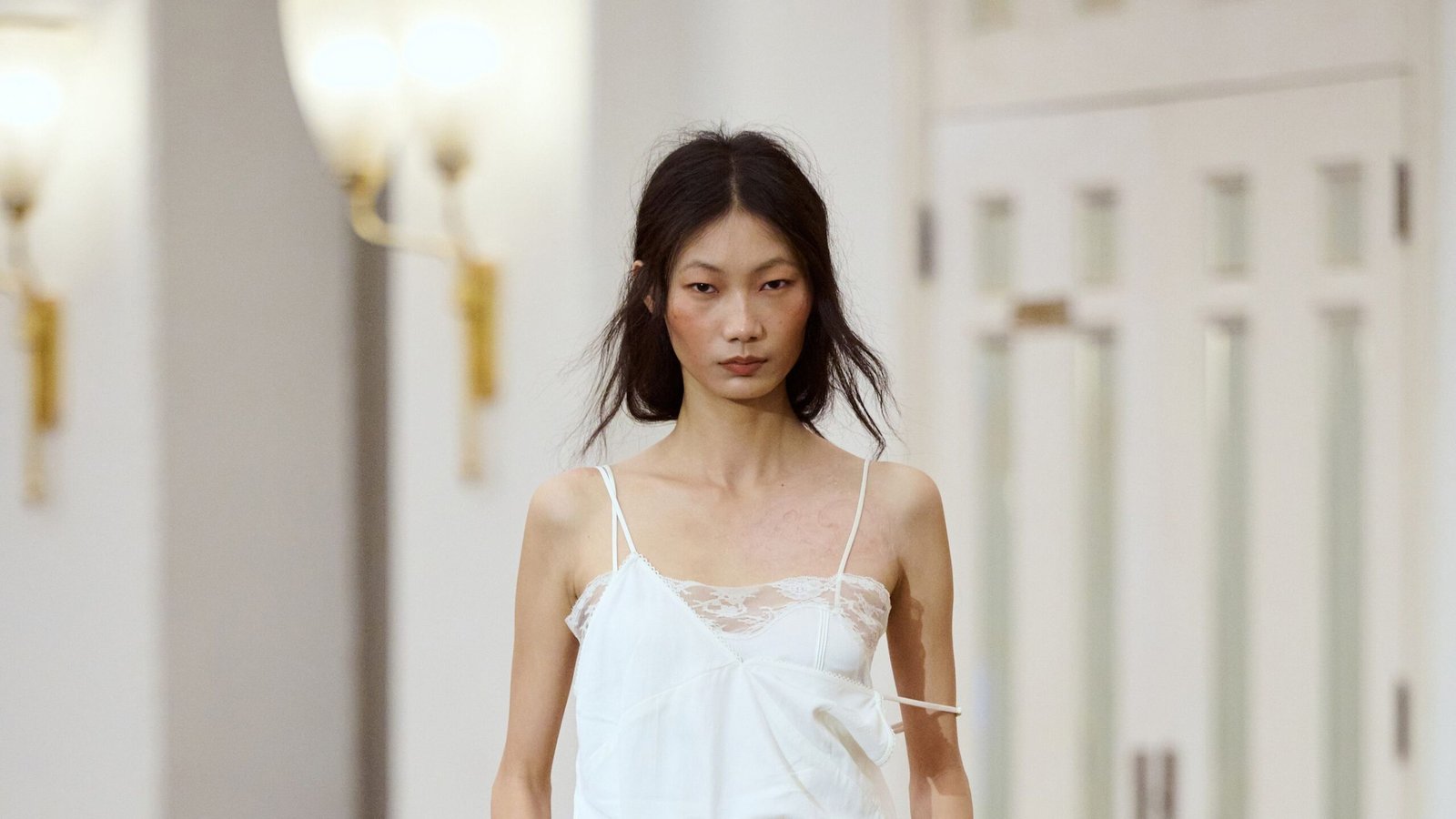
At the Okura Garden Hotel Shanghai, a former French Club whose 1926 ballroom once hosted the revels of the Jazz Age, designer Xuzhi Chen of Xu Zhi staged a rather lovely fashion séance. Beneath an oval stained-glass dome, its Art Deco colors washing over the carpeted ballroom floor, models circled live musicians. A classical harp solo gradually gave way to drums and keyboards, and the music shifted from lyricism to a grungier pulse. The atmosphere was romantic, but with an undertow.
Xuzhi Chen called the collection The Girls, insisting that girlness was a quality rather than a gender. Victorian nightgowns, pajamas, and wired crinolines concealed beneath cascading fringes were teamed with distressed denim, biker jackets, and military outerwear. Jacquard silk, lace inserts, discreet floral beadwork, and vintage-inspired prints lent the clothes the intimacy of garments borrowed from a bedroom.
The boys, pale and androgynous, wore shrunken T-shirts, washed denim, long swaying coats, and military jackets. Lace shirts and boxer shorts peeking above trouser waistbands brought underwear into daylight; lace-up ballet shoes lent even the more muscular looks a delicate counterpoint.
Chinese references were less a matter of decorative motifs than of sensibility: Chen sees the balance between fragility and strength, softness and resolve, as central to the Chinese spirit. East and West, the Victorian bedroom and the grunge-era street, met without much fuss. In the end, this show was less about dressing like a girl than allowing a little vulnerability to show.
