

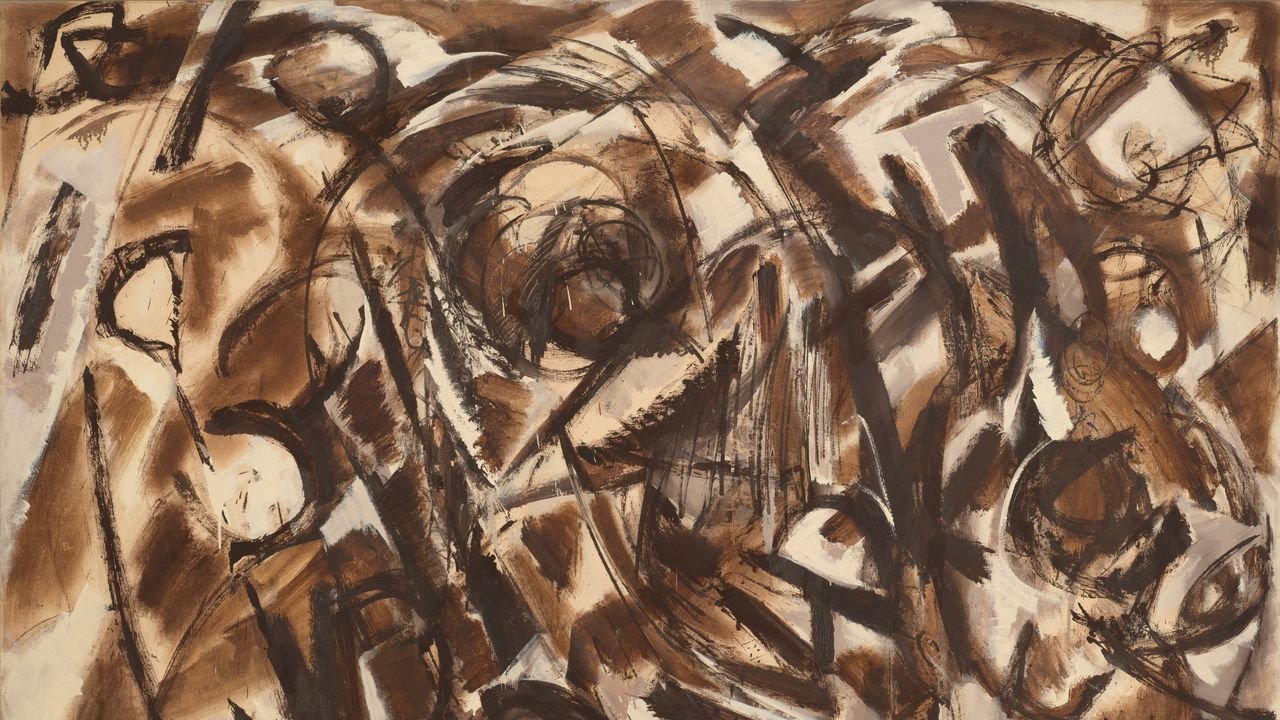
It’s not as though Krasner was unknown in Paris; she received the Knight of the Order of Arts and Letters distinction in 1983, the year before she died at the age of 75. But anyone discovering her art for the first time—or else those already familiar with her propulsive mark-making—will be rewarded with a condensed immersion into American abstraction that acknowledges her exceedingly personal and shape-shifting approach to working.
For my walkthrough of the show, I was joined by Eric Gleason, whose gallery represents the estate of both Krasner and Pollock worldwide; Caroline Black, executive director of the Pollock-Krasner Foundation (established in 1985); and Kara Vander Weg, a senior director at Gagosian, New York. Under a large skylight that emphasized Krasner’s emphatic application of color, we discussed how the ’60s offered a revealing glimpse into her output.
“She was a restless experimenter, pivoter, editor—and even within this concise 10-year period, there’s a lot of range,” said Gleason. “The diversity is evidenced by putting these paintings together.”
An installation view of “Works from the 1960s.”
© 2026 Pollock-Krasner Foundation/Artists Rights Society (ARS), New York. Photo: Maris Hutchinson. Courtesy Gagosian.
Vander Weg said they always intended the show as a complement to the one at the Met, especially given that Krasner is less known in France. Of her roughtly 600 works total, 210 paintings exist today (she had a habit of taking apart, repurposing, and collaging old canvases). The group suggested around one-third of those is currently being shown.
