

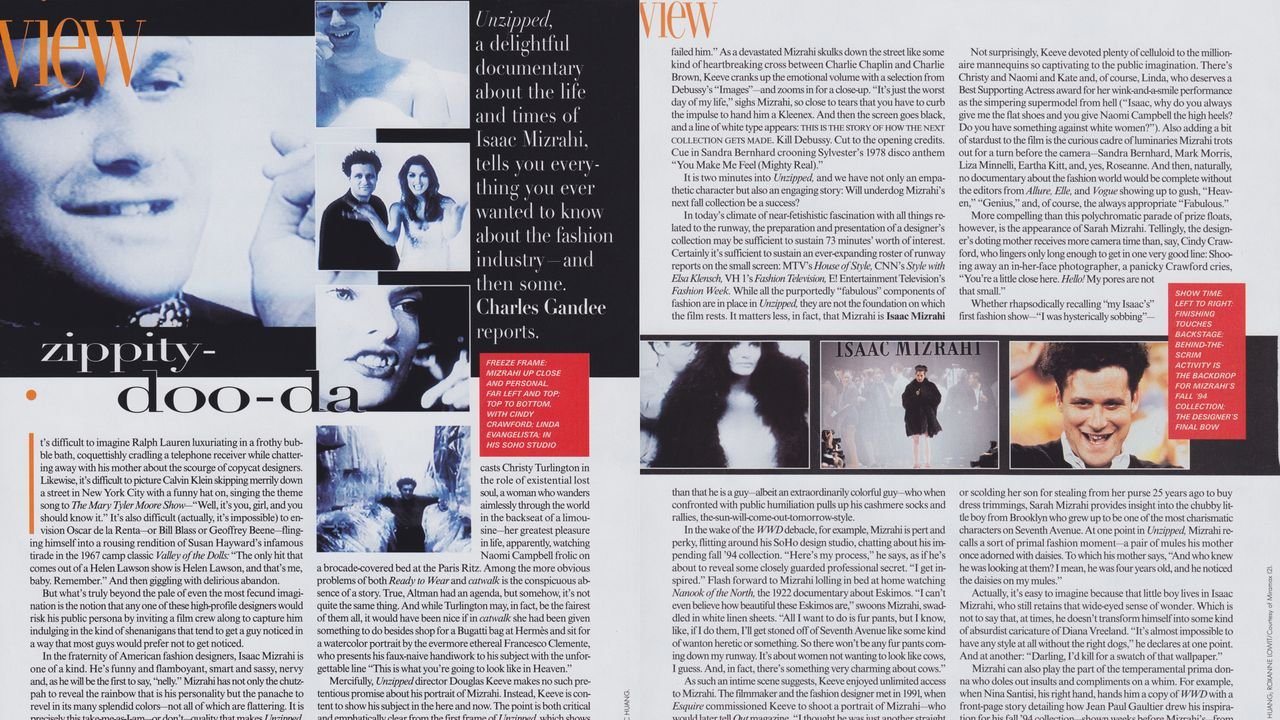
As such an intime scene suggests, Keeve enjoyed unlimited access to Mizrahi. The filmmaker and the fashion designer met in 1991, when Esquire commissioned Reeve to shoot a portrait of Mizrahi—who would later tell Out magazine, “I thought he was just another straight photographer who was flirting with me.” Keeve was not.
Although the ensuing four-year relationship between Keeve and Mizrahi did not survive the making of Unzipped, it did ensure that the film has the clarion ring of authenticity. Keeve not only knows Mizrahi well, he knows Mizrahi’s world as well—meaning that he got the scenery just right. He also got the cast of characters just right—those fashion-is-my-life hothouse flowers who seem to flourish pirouetting on the precipice of self-parody.
Not surprisingly, Keeve devoted plenty of celluloid to the millionaire mannequins so captivating to the public imagination. There’s Christy and Naomi and Kate and, of course, Linda, who deserves a Best Supporting Actress award for her wink-and-a-smile performance as the simpering supermodel from hell (“Isaac, why do you always give me the flat shoes and you give Naomi Campbell the high heels? Do you have something against white women?”). Also adding a bit of Stardust to the film is the curious cadre of luminaries Mizrahi trots out for a turn before the camera—Sandra Bernhard, Mark Morris, Liza Minnelli, Eartha Kitt, and, yes, Roseanne. And then, naturally, no documentary about the fashion world would be complete without the editors from Allure, Elle, and Vogue showing up to gush, “Heaven,” “Genius,” and, of course, the always appropriate “Fabulous.”
More compelling than this polychromatic parade of prize floats, however, is the appearance of Sarah Mizrahi. Tellingly, the designer’s doting mother receives more camera time than, say, Cindy Crawford, who lingers only long enough to get in one very good line: Shooing away an in-her-face photographer, a panicky Crawford cries, “You’re a little close here. Hello! My pores are not that small.”
Whether rhapsodically recalling “my Isaac’s” first fashion show—”I was hysterically sobbing”—or scolding her son for stealing from her purse 25 years ago to buy dress trimmings, Sarah Mizrahi provides insight into the chubby little boy from Brooklyn who grew up to be one of the most charismatic characters on Seventh Avenue. At one point in Unzipped, Mizrahi recalls a sort of primal fashion moment—a pair of mules his mother once adorned with daisies. To which his mother says, “And who knew he was looking at them? I mean, he was four years old, and he noticed the daisies on my mules.”
Actually, it’s easy to imagine because that little boy lives in Isaac Mizrahi, who still retains that wide-eyed sense of wonder. Which is not to say that, at times, he doesn’t transform himself into some kind of absurdist caricature of Diana Vreeland. “It’s almost impossible to have any style at all without the right dogs,” he declares at one point. And at another: “Darling, I’d kill for a swatch of that wallpaper.”
Mizrahi can also play the part of the temperamental prima donna who doles out insults and compliments on a whim. For example, when Nina Santisi, his right hand, hands him a copy of WWD with a front-page story detailing how Jean Paul Gaultier drew his inspiration for his fall ’94 collection—shown weeks before Mizrahi’s—from Nanook of the North, Mizrahi accuses the woman he earlier likened to Snow White of black-heartedness: “Don’t show it to me. You showed it to me! It’s like you took some kind of evil pleasure in it.”
As for Unzipped’s grand finale—Mizrahi’s fall ’94 collection? Yes. Of course, it’s a hit. And yes, of course, the morning after, we find Mizrahi back at the same Greenwich Village newsstand picking up WWD, this one proclaiming, “The man’s got a hit on his hands.” Which turns out to be quite prescient.
